Photo: Vasanth / Pexels
Bengaluru's Traffic Crawl: What Could Actually Fix It
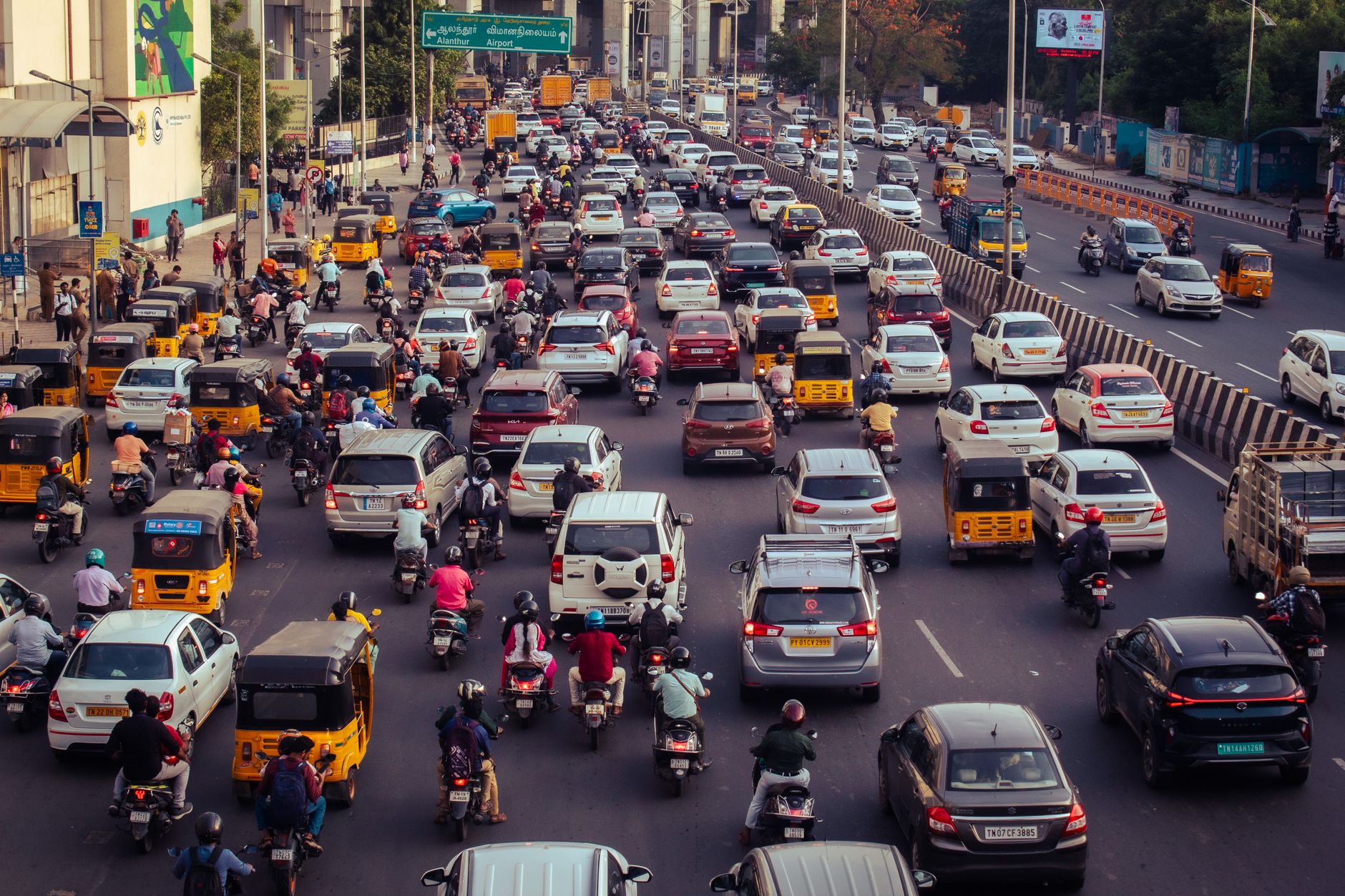
Spend any weekday evening near Silk Board or the Outer Ring Road and you understand the number instantly: in 2025, TomTom's global traffic index ranked Bengaluru the second-most congested city in the world, trailing only Mexico City. Peak-hour speeds slid to roughly 14 km per hour, and the average driver lost the equivalent of a full working week — around 168 hours — simply sitting in Bengaluru traffic. Those are not abstractions. They are missed school pickups, cold dinners, and ambulances stuck behind idling two-wheelers.
This is not a hit piece on any government or official. Cities this size are genuinely hard to run, and Bengaluru's problems were decades in the making. The useful question is narrower and more hopeful: what is actually working, what isn't, and what do people who study cities for a living say would move the needle.

The problems ordinary commuters live with
The city's vehicle count keeps climbing by an estimated 5,000 vehicles a day, while road space barely changes. A metro region of roughly 1.25 crore people is still chasing infrastructure built for a fraction of that.
The pain shows up in a few familiar ways:
- Unpredictable travel times. A 10 km trip that takes 25 minutes one day can take 50 the next, making it impossible to plan a workday or a clinic visit.
- Last-mile gaps. Even where the metro reaches, getting from the station to home or office often means an expensive auto ride or a long walk on a broken footpath.
- Flooding that shuts roads. Heavy rain regularly submerges underpasses and arterial junctions, turning a commute into a crisis.
- Patchy footpaths. Walking, the cheapest mobility of all, is treated as an afterthought, pushing even short trips onto two-wheelers.
None of this is unique to one neighbourhood or one administration. It is the cumulative result of growth outpacing planning.
What is quietly working
It would be unfair, and inaccurate, to say nothing is improving. Several efforts are showing real results.
Namma Metro has grown into one of India's largest urban rail systems, with about 96 km and 83 stations by 2025. The opening of the Yellow Line to Electronic City in August 2025 helped push daily ridership past one million for the first time. The network is targeting around 175 km by 2027, which would finally connect several job corridors that today depend entirely on the road.
The Shakti scheme, launched in June 2023, lets women and transgender residents travel free on ordinary BMTC buses. An Azim Premji University analysis found women's bus ridership rose about 2.5 times after the scheme began, with women now the majority on several busy routes. Whatever one thinks of the cost, the data shows it pulled large numbers of people onto public transport.
The fleet itself is slowly modernising. BMTC crossed 7,000 buses by September 2025, with more than 1,500 electric vehicles now in service. And the Bengaluru Suburban Railway, a roughly 149 km, 58-station network being built by K-RIDE, promises to do for Bengaluru what local trains did for Mumbai, with its first corridors due around 2026.
A governance reset worth watching
The biggest structural change is administrative. From 2 September 2025, the long-standing BBMP was replaced by the Greater Bengaluru Authority (GBA) under the Greater Bengaluru Governance Act, 2024. The GBA sits over five smaller city corporations covering about 712 sq km, and is meant to coordinate the alphabet soup of agencies — water, power, metro, buses, land — that currently plan in silos.
Fragmented authority has long been a quiet villain here. When one body digs up a road that another just laid, or when no single office owns a flooding junction, citizens pay the price. A coordinating layer, if it works as intended, could fix that. Elections to the five corporations are expected in early 2026, which would restore elected local representatives after years without them. Whether the new structure deepens local democracy or simply centralises power is a fair debate, but the reset itself is a genuine opportunity.
Where the money fight gets real
The sharpest disagreement is about what to build next. A proposed tunnel-road network, estimated at around ₹40,000 crore, has drawn pointed criticism from urban planners and citizens' groups.
The core objection is about who benefits. Experts point out that cars make up only about 10% of Bengaluru's traffic, while close to half the city moves by bus and metro. Prof Ashish Verma of IISc and others note the basic math of road space: a single tunnel lane might carry around 1,800 people an hour, whereas a metro line running tight frequencies can move close to 69,000. Spending the city's scarce capital on car capacity, the argument goes, is the least efficient way to move the most people.
There are similar questions about white-topping, the concrete resurfacing of roads. The Karnataka High Court has questioned its scientific basis, and engineers worry that poorly designed concrete roads with no space for tree pits or seepage can worsen the very flooding the city is fighting. The lesson is not that any single project is evil, but that megaprojects deserve harder cost-benefit scrutiny before commitment.
The reforms experts actually recommend
Across transport scholars, citizen forums and mobility planners, a fairly consistent to-do list emerges. None of it is glamorous, which is part of the point.
- Buy buses, fast. Studies suggest Bengaluru needs roughly 10,000 to 12,000 buses for its size, against about 7,000 today. Buses are the cheapest, quickest way to add people-moving capacity.
- Give buses their own lane. A 21 km bus priority lane between Silk Board and Baiyappanahalli, started in 2019, showed dedicated lanes can speed up the vehicles carrying the most passengers. Enforcing and expanding them costs little compared to tunnels.
- Fix the last mile. Reliable feeder autos, cycle lanes and shaded footpaths to metro and bus stops decide whether public transport actually gets used.
- Make walking safe. Continuous, unobstructed footpaths quietly remove thousands of short two-wheeler trips from the road.
- Integrate the planning. Use the GBA to align metro, suburban rail, buses and land use under one timetable and one fare logic, instead of competing projects.
- Manage demand. Staggered office hours, work-from-home windows on peak days, and parking policy can flatten the rush without pouring a single tonne of concrete.
The bottom line
Bengaluru's congestion is severe, but it is not a mystery, and it is not hopeless. The city already has the ingredients of a fix: a growing metro, a suburban rail network under construction, a bus system that proved it can pull riders, and a new governance structure with the mandate to coordinate it all. The risk is spending big on visible, car-first projects while underfunding the unglamorous moves that carry the most people.
The choice ahead is less about money and more about priorities. A rupee spent on a bus, a footpath or a metre of safe footpath moves far more Bengalureans than the same rupee spent on a tunnel. If the upcoming 2026 local elections and the GBA channel attention toward that simple arithmetic, the slowest big city in the world has a real shot at speeding up.