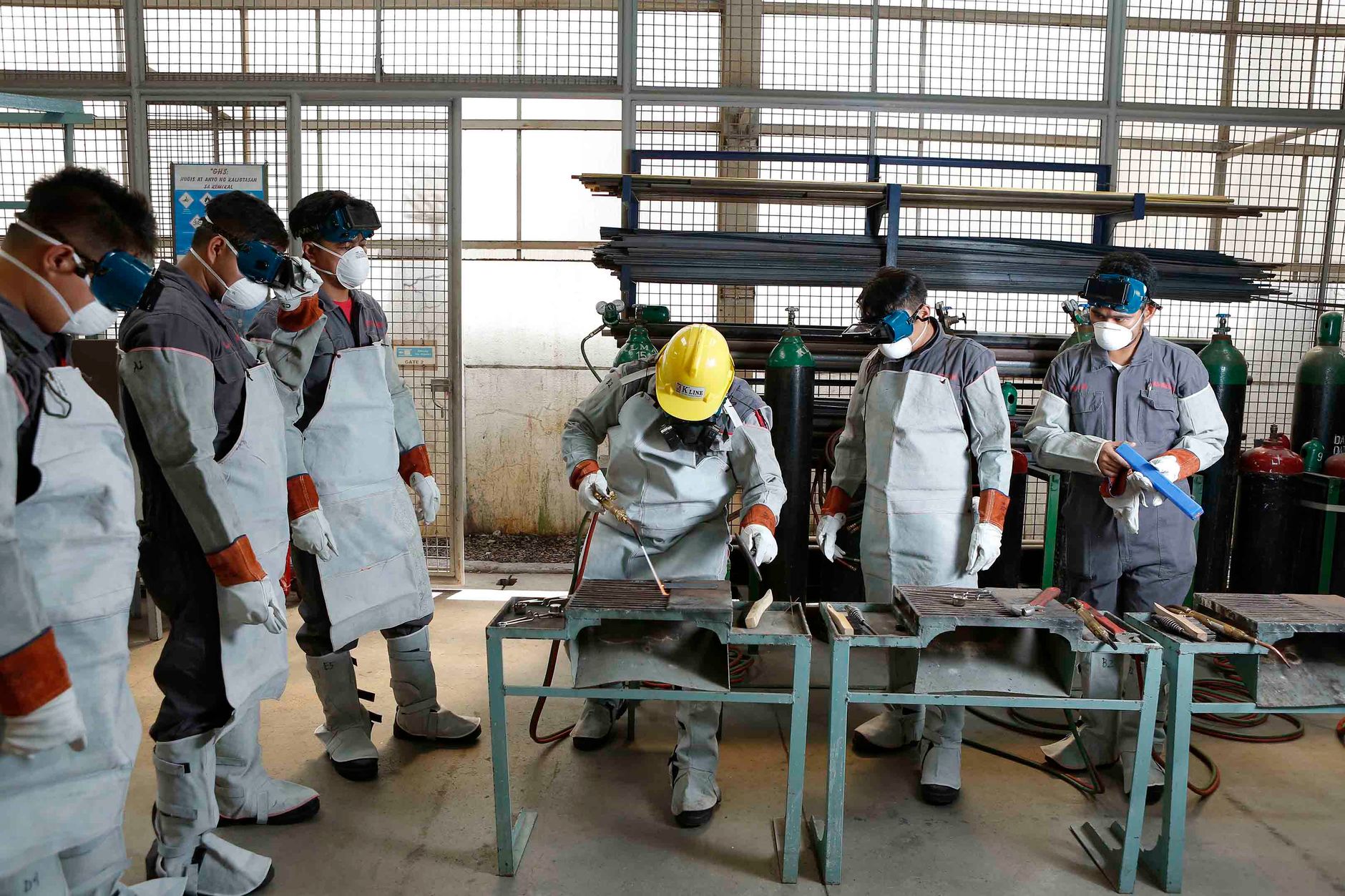
Photo: Multitech Institute / Pexels
Skilling India: The Numbers Are Up, the Placements Aren't
India runs one of the largest skilling efforts on earth, and on paper the scale is staggering. When the Skill India Mission marked ten years on 15 July 2025, the government counted more than 1.63 crore people trained across manufacturing, healthcare, IT and construction. Enrolment under the flagship Pradhan Mantri Kaushal Vikas Yojana (PMKVY) reportedly crossed around 1.76 crore by late 2025. Those are big, real numbers, and they reflect genuine effort and money.
Yet ask the obvious question — did the training lead to a job? — and the picture gets uncomfortable. This is not a story about blame. It is about why a well-funded system that trains millions still leaves so many of them without the work the certificate promised, and what specialists in vocational education say could close that gap.

The placement problem ordinary trainees actually face
For a young person who gives up months to attend a course, the test is simple: a paycheck at the end. By that test, the record has been patchy. Government and independent assessments suggest PMKVY's placement rate moved from about 18.4% under version 1.0 to roughly 23.4% under 2.0, then fell sharply to around 10.1% under PMKVY 3.0. Even on its short-term training track, placement has hovered well under half.
The second hard fact sits behind those rates. By widely cited estimates, only about 4% of India's workforce holds a formal skill certification at all. The country is not short of workers; it is short of workers whose skills are recognised, documented and matched to an employer who is hiring.
There is a quality gap too. In 2018, the employment rate among ITI (Industrial Training Institute) graduates was around 63%. In countries with deep vocational traditions — Germany, Singapore, Canada — comparable figures run between 80% and 90%. The distance is the problem worth solving.
What's quietly working, and deserves credit
A fair analysis has to say plainly that parts of the system do work, and that the trend lines are moving the right way.
The clearest bright spot is apprenticeships. Under the National Apprenticeship Promotion Scheme (NAPS), roughly 49 lakh apprentices have been engaged since 2016-17. Because apprentices learn inside a real workplace rather than a classroom, their pathway to a job is structurally stronger than a stand-alone course. Women's participation in this stream has roughly doubled, rising from about 11.3% in 2018-19 to nearly 23% in 2024-25 — a meaningful shift in a space long dominated by men.
Broader employability is also improving. The privately compiled India Skills Report 2025 put the national employability rate at 54.81%, up from 51.25% a year earlier and from roughly a third of young people a decade ago. No single survey tells the whole story, but the direction is real.
The policy machinery has been simplified, too. In February 2025 the government folded PMKVY 4.0, PM-NAPS and the Jan Shikshan Sansthan scheme into a single restructured Skill India Programme, reducing the confusing tangle of overlapping schemes that trainees and employers had to navigate.
Why courses and jobs keep missing each other
The core design flaw, most experts agree, is that too much training has been supply-driven. Targets were often set in terms of how many people were trained, not how many were employed a year later. When a system is paid to fill seats, it fills seats. Whether the local labour market needed that particular skill was a secondary question.
A few structural reasons compound this:
- Curriculum lag. Many trades are taught on outdated equipment while employers move to automation, digital tools and green technologies. The course ends; the skill is already half-obsolete.
- Short duration. A few weeks of classroom instruction rarely produces the muscle memory and workplace habits an employer will pay for.
- Weak industry ownership. Where companies treat apprentices as cheap labour rather than future hires, completion and absorption both suffer.
- Thin stipends. When a trainee earns less than informal daily-wage work, dropping out is the rational choice, especially for the poorest, who need this most.
None of this is a moral failing of any government or official. It is what happens when a vast programme scales fast and measures the wrong thing.
The reforms specialists actually recommend
The encouraging part is that the fixes are reasonably well understood, and some are already being attempted. Drawing on the NITI Aayog review of apprenticeships and the wider research consensus, the practical agenda looks like this:
- Measure outcomes, not enrolment. Fund providers partly on verified, sustained employment — a job that lasts six or twelve months — rather than on the count of people who walked through the door. Pay for results and the results follow.
- Let industry own the training. The closer a course sits to a real employer's hiring need, the better the placement. Sector skill councils and companies should help design and certify, not just receive graduates.
- Make the stipend livable. The Central Apprenticeship Council has proposed a roughly 36% stipend hike, lifting the band from about ₹5,000-9,000 to ₹6,800-12,300, with automatic biennial revision tied to inflation. Cutting the dropout cliff for poorer trainees may be the single highest-return reform.
- Start vocational learning earlier. In Germany, students enter the dual system — splitting time between classroom and shop floor — at the upper-secondary stage, with 320-plus recognised occupations. India typically introduces it later. Embedding it in school, and removing the stigma around it, widens the funnel.
- Build credible bridges back to academics. Young people resist vocational tracks partly because they feel like dead ends. Clear routes from a diploma to a degree make the choice less frightening for families.
Promising experiments to watch
Some of this is already on the ground. The new PM-SETU programme aims to modernise 1,000 government ITIs through a hub-and-spoke design — roughly 200 hub institutes anchoring 800 spokes — with a planned outlay near ₹60,000 crore split between the Centre, states and, crucially, industry partners putting in their own money. Co-investment tends to sharpen accountability.
States are innovating too. In September 2025, Tamil Nadu signed an agreement with a German consortium to bring Germany's dual training model into the state, with a goal of around 20,000 trainees over a decade. If even a few such models prove they can hit 80%-plus employment, they become templates others can copy.
What good would look like
The measure of success is not a bigger training number next year. It is a young woman from a small town who finishes an apprenticeship, is hired by the firm that trained her, and is still employed a year later — and who could, if she chose, return to formal study without starting over.
India has built the scale. The honest, non-partisan conclusion is that the next decade has to be about quality and outcomes: fewer empty certificates, more real jobs, stronger industry partnerships and stipends people can live on. The tools exist and several pilots are running. Turning them from exceptions into the norm is the work that remains — and it is the kind of reform almost everyone, across the political spectrum, can get behind.