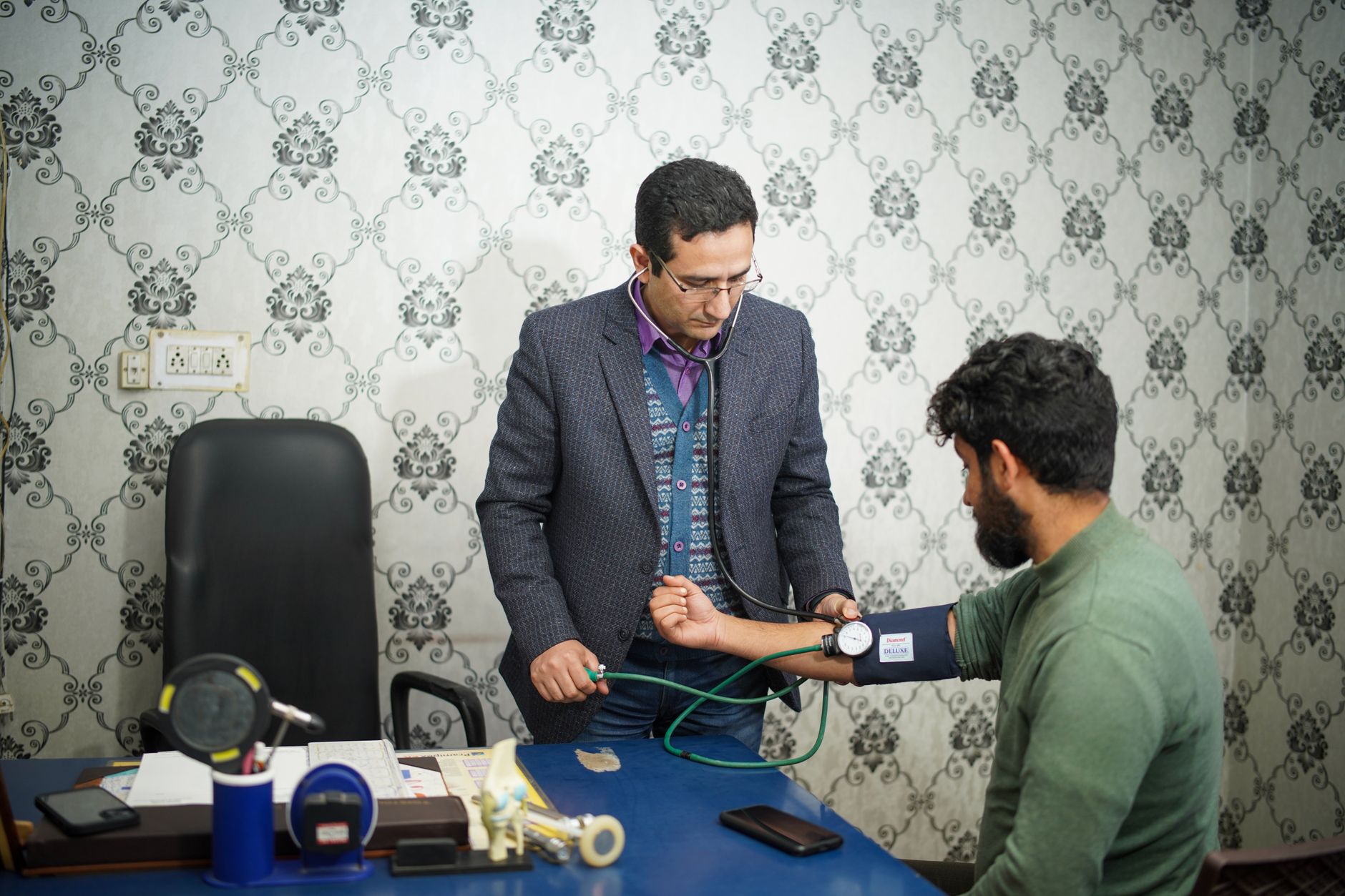
Photo: Imad Clicks / Pexels
UP and Bihar Healthcare: The Gaps, and How to Close Them
A fever that won't break, a pregnancy that needs monitoring, a grandfather's blood pressure spiking at midnight. For tens of millions of families across Uttar Pradesh and Bihar, the question that follows is not just "which doctor?" but "how far, how long the queue, and how much will it cost us?" Healthcare access in India's two most populous states is a story of real strain, but also of slow, measurable progress. This is an attempt to weigh both honestly, without pointing fingers.
The stakes are simply enormous. Together these two states are home to well over 350 million people. When their public health systems stretch thin, the consequences show up in national numbers. So it is worth setting aside the noise and looking at what the data actually says, what governments have built, and what specialists in public health believe could move the needle next.
The arithmetic that families feel every day
Start with the most basic measure: how many people share each doctor. Estimates put Uttar Pradesh at roughly one doctor for every 2,300-odd people and Bihar near one for every 2,000, both well short of the World Health Organization's benchmark of one per 1,000. Averages also hide the rural reality, because most doctors cluster in cities while most patients live in villages.
The building blocks of rural care tell the same story. National norms call for one sub-centre per 5,000 people, yet Bihar operates closer to one per 10,000. A primary health centre is meant to serve about 30,000 people; in Bihar one PHC can shoulder a population near a lakh. Uttar Pradesh, despite running the country's largest network of rural sub-centres at over 25,000, still reports that roughly 36% of doctor posts at its PHCs lie vacant.
Then comes the part that quietly drains household savings. Across India, out-of-pocket spending makes up around 39% of all health costs, down sharply over the past decade. In Uttar Pradesh that share reportedly climbs past 64%. In Bihar the burden falls hardest on those least able to bear it: studies have found that among the poorest rural households, medical needs can eat up the overwhelming majority of monthly consumption. A single hospitalisation can tip a family into debt.

Why the gaps are stubborn, not simple
It is tempting to blame any one thing, but the causes are layered. Vacancies are not only about hiring; they are about retention. A young doctor posted to a remote block often faces poor housing, weak equipment, no specialist colleagues to consult, and little career progression. Many leave for cities or abroad. Nationally, around 70% of specialist posts at community health centres sit empty, and that shortage is felt acutely in both states.
Demand pressures compound supply gaps. Bihar's NFHS data has flagged that more than 40% of children under five are stunted, a marker that signals deeper problems in nutrition, maternal care and sanitation. High disease burden meeting thin staffing means longer queues, rushed consultations and patients travelling far for care that should be available nearby.
There is also a governance dimension that is easy to miss. Filling a post is one thing; ensuring the centre has piped water, a steady drug supply, working diagnostics and supportive supervision is another. Surveys in both states have repeatedly found PHCs lacking basics such as a reliable water connection. When the plumbing and the medicine cabinet fail, even a fully staffed clinic underdelivers.
What is genuinely working
None of this means nothing has changed. Some of the most significant reforms of the past few years are visible on the ground, and they deserve a fair hearing.
The Ayushman Arogya Mandir programme, the renamed Health and Wellness Centres under Ayushman Bharat, has expanded primary care dramatically. The country now counts over 1.76 lakh of these centres, designed to deliver free preventive, maternal, child, chronic-disease and basic curative care close to home. They have collectively served hundreds of crores of patient visits, and a large majority of the planned urban centres are reported operational.
Telemedicine has been a quieter revolution. The government's eSanjeevani platform lets a health worker at a village centre connect a patient by video to a specialist sitting at a district hospital or medical college, free of cost. With more than 40 crore consultations nationally and a user base that skews towards women and the elderly, it directly attacks the specialist-shortage problem without waiting decades to train new doctors.
There is also fresh intent on staffing. Bihar's health administration has announced a drive to fill tens of thousands of vacant posts, including a fresh tranche of doctor and dental-officer positions, alongside female and male health workers. Recruitment alone won't fix retention, but it signals that the vacancy problem is finally being treated as urgent. Both states have also expanded medical-college capacity, slowly widening the pipeline of new graduates.
The reforms experts actually back
Ask public health researchers what would move these states forward, and a fairly consistent set of ideas emerges. Most are unglamorous and structural, which is precisely why they tend to work. Here are the ones that come up most often:
- A dedicated public health cadre. Running a district's health system is a distinct skill from treating patients. Specialists argue for a separate management cadre so that planning, supply chains and supervision aren't left to clinicians juggling them on the side.
- Train and value family physicians. Strengthening general-practice and family-medicine skills lets a single well-trained doctor handle a far wider range of problems at the primary level, easing pressure on referral hospitals.
- Make rural posting attractive, not just mandatory. Evidence shows compulsion alone fails. Decent housing, functioning equipment, hardship pay, and a clear path to post-graduate seats and promotions are what actually keep doctors in villages.
- Fix the basics first. Piped water, uninterrupted drug supply, working diagnostics and reliable power turn a nominal PHC into a real one. Targeted upgrades to meet existing standards often beat building anew.
- Scale telemedicine with last-mile support. eSanjeevani works best when the local centre has trained staff, connectivity and the medicines a remote consultation prescribes. Investing in that hub-and-spoke backbone multiplies the return.
- Train staff for today's disease mix. Continuous training in managing diabetes, hypertension, mental health and elderly care matches the system to how illness in these states is actually shifting.
Why this is worth getting right
The encouraging part is that these are not exotic fixes. They are well-understood, much-studied, and in several cases already being piloted. The harder part is consistency: holding the course across budget cycles and administrations so that a centre staffed and stocked this year is still staffed and stocked five years on.
For an ordinary family in a Purvanchal village or a Bihar block town, success looks modest and profound at once. A clinic within reach that is open, staffed and stocked. A specialist a video call away. A hospital bill that does not become a loan. None of that requires a miracle. It requires steady attention to plumbing, posting and supply, the parts of governance that rarely make headlines but decide whether care arrives in time.
Uttar Pradesh and Bihar have shown they can build at scale; the centres exist, the platforms work, the recruitment is moving. The unfinished task is to make access dependable, everywhere, for everyone, every day. That is a goal worth measuring progress against, year after year, regardless of who is in office.