
Photo: Neeraj Mohan / Pexels
ABS Now Mandatory on Every New Bike: What Buyers Must Know
If you are buying a scooter or motorcycle in India this year, the showroom experience has quietly changed. Every new two-wheeler now has to come with ABS — the anti-lock braking system that was, until recently, reserved for pricier machines above 125cc. The safety net that stops your front wheel from skidding out from under you in a panic stop is no longer a feature you pay extra to upgrade to. It is the baseline.
This is one of the biggest two-wheeler safety changes India has seen since helmets became compulsory, and it touches the most price-sensitive corner of the market: the 100cc and 110cc commuters that millions of families ride to work, school and the sabzi mandi. Here is what the ABS mandatory rule actually means for your next purchase, your wallet and your safety.
What changed, and why it matters
For years, the rule was split. Two-wheelers above 125cc needed ABS, while everything below that could get away with a cheaper Combined Braking System (CBS). The new norms close that gap and bring ABS to two-wheelers of all engine capacities.
The scale of this is easy to underestimate. The sub-125cc segment is the heart of Indian two-wheeler sales — by industry estimates it accounts for roughly 77% of the market. So this is not a tweak for enthusiasts; it is a safety upgrade aimed squarely at the bread-and-butter commuter that most Indians actually ride.
Why push it through? Two-wheelers make up a grim share of India's road deaths, and a huge number of those crashes involve riders losing control under hard braking — the rear wheel hops, the front locks, and the bike goes down. ABS is one of the few proven technologies that directly attacks that failure mode.

How ABS actually works on a bike
When you grab the brakes hard, especially on a wet or gravelly patch, a wheel can stop spinning while the bike is still moving — that is a lock-up, and a locked wheel has almost no grip and no steering. The bike slides.
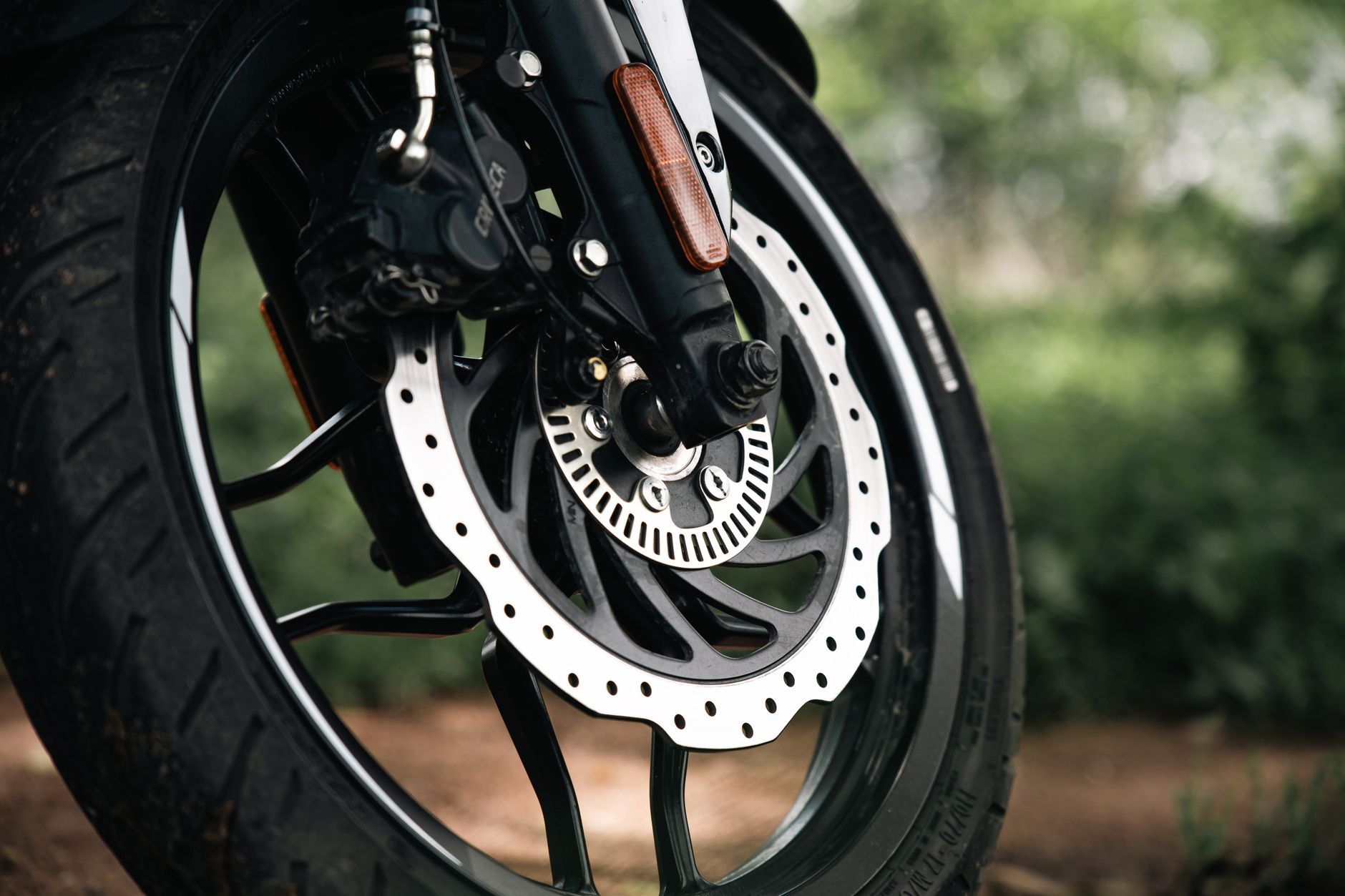
ABS uses speed sensors on the wheel to detect that split-second of impending lock-up. It then rapidly pulses the brake — releasing and re-applying many times a second — so the tyre keeps rotating just enough to hold traction. The practical payoff is two-fold:
- Shorter, more controlled stops on slippery surfaces, instead of a long skid.
- You can still steer while braking hard, which is what lets a rider swerve around an obstacle instead of plowing into it.
What ABS does not do is defy physics. It will not save you from bald tyres, a wet manhole cover taken at speed, or braking mid-corner with the bike leaned over. Think of it as a strong safety margin, not a force field.
Single-channel vs dual-channel: what you'll get
Not all ABS is the same, and the difference matters when you read a spec sheet. There are two flavours:
- Single-channel ABS — monitors and controls only the front wheel. This is what most budget commuters now get, because the front brake does the bulk of the stopping and front lock-ups are the most dangerous. It is cheaper and still delivers the core safety benefit.
- Dual-channel ABS — controls both front and rear wheels independently. It is more sophisticated, costs more (roughly ₹12,000–₹15,000 to implement), and is typically found on bigger, faster motorcycles where rear stability under braking matters more.
For an everyday city rider, single-channel ABS on the front wheel covers the scenario that causes the most crashes. If you ride a powerful bike, tour long distances, or ride hard, dual-channel is worth seeking out — and on many larger machines it is standard anyway.
The price catch you should budget for
Safety is rarely free, and this is the part that pinches. Adding ABS — and often a front disc brake to go with it on the cheapest models — pushes ex-showroom prices up.
Industry analysts peg the increase at around 3–5% across the affected segment. In rupee terms that is roughly ₹2,500–₹4,000 for many commuters, but on the most basic 100cc motorcycles — where bikes start near ₹60,000 and may need both a disc brake and single-channel ABS bolted on — the jump can be closer to ₹6,000–₹10,000.
That is a real number for an entry-level buyer. The honest way to look at it: it is a one-time cost spread over years of ownership, buying you a braking system that can be the difference between a near-miss and a hospital visit. Still, if you are budgeting, build this premium into your on-road price calculation rather than being surprised at the counter.
There has also been industry lobbying to delay or soften the rule for the smallest sub-125cc bikes, with manufacturers asking the government and ARAI to re-examine ABS effectiveness and cost on very low-powered machines. So expect some noise and possible fine-tuning around the edges — but the direction of travel is clearly toward universal ABS.
Two helmets in the box: the rule riding shotgun
The ABS mandate arrived alongside a second, less-discussed change that is just as useful. Dealers are now required to provide two BIS-certified helmets with every new two-wheeler — one for the rider and one for the pillion.
This quietly fixes a chronic problem: people buy a helmet for themselves and let the pillion ride bare-headed. Insist on getting both helmets, and check for the ISI / BIS mark — a certified helmet is the single cheapest piece of safety gear you own, and a fake one is worse than useless. If a dealer tries to fold the helmet cost into a vague "accessories" charge or skip the second one, push back; it is your entitlement.
What to check before you sign
The rules do the heavy lifting, but a smart buyer still verifies. Before you pay:
- Confirm the ABS type — ask whether it is single- or dual-channel, and don't assume the higher variant has it if the base one doesn't.
- Look for the front disc brake on entry bikes; single-channel ABS is usually paired with it.
- Get both BIS helmets in writing on the invoice, and check the certification mark.
- Test the brake feel on the test ride — good ABS engages smoothly, not with a violent grab.
- Don't skimp on tyres later — ABS is only as good as the rubber transmitting its commands to the road.
The bottom line
India has just made its most common vehicle meaningfully safer by default. The trade-off is a few thousand rupees more upfront, a debate over whether the tiniest bikes truly need it, and a learning curve for riders used to skidding to a stop. But for a country where two-wheelers carry the bulk of daily commuters, getting ABS and a proper helmet onto every new bike is the kind of unglamorous rule that quietly saves lives. When you shop for your next ride, treat ABS not as a luxury line item but as the floor — and spend your negotiating energy on getting the right variant and your two certified helmets out the door.


