Photo: Google DeepMind / Pexels
The Attention Switch Hiding in Your Oldest Brain Region
Attention has long been treated as a high-end feature of the human brain, the job of the wrinkled prefrontal cortex that makes us planners and problem-solvers. A new study says the real control switch sits somewhere far older and far deeper. Researchers at Johns Hopkins University have traced the power to focus, and to ignore, to a small circuit of neurons in the brainstem, a region so ancient that birds, fish and reptiles carry their own version of it.
The finding, published in Nature Communications and reported on June 22, 2026, flips a piece of textbook thinking. When the team switched these neurons off in mice, the animals stopped being able to concentrate. Faint, trivial distractions suddenly hijacked them. Switch the neurons back on, and focus returned, even against strong competing signals. It looked less like a quirk of mouse behaviour and a lot like the everyday struggle described by people with ADHD.
The most surprising part: it isn't where we thought
For decades, attention was filed under the prefrontal cortex, the executive suite of the primate brain. The Johns Hopkins work, led by senior author Shreesh Mysore with lead author Ninad Kothari, locates the decisive machinery somewhere else entirely: a cluster of inhibitory neurons buried in the brainstem.
These are GABAergic neurons, the brain's brakes. Rather than firing up a target, their job is to suppress everything else, the way a spotlight works by leaving the rest of the stage dark. Mysore's team describes this region as a kind of selection engine, constantly judging which signal in the world deserves your focus right now and muting the competition.
The twist is evolutionary. The brainstem is some of the oldest neural real estate vertebrates have. If the controller of attention lives there, then attention is not a late primate luxury. It is foundational equipment, present long before anything resembling human reasoning showed up.
How they caught the neurons in the act
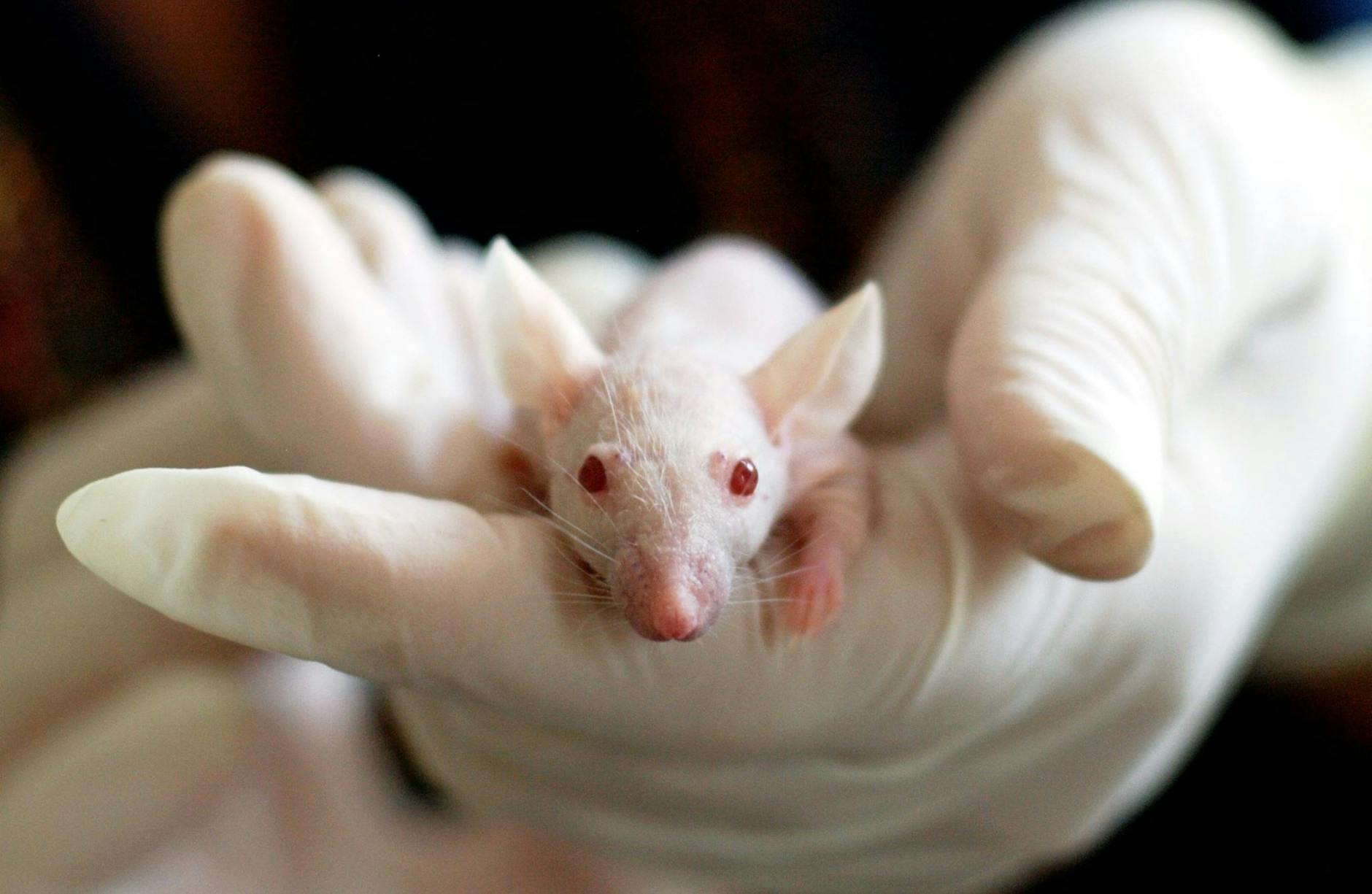
Proving that a brain region controls attention is harder than it sounds. You have to show that the animal can see, can move, can act, and still fails specifically at focusing. The team built a task for mice that mirrors the kind of test psychologists run on people.
A mouse faced a screen and had to attend to information presented directly ahead while ignoring distracting stimuli off to the side. Touch the correct location, get a reward. The mice were good at it, reliably keeping their attention where it belonged and brushing off the noise.
Then the researchers temporarily silenced the brainstem neurons. The animals fell apart, not because they had gone blind or clumsy, but because they could no longer filter. They became, in the team's word, hyper-distractible. Their eyes and limbs worked fine. What broke was the ability to choose.
Off, and then back on
What makes the result persuasive is its reversibility. This was not damage. The neurons were quieted temporarily and then allowed to fire again.
- With the circuit silenced, even weak, faint distractors pulled the mice off task.
- With the circuit restored the following day, the same animals could once again ignore distractions, including strong ones.
That on-off pattern is the difference between a vague correlation and a real control knob. The neurons were not merely active during attention; they were necessary for it. Take them offline and the spotlight scatters. Bring them back and it sharpens.
Why it reads like ADHD
The behaviour the mice showed has an uncomfortable familiarity. Anyone who has tried to read a page while a phone buzzes, or watched a child bounce from one thing to the next, knows the feeling of attention that will not stay put.
Mysore drew the line plainly, noting that a hallmark of ADHD is that even faint distractors pull attention away, which is exactly what appeared when the neurons were switched off. That is a careful claim, and worth reading carefully. The study does not announce a cause of ADHD, and it certainly does not offer a cure. What it offers is a specific, testable circuit, a physical place in the brain where the symptom of distractibility can be produced and reversed on demand.
That matters because attention disorders have been notoriously hard to pin to biology. Diagnoses rest on behaviour and questionnaires, not on anything you can measure in tissue. A defined circuit gives researchers something concrete to point an instrument at.
The deep-time angle that makes it share-worthy
Here is the fact worth telling a friend. The circuit the team studied is not unique to mice or even to mammals. The brainstem region involved is conserved across vertebrates, which means birds, fish and reptiles carry their own versions of the same attentional hardware.
Think about what that implies. A hawk locking onto a single mouse in a moving field, a fish tracking one flicker of prey in a cluttered reef, a lizard freezing on a single approaching shadow, all of it may run on machinery that predates the primate brain by hundreds of millions of years. Attention, in this telling, is not what made us clever. It is older than cleverness.
Mysore's earlier research traced selective attention in birds, work that pointed toward exactly this kind of ancient midbrain and brainstem circuitry. The new mouse study extends that thread into mammals and, by extension, toward us. We did not invent focus. We inherited it.
What comes next
The obvious frontier is the human brain. The team has proposed measuring the activity of this circuit in people with ADHD and autism, conditions in which attention and distraction work differently. If the circuit behaves measurably differently in those individuals, it could become a target, for diagnosis, for drugs, or for more precise therapies than the broad stimulants used today.
A few cautions are worth keeping in view:
- This is a mouse study. The leap to human treatment is long and frequently does not survive the journey.
- The work shows the circuit is necessary for attention, not that it is the only thing involved. The prefrontal cortex still matters; it is simply not working alone.
- ADHD is a complex condition with many contributing factors. A clean result in a controlled experiment is a clue, not a verdict.
Still, the shape of the discovery is genuinely striking. The thing that lets you read this sentence to the end, the quiet act of holding one signal and dimming the rest, appears to be governed by some of the oldest neurons you own. Not the part of the brain that makes you human, but a part you share with a sparrow and a goldfish. The spotlight was switched on a very long time ago.