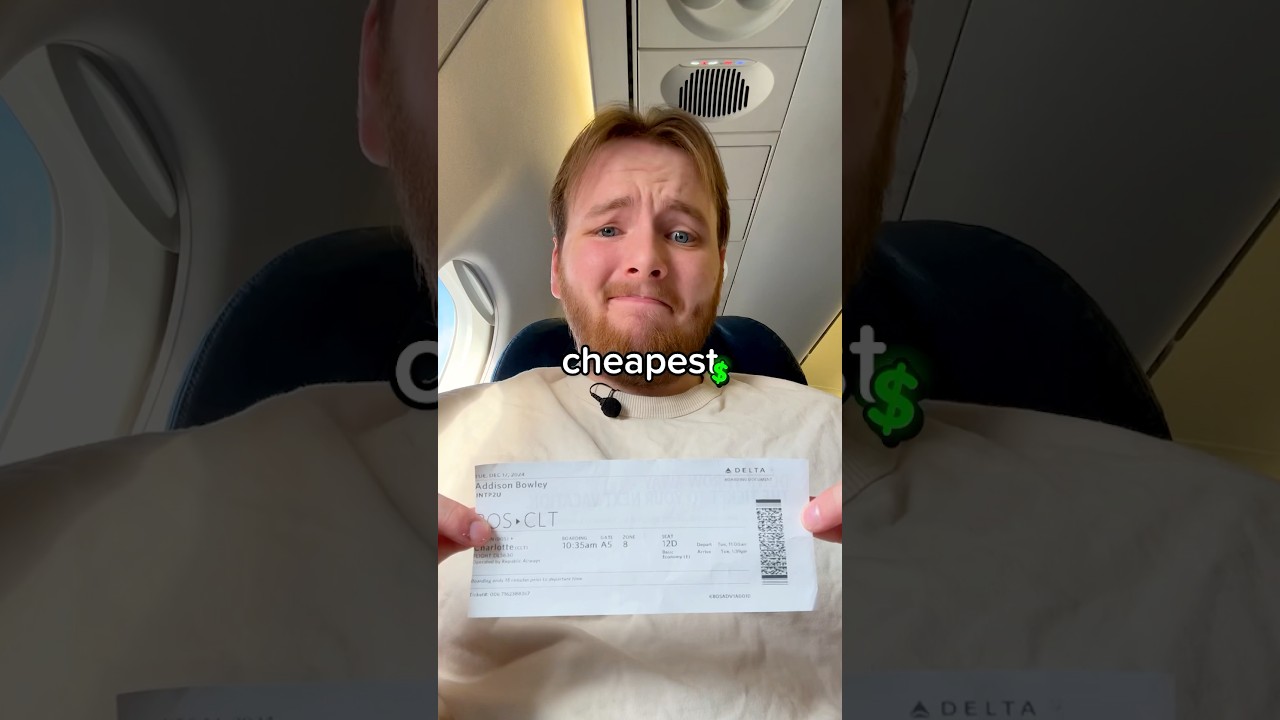
What the Cheapest vs Priciest Delta Seat Really Buys You
A short travel video doing the rounds on YouTube has a deceptively simple premise: book the cheapest seat on a Delta Air Lines flight, then book the most expensive one, and put them side by side. The cheapest is a cramped Basic Economy spot at the back. The dearest is a Delta One Suite with a door, a flat bed and a price that can be many times higher. Both seats fly the same route, take off at the same minute and land together. That contrast is exactly why the clip keeps getting shared.
This kind of cheapest vs most expensive seat comparison has quietly become one of aviation's most reliable viral formats. It taps a question almost every flyer has asked while shuffling past the curtained-off front cabin: what is all that money actually buying? The honest answer is more interesting than either the airline's glossy marketing or the cynical "it's all a rip-off" take.
Why this format keeps going viral
Part of the appeal is voyeurism. Most people will never sit in a five-figure suite, so a few minutes of footage is the closest they will get. It works like a house tour for something you can rent by the hour but rarely will.
The other part is the maths. When two seats on one plane can differ by a factor of ten or more, the mind instinctively wants to audit the difference. Viewers are not really watching a seat review. They are watching a referendum on whether luxury is worth it, and everyone brings their own verdict to the comments.
There is also a small thrill of transgression. Economy passengers are funnelled past the premium cabins during boarding, allowed to glimpse but not linger. A video that walks you slowly through both worlds gives you the look the boarding process denies you.
What the cheapest seat actually is
Basic Economy is not simply "economy, but cheaper." It is a stripped-down fare class designed to win the price-comparison search and then claw back value through restrictions. The seat itself is usually identical to standard economy. What changes is everything around it.
Typical Basic Economy limits include:
- No advance seat selection — you are assigned a seat at check-in, often a middle one
- No changes or refunds, or only at a steep penalty
- Last boarding group, so overhead bin space is often gone
- Limited or paid carry-on on some carriers and routes
- Few or no frequent-flyer perks such as upgrades or full mileage
The trap is that the fare looks like a bargain on a booking site and only reveals its costs later. Travellers who need to change plans, sit with family or carry a bag can end up paying more than a regular economy ticket would have cost. For first-time international flyers from India connecting through a US hub, this is a genuinely common and avoidable mistake.
What the most expensive seat buys
At the other end, Delta One and its newer suite version are the airline's long-haul flagship. The headline feature is a lie-flat bed, often angled in a herringbone layout with a privacy door on the latest jets. Around that sit premium dining, better bedding, lounge access before the flight and priority through almost every queue.
The crucial thing to understand is what you are not paying for. You are not buying speed. The suite does not get you there sooner. You are buying time spent differently — sleeping instead of enduring, working instead of waiting, arriving able to function instead of needing a recovery day.
That reframes the whole debate. On a daytime hop of a few hours, a flat bed is mostly wasted, and the premium looks indulgent. On a brutal overnight crossing of ten hours or more, the same seat can be the difference between landing fresh for a meeting and landing useless. The value is real, but it is wildly route-dependent.
The part the video can't fully show
A camera captures the hardware: the seat width, the screen, the door. It struggles to capture the parts that often matter most. Sleep quality at altitude, how rested you feel at the destination, and the calm of skipping long security and immigration lines do not film well, yet they are where premium cabins earn their keep.
There is a flip side worth saying plainly. For a fit traveller on a short flight who can sleep anywhere, the gap shrinks to a nicer meal and a wider seat. Spending heavily there is a preference, not a necessity. The smartest flyers treat the cabin choice as situational rather than a fixed identity.
How this maps onto Indian long-haul travel
Indian outbound travel has surged, and the cheapest-vs-priciest question lands squarely on the long sectors to North America, Europe and the Gulf. Delta itself flies Indians mostly via codeshare and connecting routes, but the lesson generalises to every carrier serving the country.
A few practical takeaways for travellers booking from India:
- Read the fare rules, not just the price. A Basic Economy or equivalent "saver" fare can cost more once you add a seat, a bag and a possible change.
- Consider Premium Economy as the sweet spot. It is a real cabin with meaningful extra room and recline, usually far cheaper than business, and often the best value on a long overnight flight.
- A paid bulkhead or exit-row seat in regular economy can buy most of the comfort that matters for a fraction of a business-class fare.
- Use miles and points. Premium cabins are where frequent-flyer programmes deliver outsized value, so a long-saved balance is best spent on a flat bed, not a short economy hop.
The middle ground most flyers ignore
The viral framing is binary by design: rock-bottom versus top-of-the-range. Real travel rarely is. Between the two extremes sit Comfort-style extra-legroom economy, Premium Economy and discounted upgrade bids offered at check-in, where you name a price to move up if seats are unsold.
Those options are less photogenic, which is precisely why videos skip them. But for the overwhelming majority of journeys, the right answer is somewhere in that ignored middle. The most expensive seat is a fascinating object and a fair splurge on the right route. It is not the default the algorithm makes it feel like.
What comes next
Expect more of these clips, not fewer. Airlines keep widening the gap between their cheapest and dearest products — adding doors, bigger screens and fancier bedding up front while squeezing the back — and that growing distance is the engine of the format. The bigger the spread, the more shareable the comparison.
For viewers, the useful habit is to watch these videos as a pricing lesson rather than a luxury fantasy. The cheapest seat punishes the unprepared with hidden restrictions. The priciest rewards a specific situation, mainly long overnight flights, and wastes money outside it. Knowing which trip you are actually taking is worth more than any seat review.