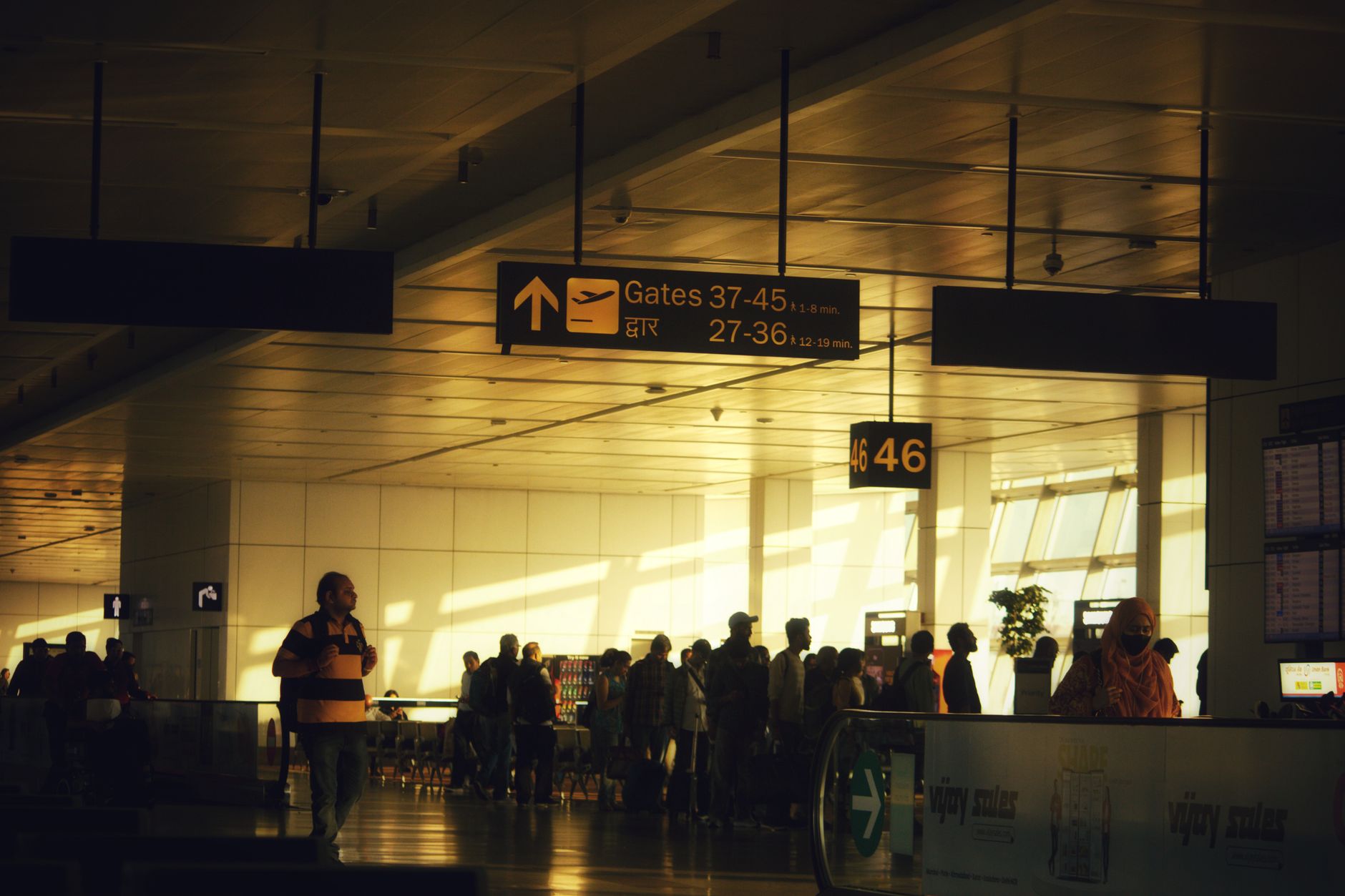
Photo: Omkar Pendsay / Pexels
DigiYatra Explained: How Face Scan Boarding Works in India
DigiYatra: walking through an Indian airport using just your face
Imagine reaching the airport, glancing at a camera, and strolling through the entry gate without fishing out your ID or boarding pass. That is the promise of DigiYatra, India's face-recognition-based air travel system that has quietly spread to more than two dozen airports. For frequent flyers stuck in long verification queues, it can shave real minutes off the slog from kerb to gate.
Launched in December 2022 and expanded steadily since, DigiYatra replaces three manual ID checks — at the terminal entry, the security hold area, and the boarding gate — with a quick facial scan. No CISF jawan squinting at your card, no agent stamping your pass. It sounds futuristic, and it works, but it also raises fair questions about where your face goes. Here is a clear, practical guide.

How DigiYatra actually works
The system runs on a single idea: Face Recognition Technology (FRT) linked to your verified identity and your day's flight. You enrol once, then your face becomes your travel token.
The flow at the airport is simple:
- At the entry e-gate, you scan the barcode on your boarding pass, then look at the camera.
- The camera matches your live face to the credential you enrolled with.
- The gate opens, and your travel record is shared with that airport only for the day.
- At security and at the boarding gate, the same face match waves you through.
Crucially, DigiYatra works on a decentralised, self-sovereign identity model. There is no giant central server holding millions of faces. Your identity credential lives in a secure wallet on your own phone, and you choose to share it, in encrypted form, with a specific airport for a specific trip. Once you have flown, that shared copy is meant to be wiped.

Setting it up: a step-by-step
Getting started takes about five minutes and needs an Aadhaar-linked verification. Here's the process:
- Download the official DigiYatra app from the Play Store or App Store. Check the publisher carefully — fake clones exist.
- Register with your mobile number and an OTP.
- Complete identity verification using Aadhaar through DigiLocker-style consent, which pulls your name and details.
- Take a selfie; this becomes the reference face for all future matches.
- When you book a flight, add the trip by scanning or importing your boarding pass before reaching the airport.
At the airport, head to the dedicated DigiYatra e-gates rather than the manual counters. A small but useful tip: enrol and add your flight at home on good Wi-Fi, because doing it in a crowded terminal with patchy signal defeats the time-saving purpose.
What data it collects — and what it doesn't
This is the part that deserves attention. DigiYatra was designed, on paper, around data minimisation. The key safeguards are:
- Your biometric and ID data are encrypted and stored locally on your device, not in a national repository.
- Trip information shared with an airport is deleted within 24 hours of your flight's departure.
- Participation is voluntary and free — there is no fee to enrol or use it.
- You can delete your ID from the wallet whenever you like, removing the stored credential entirely.
What the airport's system does briefly hold is the day-of-travel data needed to admit you. The architecture is meant to ensure no single body can build a permanent, searchable log of your movements. Privacy researchers have nonetheless flagged real concerns: the DigiYatra Foundation that runs it is a private non-profit, not a statutory body, and India's data-protection law is still settling into force. Function creep — where a convenience tool quietly expands its uses — is the worry most often raised.
The privacy debate, fairly stated
Facial recognition is uniquely sensitive because, unlike a password, you cannot change your face if data leaks. Critics argue that normalising face scans at airports softens public resistance to surveillance elsewhere. There have also been reports of travellers being signed up without clear consent by over-eager staff at some counters — a genuine problem when the whole system rests on the idea of being optional.
The counter-argument is the decentralised design itself. Because credentials sit on your phone and trip data self-destructs, DigiYatra is structurally different from a CCTV network that scans everyone passively. You actively present your face; the system does not hunt for it in a crowd.
The honest takeaway: it is a convenience worth using if you fly often, provided you treat it deliberately. Enrol yourself, on your own phone, and never let an airport agent set it up on your behalf. If you are uneasy, simply don't enrol — the regular queues are not going anywhere.
Where it works and what's coming next
DigiYatra is now live at a broad spread of major and mid-size airports, including hubs like Delhi, Mumbai, Bengaluru, Hyderabad, Kolkata, Chennai, Pune, Ahmedabad, Goa and Varanasi, with the network expanding as the rollout continues. Coverage varies, so check whether your specific airport and terminal support it before relying on it.
Looking ahead, several developments are in the pipeline:
- More airports are being added, with the goal of near-universal coverage across busy terminals.
- Discussions on extending DigiYatra-style credentials to international travel and to non-airport uses such as hotel check-ins and railway access have surfaced, though these remain early-stage and contentious on privacy grounds.
- Improvements to the app's reliability and a planned ability to transfer your wallet to a new phone address a common frustration, since losing or changing your device today can mean re-enrolling.
That last point is a practical caveat. If you switch phones, factory-reset your device, or uninstall the app, your locally stored credential goes with it and you start fresh.
Should you use it? A quick verdict
DigiYatra is genuinely useful for one clear audience: frequent domestic flyers who hate queues and travel light on documents anyway. The time saved at three separate checkpoints adds up, especially at congested metro airports during peak hours.
A few rules to use it well:
- Always carry physical ID. DigiYatra can be down, your phone can die, and gates can glitch. It is a fast lane, not a replacement for your documents.
- Enrol yourself, at home, from the official app only.
- Review and delete your stored ID periodically if you fly rarely, so a dormant credential isn't sitting on an old phone.
- Don't assume every airport or terminal supports it — confirm in advance.
Used thoughtfully, DigiYatra is one of the more tangible ways India's digital-public-infrastructure push touches everyday life: less paper, shorter lines, and your boarding pass replaced by a glance. Whether that convenience is worth handing over your face is, fittingly, a choice the system leaves entirely to you.