DKS Oath Draws a Kerala MP: What the Guest List Signals
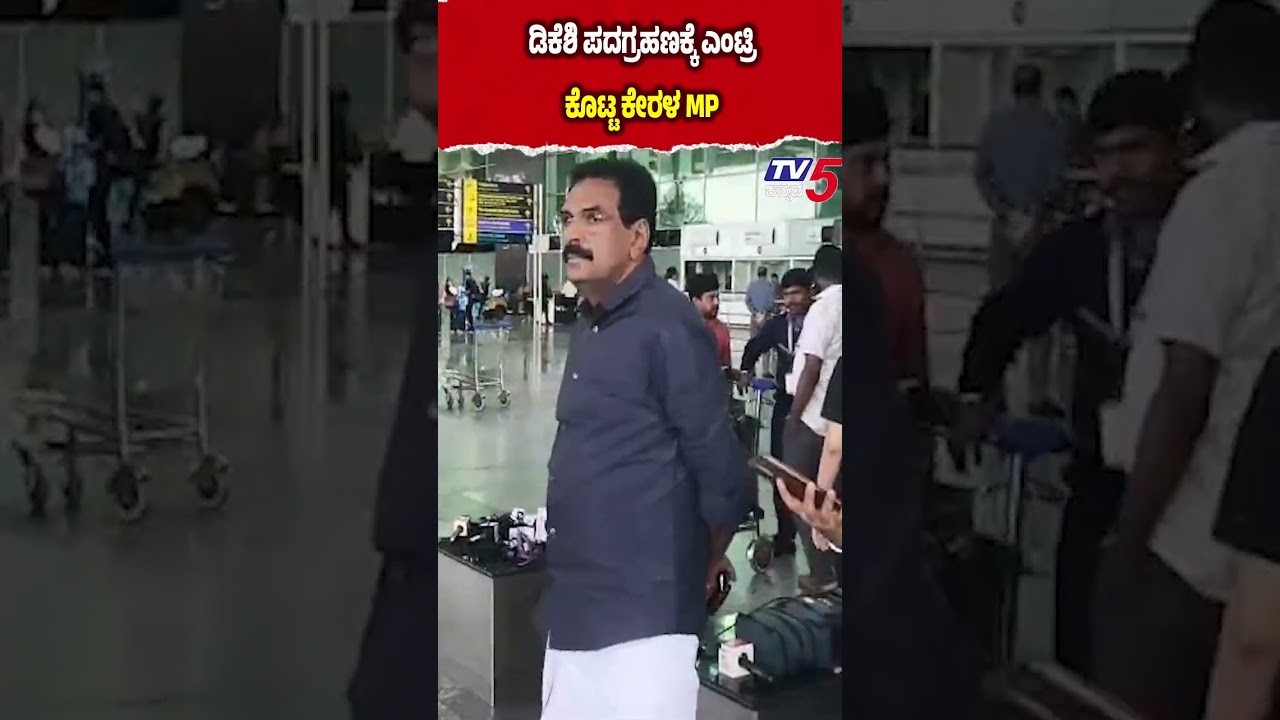
A few seconds of footage — a Kerala MP walking out of the arrivals gate at Bengaluru's airport, garlanded and trailed by a small knot of workers, ahead of DK Shivakumar's oath as Karnataka Chief Minister — has quietly racked up views on YouTube. It is the kind of clip that looks like nothing and means a lot. No speech, no slogan, just a politician landing in another state. Yet thousands clicked, because in Indian politics a guest list is rarely an accident.
The backdrop is one of the most closely watched handovers in recent Congress history. On 3 June 2026, Shivakumar — long the party's most powerful organiser in Karnataka and its state unit chief — finally took the top job after a two-and-a-half-year power-sharing understanding with Siddaramaiah that dated back to the 2023 Assembly victory. A swearing-in that follows a long, public tug-of-war is never just a formality. It is a statement, and every face in the front rows is part of the message.
Why a Kerala MP at a Karnataka oath is the story
On paper, a parliamentarian from one state attending a Chief Minister's oath in another is unremarkable courtesy. In practice, it is choreography. Oath ceremonies are invitation-only spectacles, and who is flown in — and who is seated where — is decided with the same care as a cabinet list.
A visitor from Kerala carries a specific subtext. Kerala is one of the few large states where the Congress-led front remains a serious contender, and the two states share a long, politically active border belt. Bringing a southern neighbour onto the stage lets the party tell its workers a simple story: this is not one man's coronation in one city, it is a regional moment with reach beyond Karnataka's lines.
It also matters for Shivakumar personally. After years of being cast as the patient number two, an out-of-state guest signals that his arrival is being treated as nationally significant, not merely a local reshuffle. The optics say he has standing in the wider party, not just a vote bank in old Mysuru.
The swearing-in as political theatre
Strip away the constitutional bit and a swearing-in is surprisingly small. The Governor administers the oath of office and secrecy; the new Chief Minister signs a register; it is over in minutes. Everything else — the dais, the lakhs of supporters bussed in, the celebrity invitees, the live feeds — is pure stagecraft, and India has perfected it.
That theatre does real work. A few things a high-wattage oath is designed to broadcast:
- Unity: rivals sharing a stage tells cadres the infighting is, officially, over.
- Reach: guests from other states project the party as a national force, not a one-state outfit.
- Strength: a visibly massive crowd is a low-cost show of mobilisation muscle ahead of future polls.
- Hierarchy: seating, garlands and speaking slots quietly rank who is in and who is out.
When a clip of a single arriving guest goes viral, it is because viewers instinctively read all of this. The footage is short; the political grammar behind it is dense.
What's verified, and what isn't
Here it is worth being careful. The trending video shows a Kerala MP arriving in Bengaluru in the run-up to the ceremony. The broad fact — Shivakumar's oath, the date, the long handover from Siddaramaiah — is well established and not in dispute.
What a viral clip cannot confirm is motive. Whether a particular guest was there as an official party representative, a personal friend, or simply a leader passing through is not something a few seconds of airport video can settle. Treat any sweeping claim about a "secret message" behind one arrival as interpretation, not fact. The honest reading is that cross-state attendance is normal at big Congress events, and that this one was unusually high-stakes, so attendance was unusually scrutinised.
It is also worth flagging that bilingual news clips — the title here runs in both English and Kannada — travel fast precisely because they are short and emotionally legible. Virality is not the same as importance, and a high view count does not mean a hidden plot.
The handover that made every guest matter
To understand why even minor arrivals drew cameras, recall how fraught the road to this oath was. The 2023 win handed Congress a strong Karnataka mandate, but the chief ministership was contested between two heavyweights. The compromise — Siddaramaiah first, with Shivakumar's turn to follow — kept the peace but left the second half of the term hanging over the government for years.
When the switch finally happened, the central question was whether it would be graceful or grudging. A smooth, well-attended ceremony with rivals and allies present is the visual proof of a clean transition. An empty-looking dais, or conspicuous absences, would have told the opposite story. That is why this particular swearing-in was watched frame by frame, and why a Kerala MP stepping off a flight became content worth clipping.
For a party that has struggled to look cohesive nationally, a Karnataka transition that looks managed is valuable. Karnataka is its richest, most important southern stronghold; a public wobble there would echo well beyond the state.
Guest lists as a map of alliances
Across Indian politics, reading the invitee list of an oath has become a minor analytical sport — and not without reason. Who attends, who sends a deputy, and who stays away is treated as a live snapshot of where loyalties sit.
A few patterns observers tend to look for:
- In-party rivals sharing the stage — read as a truce, however temporary.
- Allies from other states — read as a coalition or front in good health.
- Conspicuous no-shows — read as a sulk, a snub, or a realignment in progress.
- Non-political celebrities — read as a bid for mass, aspirational appeal.
Seen through that lens, a southern neighbour's MP turning up is a small green tick in the "front is healthy" column. It is the sort of detail that means little on its own but adds up across a dozen such signals.
What happens next
The harder test begins once the garlands wilt. Shivakumar inherits a government already most of the way through its term, with the next Assembly contest moving steadily closer. His immediate challenge is to convert the goodwill of a clean handover into delivery on welfare promises and administration, while keeping the Siddaramaiah camp on side rather than restless.
The out-of-state attendance hints at a second front, too: a Congress attempt to knit its southern units into a more visible bloc, useful both for morale and for the larger national argument the party wants to make. Whether that hardens into real coordination or stays at the level of ceremonial appearances is the thing to watch.
For now, the clip has done its job. It travelled, it sparked speculation, and it reminded everyone that in Indian politics the most-watched moment is sometimes not the oath itself but who walked through the airport gate to see it. The substance — governance, the term ahead, the party's southern math — will be settled far from the cameras, over the months that follow.