Photo: Emran Omar / Pexels
Hanle Dark Sky Reserve: How to Stargaze in India's Darkest Sky
If you have only ever seen a few dozen stars from a city rooftop, the night sky over Hanle will rearrange your sense of scale. From this remote corner of southeast Ladakh, the Milky Way is not a faint idea but a luminous river arching from horizon to horizon, bright enough to cast a shadow. This is the heart of the Hanle Dark Sky Reserve, India's first legally protected night sky and one of the few places on the planet where darkness itself is treated as a resource worth saving.
Notified by the Ladakh administration in late 2022, the reserve sprawls across roughly 1,073 square kilometres of high-altitude desert surrounding the Indian Astronomical Observatory (IAO). It is equal parts science station, conservation project and a genuinely bookmarkable destination for anyone willing to make the long, thin-air journey. Here is why the sky here is so extraordinary — and exactly how to go see it for yourself.

Why Hanle's sky is officially the darkest in India
Astronomers measure light pollution using the Bortle scale, which runs from Class 1 (a primordial, pitch-black sky) to Class 9 (the washed-out orange glow of a city centre). Most of urban India sits at Class 7 to 9, where the Milky Way is simply invisible. Hanle is rated Bortle Class 1, the rarest and darkest classification there is.
Three things combine to make this possible. First, altitude: the observatory perches at about 4,500 metres above sea level, putting you above a large fraction of the atmosphere's dust, moisture and haze. Second, dryness — Ladakh is a cold desert with thin, arid air and very little water vapour to scatter light. Third, isolation: there are no large towns, factories or highways for hundreds of kilometres to leak stray light upward.
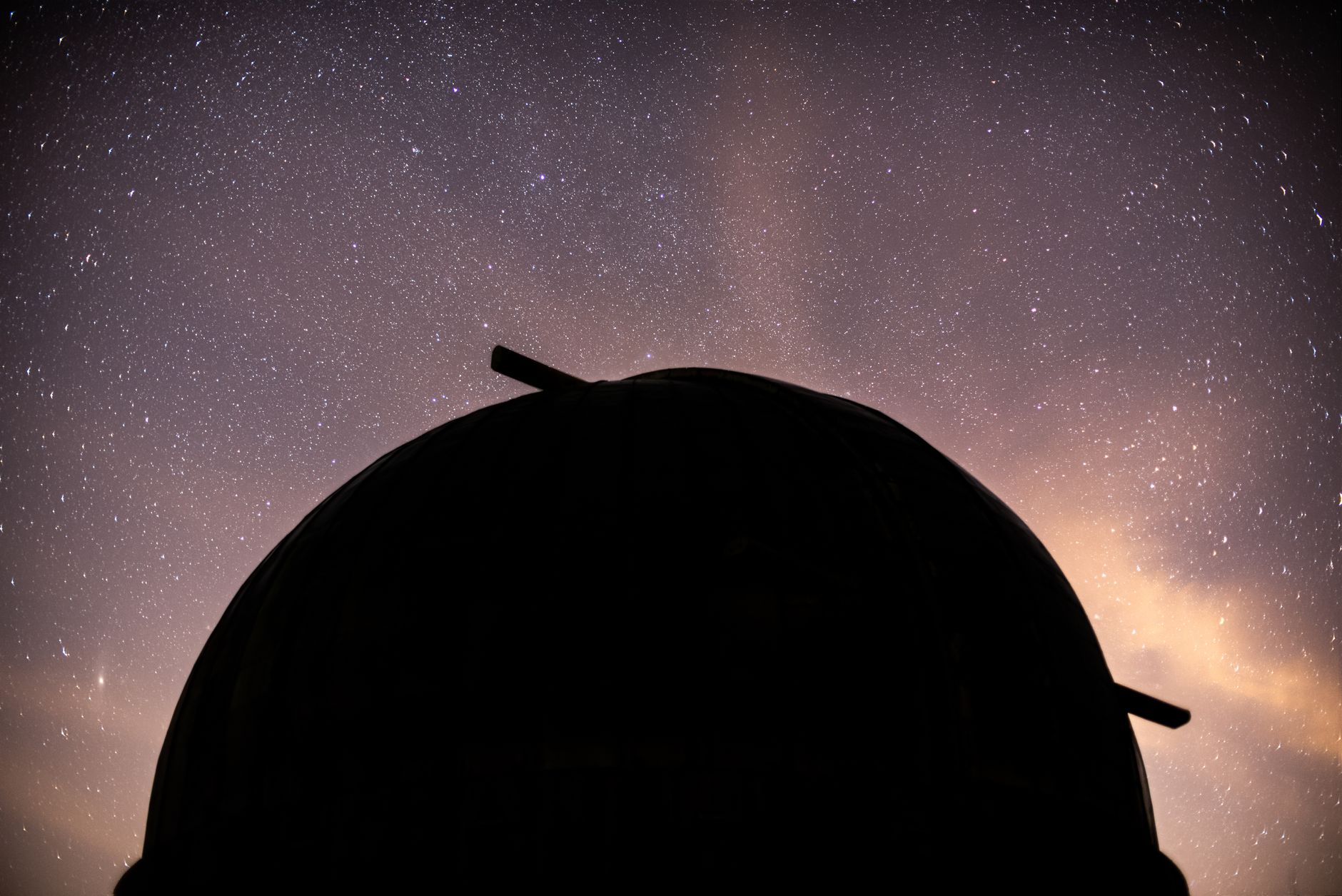
The result is a sky so transparent that faint phenomena most Indians have never witnessed become routine. On a moonless night you can trace the zodiacal light, a ghostly cone of sunlight scattered by interplanetary dust, and pick out the Andromeda galaxy — light that left its stars over two million years ago — with your unaided eye.
A working observatory, not just a viewpoint
Hanle is not a tourist attraction that happens to have dark skies; it is a serious scientific site that tourism grew around. The IAO, run by the Indian Institute of Astrophysics (IIA), is among the highest optical observatories in the world and has been imaging the cosmos from this ridge for over two decades.
In October 2024, India inaugurated the MACE telescope here — the Major Atmospheric Cherenkov Experiment — a 21-metre dish that is Asia's largest and the world's highest instrument of its kind. Rather than capturing ordinary starlight, MACE detects the faint flashes produced when high-energy gamma rays from violent cosmic events slam into the upper atmosphere. It is the kind of frontier physics that needs exactly the clean, high, dark conditions Hanle offers.
This matters for visitors too: the science community has a direct stake in keeping the skies dark, which is why the reserve enforces lighting rules. Protecting the view for the telescopes also protects it for you.
The clever part: local Astronomy Ambassadors
The smartest feature of the Hanle model is social, not technical. To make sure stargazing tourism benefits the people who live in the reserve's handful of hamlets, the IIA trained more than 40 local residents as Astronomy Ambassadors. Many keep an 8-inch telescope at their homestay and run guided night-sky sessions for guests.
The payoff is threefold:
- Money stays local. Instead of profits flowing to outside operators, the families hosting you earn directly from the sky above their homes.
- You get a real guide. Ambassadors can swing a telescope onto Saturn's rings, a globular cluster or a nebula, and explain what you are seeing.
- Conservation gains an ally. Communities that earn from dark skies have every reason to keep them dark, turning residents into stewards rather than bystanders.
It is a quiet template for how astro-tourism can work without trampling the very thing people come to see.
How to plan your trip
Getting to Hanle is part of the experience and demands respect for the terrain. A practical checklist:
- Pick the season. The accessible window is roughly May to October. Winter temperatures plunge far below freezing and roads can close. For the warmest, clearest nights, aim for July, August or September.
- Chase the new moon. A bright full moon drowns out the faint sky. Check a lunar calendar and book your nights as close to the new moon as you can.
- Sort your permits and fees. Hanle sits near a sensitive border, so factor in inner-line or protected-area permissions and the online Ladakh environment and wildlife fees. Rules shift, so verify the current requirements before you set out.
- Acclimatise first. Spend two or three nights in Leh and ascend gradually. At 4,500 metres, altitude sickness is a real risk — hydrate, avoid alcohol, and never rush the climb.
- Book a homestay with an Ambassador. This secures both a warm bed and a telescope-led session, and supports the local economy.
What to pack — and what to leave switched off
The cardinal rule of any dark-sky site is no white light. A single phone torch can wreck the night vision of everyone around you, which takes 20–30 minutes to rebuild. Bring a red-light torch instead; red wavelengths preserve your eyes' dark adaptation.
A few other essentials:
- Serious warm layers, including gloves and a windproof outer shell — even summer nights are bitterly cold at this altitude.
- A reclining chair or mat, so you can watch the sky for hours without straining your neck.
- Binoculars, which are often more rewarding than a telescope for sweeping the Milky Way's star clouds.
- A star-map app set to night/red mode, or a simple planisphere.
Go easy on expectations of dramatic camera shots; the naked-eye experience is the real prize.
Why this matters beyond one village
Darkness is vanishing fast. Across the world, light pollution is brightening night skies by a few percent every year, erasing the stars for billions of people and disrupting wildlife, from migrating birds to nocturnal insects. A protected reserve like Hanle is a rare counter-current — proof that a community, a scientific institution and a government can agree that an empty black sky is worth defending.
For the traveller, the takeaway is simpler. Hanle Dark Sky Reserve offers something no Indian city can: a direct, humbling view of the galaxy we live inside. Plan around the moon, climb slowly, kill the white light — and look up. The sky you see there is the one our ancestors knew, and one most of us have quietly lost.