Photo: Pranjall Kumar / Pexels
Makhana Boom: How Bihar's Pond Snack Conquered the World
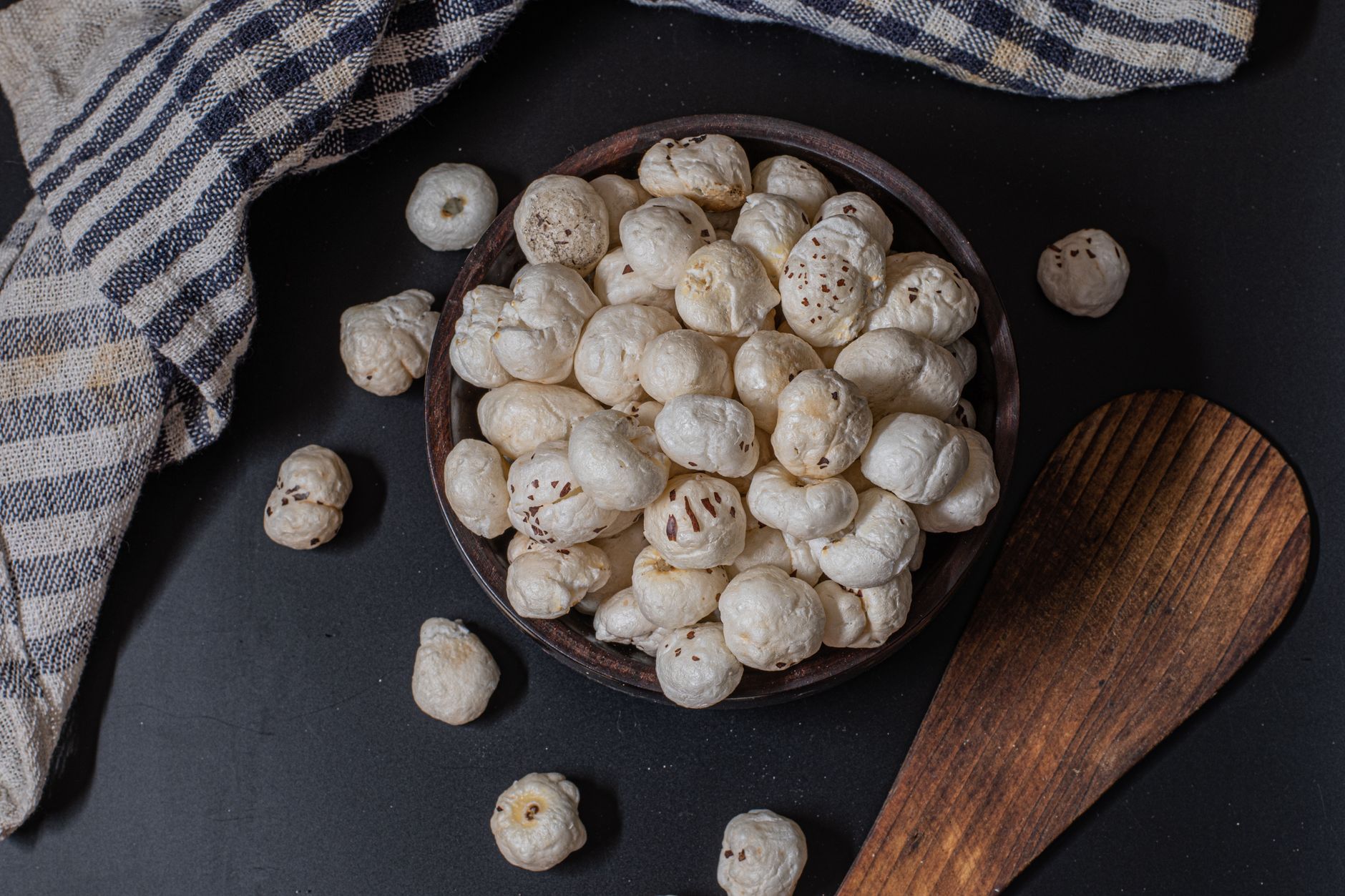
Walk into any premium grocery aisle in Mumbai, Dubai or New Jersey and you will find them: crisp white puffs in resealable pouches, flavoured with peri-peri, cheese, or pink Himalayan salt, sold at prices that would have stunned a Bihar farmer a decade ago. This is the makhana boom — the unlikely rise of a humble aquatic seed, traditionally roasted at home and eaten during fasts, into one of India's hottest health-food exports. Behind every airy puff lies a story of muddy ponds, back-breaking labour, clever branding and a government betting big on a single crop.
What Makhana Actually Is
Makhana goes by many names — fox nut, gorgon nut, lotus seed, Euryale ferox — but it is none of those things in the everyday sense. It is the seed of a prickly water lily that grows in stagnant ponds and wetlands, its huge floating leaves studded with thorns. The plant flowers underwater, then drops its seeds to the muddy bottom, where they sit through the cycle of monsoon and dry season.
Those raw seeds are small, hard and unappetising. The familiar white puff is the result of a labour-intensive transformation: the seeds are cleaned, sun-dried, graded by size, and then roasted in hot pans before being struck — often by hand — at exactly the right moment so the kernel pops out of its black shell, expanding several times in volume. Larger, whiter, more uniform pops fetch the highest grades and prices. It is closer to popcorn-making than to harvesting a nut, and the skill involved is one reason makhana long resisted full mechanisation.

Why Bihar Owns This Crop
The vast majority of the world's makhana comes from a single Indian state: Bihar, and within it the Mithila region around districts like Darbhanga, Madhubani and Purnia. The geography is almost custom-built for it — a flat, flood-prone landscape laced with seasonal ponds and oxbow lakes left behind by shifting rivers. Water that is a curse for grain farmers is a blessing for an aquatic crop.
Historically the harvest has been the domain of the Mallah community of fishers and pond-divers. Collecting the seeds means wading into chest-deep, murky water and groping along the bottom by feel, sometimes diving repeatedly through a single day. It is exhausting, low-paid, and physically punishing work, with risks ranging from leeches and skin infections to the thorns of the plant itself. For generations this labour was invisible in the final product — a snack sold cheaply and credited to no one.
That anonymity is exactly what began to change. In 2022, Mithila Makhana received a Geographical Indication (GI) tag, formally tying the name and reputation of the product to its region of origin, much like Champagne or Darjeeling tea. A GI tag does not magically raise farmer incomes overnight, but it builds a brand, blocks imitators from misusing the name, and signals to buyers that this is a product with provenance worth paying for.
How a Fasting Food Became a Superfood
For most of its life makhana was a quiet ingredient. In North Indian kitchens it was simmered into kheer, tossed into rich gravies, or dry-roasted with a little ghee and salt as a snack permitted during Hindu fasting days, when grains are avoided. It was nutritious but unglamorous — the kind of thing your grandmother made, not something you posted online.
The rebrand into a global "superfood" rode a perfect wave of consumer anxieties. Makhana is light, low in fat, naturally gluten-free, and a reasonable source of plant protein and minerals. It is crunchy and satisfying without being fried, which let marketers position it as the guilt-free answer to chips and namkeen. For the wellness crowd it ticked every box: vegan, ancient, Indian, and Instagrammable.
A word of honest caution is warranted here, because the hype outruns the evidence. Many sweeping health claims — that makhana dramatically controls blood sugar, reverses ageing, or melts fat — rest on small studies, animal research or traditional belief rather than robust human trials. What is fair to say is that, as a swap for deep-fried snacks, lightly roasted makhana is a genuinely sensible choice. As a magic cure, it is oversold. The smart way to enjoy it is as a tasty, low-calorie snack — not as medicine.
The Economics Behind the Puff
The makhana value chain is a textbook case of where the money actually sits. The farmer and the diver, who do the riskiest and hardest work, have traditionally captured the smallest slice. Most of the value is added later — in grading, roasting, flavouring, packaging and branding. A kilogram of raw seed that earns a pond-worker a modest sum can be transformed into flavoured retail packs worth many times more once a recognisable label is slapped on.
Startups and FMCG brands spotted this gap and rushed in, turning a commodity into a category. Slick pouches, bold flavours, urban gyms and e-commerce did the rest. Exports have climbed too, with Indian makhana reaching the Gulf, Southeast Asia, Europe and North America, often aimed first at the diaspora and then at curious local buyers looking for the next quinoa or chia.
The boom has also drawn the crop beyond Bihar. Farmers in other states, and even other countries, have begun experimenting with field-pond cultivation, where makhana is grown in shallow managed ponds rather than wild wetlands — a method that makes harvesting easier and yields more predictable. That expansion is good for supply, but it also threatens Bihar's near-monopoly and puts pressure on the value of the Mithila name.
The State Steps In
Recognising both the opportunity and the inequity, the government has moved to formalise the sector. In the 2025-26 Union Budget, the Centre announced a dedicated Makhana Board for Bihar, intended to organise farmers, improve processing, support marketing, and channel training and research into the crop. The political logic is hard to miss in an election-sensitive state, but the economic logic is sound: a fragmented, informal sector rarely captures full value on its own.
The practical questions are the ones that will decide whether the board matters. Can it push better roasting and grading technology to farmer collectives so they keep more of the margin? Can it protect the GI tag from dilution as cultivation spreads? Can it improve the lives of the divers whose labour underpins the entire trade, rather than simply enriching the brands at the top? A board can convene and fund; it cannot, by itself, rewrite who holds power in a supply chain.
What Comes Next
The near-term trajectory looks bright. Demand is rising, flavours keep multiplying, and makhana is creeping out of the snack aisle into breakfast cereals, energy bars, baking and even pet treats. Mechanised popping and pond cultivation promise to ease supply bottlenecks and stabilise prices.
The risks are equally real. A commodity boom can flip to glut if too many growers pile in; quality can suffer as cheaper, mechanically popped seed floods the market; and the romance of "Bihar's pond superfood" fades fast if the people in those ponds remain the poorest link in the chain. The crop's deeper promise is not just a trendy snack but a model — proof that a low-input, climate-suited, water-loving crop from one of India's poorer regions can earn global money.
For now, the next time you tear open a pouch of peri-peri fox nuts at your desk, it is worth a moment's thought. That airy, weightless puff travelled from the bottom of a muddy Bihar pond, through a diver's hands and a roaster's pan, to your snack drawer. Few foods carry their whole geography quite so lightly.