Photo: Antonio Moura / Pexels
The Moon's Biggest Crater Was Carved by a North-to-South Strike
Around 4.25 billion years ago, an object roughly the width of England slammed into the far side of the Moon, struck at a glancing angle, and tore a wound so vast it is still the biggest crater anyone has found anywhere in the inner Solar System. New computer simulations have now reconstructed that collision blow by blow — and they reveal something that changes where astronauts should go digging for the Moon's deepest secrets.
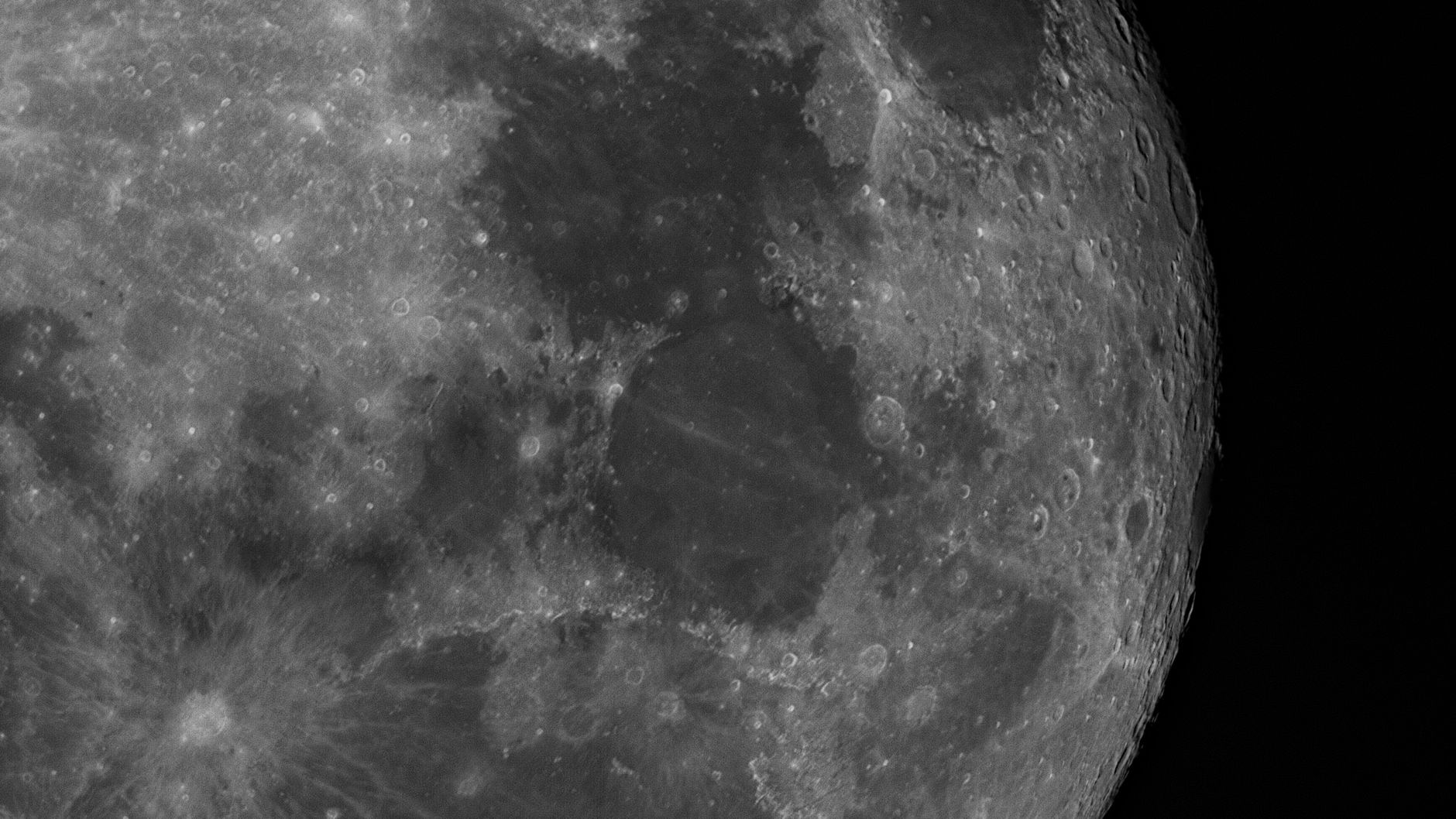
The story centres on the South Pole-Aitken basin, the Moon's largest crater, a scar more than 2,000 kilometres across and up to about 8 kilometres deep. It is so large that it spans the distance from the lunar south pole almost to the equator. For decades scientists agreed it was old and enormous. What they could not agree on was how exactly it formed, and which direction the killer blow came from. A pair of studies published in Science Advances on 8 May 2026 has now filled in those blanks with startling precision.

A glancing blow from the north
Using high-resolution three-dimensional models, the research team ran the impact again and again on a supercomputer until the simulated crater matched the real one. The best fit was sobering. The impactor was about 260 kilometres wide — not a tidy lump of rock but a differentiated body, meaning it had already separated into a dense iron-rich core wrapped in rocky layers, like a miniature planet.
It came in fast, at roughly 13 kilometres per second, and crucially it hit at a shallow angle of around 30 degrees rather than straight down. The trajectory ran from north to south across the lunar far side. That single detail — the direction of travel — turns out to matter enormously, because an oblique strike does not spread its debris evenly. It throws material forward and sideways, leaving a lopsided fingerprint across the surface.
The butterfly-shaped spray of mantle rock
When an object that big hits that hard, it does not just gouge a hole. It punches through the crust and flings up rock from deep inside the Moon — the mantle, the layer scientists most want to study because it holds clues to how the Moon formed and cooled.
The simulations show the ejected mantle material settling in a butterfly-like pattern, with two broad wings of debris splayed out around the basin. The numbers are specific:
- Mantle material reached roughly 550 kilometres beyond the rim in the downrange direction (the way the impactor was travelling).
- It spread about 650 kilometres to either side, across the line of impact.
- Almost no mantle rock landed uprange, behind the point of impact — a telltale blank zone that oblique strikes always leave.
In total, the collision is estimated to have thrown out about 4.2 million cubic kilometres of mantle material. Some of it piled up in layers a few hundred metres thick; in certain spots the deep rock may sit in deposits close to 3 kilometres thick. That is an extraordinary amount of the Moon's interior, hauled to the surface in seconds and left lying there for billions of years.
Why this rewrites the treasure map
Here is the part that makes planetary scientists sit up. If you know which way the impactor was travelling, you know which way the mantle debris flew. And if you know that, you know exactly where to walk to pick up a piece of the Moon's interior without drilling kilometres into solid rock.
The modelling suggests the lunar mantle could lie within reach near the south pole, with an average thickness of about 350 metres of mantle-rich material across parts of the region that future missions are eyeing. For a geologist, that is the difference between a quick scoop and an impossible excavation.
The work came out of the Center for Lunar Origin and Evolution, led by the Southwest Research Institute under Dr William Bottke, with the companion papers led by Dr Shigeru Wakita of Purdue University and Dr Gabriel Gowman of the University of Arizona. Their two studies tackle the impact and its aftermath from different angles, but they point to the same conclusion: the South Pole-Aitken basin is not a random mess. It is a readable record, and the writing runs north to south.
How we know it is so old
The age that anchors all of this — 4.25 billion years — is not a guess from the simulations. It comes from actual Moon rock. In June 2024, China's Chang'e-6 mission became the first ever to bring samples home from the lunar far side, scooping up nearly 1,935 grams of soil from within the basin itself.
When a team led by Prof Chen Yi at the Chinese Academy of Sciences analysed those grains, the chemistry pinned the basin's birth to roughly 4.25 billion years ago — a time when the Moon was barely 300 million years old and the Solar System was still a shooting gallery of debris. That date makes the South Pole-Aitken basin a foundation stone for the entire timeline of cratering across the Moon, and by extension the inner planets.
What Artemis could bring back
All of this lands at a pointed moment. NASA's Artemis III crewed landing, currently targeted for around 2028, is aimed squarely at the lunar south pole — the very region the new models say is carpeted with deep mantle rock thrown out by the ancient impact.
The researchers go so far as to suggest that Artemis III astronauts may set down inside the ejecta blanket that holds excavated mantle material. If they do, a routine sample collection could hand scientists pieces of the Moon's interior that have sat exposed since before life began on Earth. That would let researchers test the simulations directly — checking whether the predicted ages and compositions hold up against rock you can put under a microscope.
A few things are worth keeping in proportion. These are models, not eyewitness accounts, and the exact figures will be refined as more far-side samples come back. The 30-degree angle, the 13-kilometre-per-second speed and the 260-kilometre impactor are the best-fitting values, not certainties carved in stone.
The bigger picture
What makes this discovery quietly thrilling is how much it packs into one event. A single collision, in the Moon's infancy, dug the deepest hole in our corner of space, splashed the Moon's own guts across its surface, and left a coded map of where to find them. For most of human history that map was unreadable. Now, with samples in hand and supercomputers doing the forensics, we can trace the arc of debris back to the direction the blow came from.
The next chapter may be written by astronauts. If a crew steps onto the south pole later this decade and scoops up a handful of grey soil, there is a real chance they will be holding a fragment of the Moon's mantle — rock that was buried more than a hundred kilometres deep until one catastrophic morning 4.25 billion years ago flung it into the light.