
Photo: Andrea Prochilo / Pexels
How to Read a Red-Carpet Look: Fabric, Cut and Jewels
Every awards season, the same scene repeats. A star steps out of a car, the cameras fire, and within minutes the internet has decided whether the look is a triumph or a miss. What most viewers react to is a feeling. What stylists actually see is a set of decisions: a fabric chosen for how it behaves under light, a silhouette engineered to shift proportion, and accessories placed to guide the eye. Once you know how to read red-carpet glamour at that level, you stop scrolling past the pictures and start understanding them.
The good news is that the grammar is learnable. The same principles that govern a Cannes gown or a Met Gala suit apply to what you wear to a wedding or a reception. Here is how the pieces fit together.
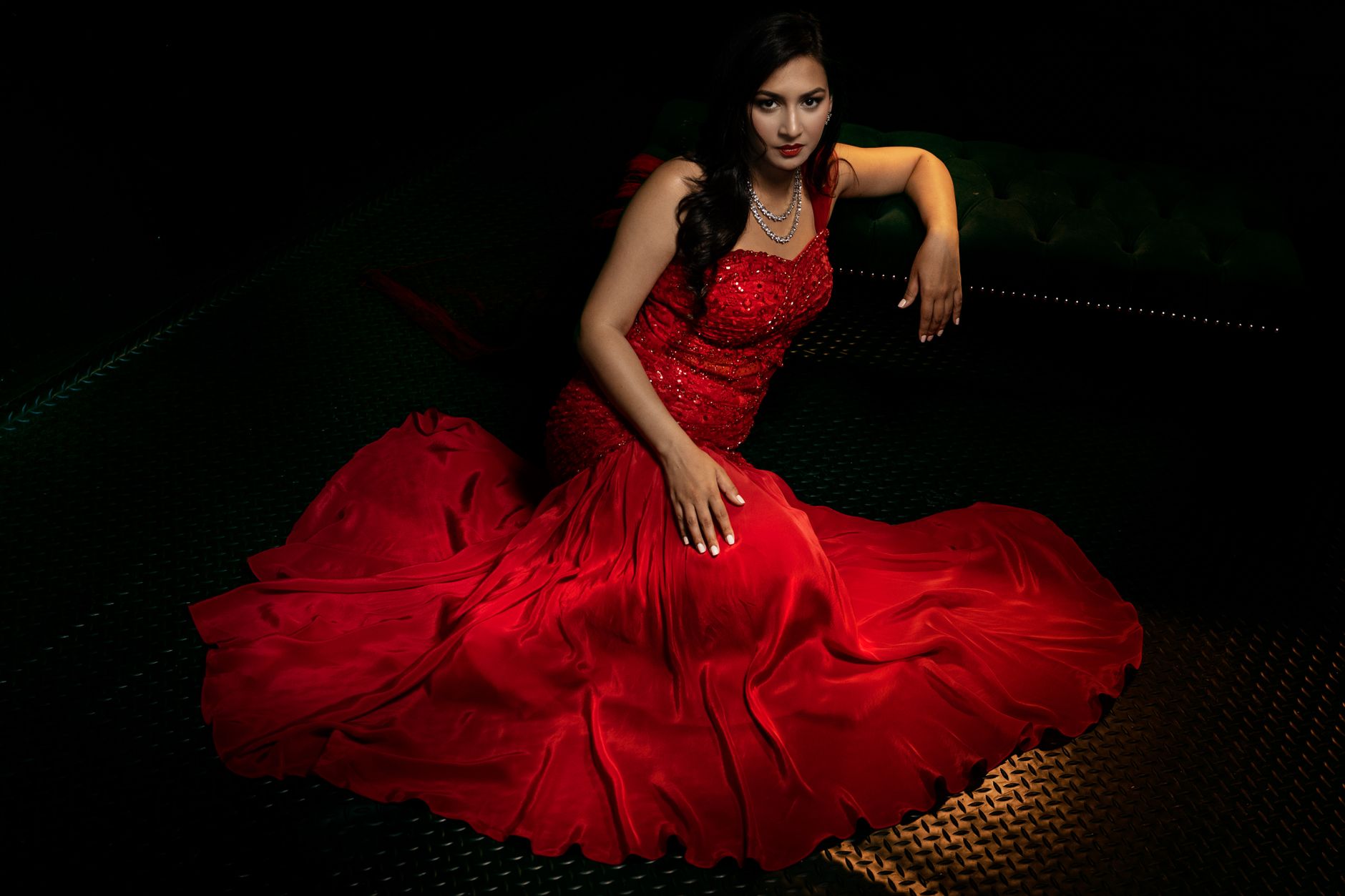
Fabric Sets the Mood Before Anyone Speaks
Fabric is the first decision and the loudest one. It dictates how a garment moves, how it photographs, and what emotion it carries. A stylist will often pick the textile before settling on the shape, because the cloth decides what the shape can even do.
Think of it in broad families:
- Structured fabrics — silk satin, faille, mikado, heavy crepe — hold their own shape. They build sculptural gowns and sharp tailoring, and they read formal and commanding. Aishwarya Rai Bachchan's all-white tuxedo-style closing-ceremony look at Cannes 2026 leaned on exactly this kind of structure.
- Fluid fabrics — chiffon, georgette, charmeuse, fine silk — pour over the body and move with the wearer. They read soft, romantic, sensual.
- Volume fabrics — organza, tulle, taffeta — trap air and create drama. Crinkle organza layered over lace, as used in one of Alia Bhatt's Cannes 2026 ball gowns, is how designers get a skirt that floats rather than droops.
- Texture fabrics — velvet, lamé, sequined mesh — play with light. Velvet swallows it for richness; sequins and zari throw it back at the cameras.
The quickest tell of a high-end look is how the fabric reacts to flashbulbs. Cheap synthetics flare into a flat white blob. Good silk, beaded tulle and real zari scatter light into depth. That difference is why couture houses spend on textile, not just embellishment.

Silhouette Is Really About Proportion
Most people describe a silhouette by its category — column, ball gown, mermaid, jumpsuit, suit. That is the vocabulary, but the actual work is proportion: where the waist sits, where volume gathers, and where the eye is told to land.
A column gown lengthens. A mermaid holds the body close to the knee then explodes, drawing attention to movement. A ball gown trades on contrast — a tiny defined waist against a vast skirt. A well-cut tuxedo or trouser look, the kind that ruled the 2025 Met Gala's "Tailored for You" dress code, uses sharp shoulders and a clean line to signal control rather than softness.
The principle underneath all of them is balance. Volume on the bottom usually wants restraint on top. A heavily worked bodice often pairs with a plain skirt. When a gown feels "off" even though every element is expensive, it is almost always a proportion problem — two areas competing for attention, or a waistline placed where it shortens the frame.
This is also where Indian designers have quietly rewritten the rulebook. Tarun Tahiliani's concept saree at the Bharat Pavilion in 2026, which married Victorian corsetry to a chanderi dhoti skirt and traditional drape, is a clean example of borrowing Western structure to hold up an Indian silhouette. The corset does the engineering; the drape does the storytelling.
Colour and Light Do Half the Work
Colour on the red carpet is chosen for the venue, not the living room. Stage lighting and camera flash flatten some shades and electrify others. Pure white and ivory photograph crisp and architectural, which is why so many statement looks go monochrome. Deep jewel tones — emerald, sapphire, oxblood — read luxurious on camera because they hold shadow and depth.
Metallics and embellishment are a separate calculation. A fully beaded gown is essentially built to perform under flash, every sequin acting as a tiny mirror. The risk is that heavy sparkle can overwhelm the cut, so designers often anchor it with a simple shape. Embellishment and silhouette rarely both get to shout.
The other quiet variable is skin and hair against the fabric. Stylists pick shades that lift the wearer's complexion under harsh light, which is why the "perfect" colour on a carpet sometimes looks unremarkable on a hanger.
Accessories Finish the Sentence
If fabric and silhouette write the sentence, accessories are the punctuation. Their job is to complete the thought, not start a new one. The most common mistake — at every level, from college farewells to film festivals — is treating accessories as additions rather than edits.
A reliable way to read them:
- Find the focal point. A great look usually has one hero accessory — a chandelier earring, a sculptural cuff, a single dramatic neckpiece. Everything else steps back.
- Check the neckline conversation. A high or covered neckline frees the ears for big earrings. A plunging or strapless neckline invites a necklace. Doing both at full volume usually crowds the face.
- Match the metal and mood to the fabric. Antique gold and polki sit naturally with silk and zari; cool platinum and diamonds suit sharp tailoring and cool-toned gowns.
- Mind the scale. A vast ball gown can carry heavy jewels; a fluid slip dress is usually overpowered by them.
For Indian red-carpet looks, jewellery often carries the heritage signal — uncut polki, temple gold, emeralds — even when the silhouette is fully Western. That contrast, traditional stones against modern construction, is a deliberate effect, not an accident.
How to Tell Couture From Off-the-Rack
Viewers often ask why one gown costs a fortune and another, which looks similar, does not. The answer is in the parts you cannot see in a thumbnail.
Look for internal structure — boning, built-in corsetry, hand-stitched canvas — that lets a gown hold a shape without the body straining. Look for fabric that drapes cleanly with no puckering at the seams. Look at where embellishment sits: couture beadwork follows the body's curves and the garment's lines, while mass-produced sparkle is often applied in flat, even fields. And look at fit. The single biggest giveaway of luxury is a garment that looks moulded to one specific person, because it usually was.
This is the real meaning of a "custom" credit. When a label builds a corset bodice and drapes chiffon into a skirt for one wearer, as several designers did for Cannes 2026 debutants, the value is in the engineering as much as the cloth.
Reading a Look Like a Stylist
Put it together and you can assess almost any red-carpet picture in under a minute. Run through it in order:
- Fabric: Is it structured, fluid, voluminous or textured — and does it suit the mood the wearer is going for?
- Silhouette: Where is the waist, where is the volume, and where does my eye land first?
- Proportion: Is one area doing the talking, or are two areas fighting?
- Colour and light: Does the shade lift the wearer, and is sparkle balanced against the cut?
- Accessories: Is there a single hero piece, or a pile-up?
A look that earns the headlines almost always passes all five. The fabric, the cut and the jewels are telling one story instead of five different ones. That coherence is what we register as "effortless," even though it is the result of a dozen careful choices.
The next time a carpet lights up your feed, skip the instant verdict. Read the fabric first, then the shape, then the punctuation. You will find you can explain why a look works long before the captions tell you it did — and you will dress a little smarter for your own big nights, too.