Photo: Pablo Araujo / Pexels
Train to Kashmir: Inside India's Sky-High Himalayan Railway
For most of independent India's history, reaching the Kashmir Valley by rail was impossible. You took a train as far as Jammu, then surrendered to the road — a winding, landslide-prone crawl over the Pir Panjal mountains that could turn a four-hour drive into a full day of white knuckles. That era is over. The train to Kashmir now runs straight into the Valley, gliding across gorges on bridges that rank among the boldest pieces of engineering anywhere in the world. For travellers, it is one of the most dramatic rail journeys you can take on the subcontinent. For the Himalaya, it quietly rewrites the rules of who gets to go there, and how.
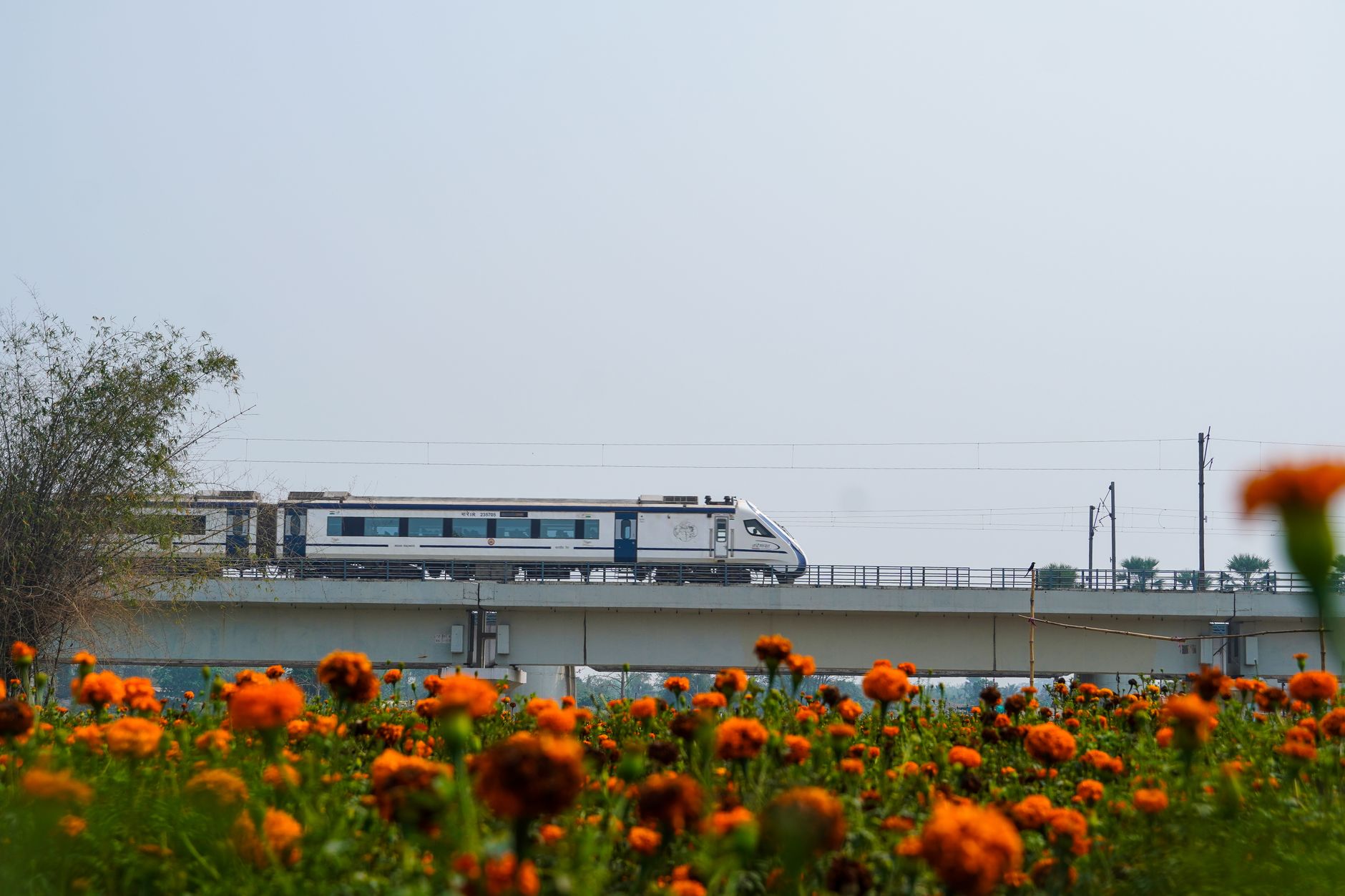
The train to Kashmir that took three decades to build
The line that made this possible is the Udhampur–Srinagar–Baramulla Rail Link, usually shortened to USBRL. It stretches roughly 272 kilometres through some of the most punishing terrain in the country, knitting the Kashmir Valley into India's national rail network for the first time. The project was conceived in the 1990s and declared a national priority in the early 2000s, which gives you a sense of how stubborn the geography was. Engineers spent years not laying track but simply figuring out where track could survive — mapping fault lines, fragile slopes and rock that crumbles when you look at it the wrong way.
The full route was completed in stages, with the final and hardest section formally opened in mid-2025. What had been a patchwork of disconnected segments became a single continuous ride from the plains up to Srinagar and on to Baramulla. The headline isn't just that the train arrives in Kashmir. It's that it does so by performing feats most railways never attempt.

A bridge taller than the Eiffel Tower
The centrepiece is the Chenab Bridge, now recognised as the world's highest railway arch bridge. Its deck sits roughly 359 metres above the bed of the Chenab river — comfortably higher than the Eiffel Tower, which tops out around 330 metres. Standing on a train as it crosses, you are suspended in open Himalayan air, the river a thin silver thread far below and the steel arch curving beneath you like the spine of some enormous animal.
What makes the bridge remarkable isn't only its height. It was engineered to stand in a severe seismic zone, to shrug off extreme wind, and — in a detail that says everything about the region — to keep functioning even in scenarios involving blasts. The single steel arch had to be assembled across a chasm with no easy ground to build from, using cable cranes strung between the canyon walls. The result looks almost delicate from a distance, yet it is built to last well over a century.
The Chenab Bridge gets the photographs, but it has a quieter sibling that is just as significant. The Anji Khad Bridge is India's first cable-stayed railway bridge, a single tall pylon fanning out steel cables to hold the deck where a conventional bridge simply could not be founded. Together, the two crossings solve problems that had defeated planners for years.
Engineering against the Himalaya
Bridges are the visible drama; tunnels are the hidden one. A huge share of the route runs underground, because in young, folding mountains it is often safer to bore through a ridge than to cling to its outer face. The line includes some of the longest transport tunnels in the country, and building them meant fighting water that gushed in unexpectedly, rock that shifted under pressure, and ventilation challenges deep inside the range.
The Himalaya are geologically young and still rising, which makes them beautiful and treacherous in equal measure. Slopes that look solid can liquefy in a heavy monsoon. Faults run in directions that don't appear on old maps. Engineers responded with slope stabilisation, drainage systems and constant monitoring, treating the mountains less as a backdrop and more as a living opponent that had to be negotiated with at every kilometre. The achievement here is not that humans conquered the range — the Himalaya don't get conquered — but that they found a way to coexist with it on rails.
A Vande Bharat built for snow
Getting the track laid was only half the battle. A train running into Kashmir has to survive a Valley winter, where temperatures plunge well below freezing and snow can bury everything. The semi-high-speed Vande Bharat trains introduced on this route were specially adapted for the cold: heated systems to keep the air breathable and comfortable, anti-freeze arrangements to stop water systems from seizing, and windscreen heating so drivers can actually see through a blizzard.
These are the unglamorous details that decide whether a service is a novelty or a lifeline. A train that strands passengers in a snowdrift helps no one. By contrast, a climate-hardened train that runs reliably through December turns the railway into genuine year-round infrastructure — the difference between a scenic experiment and a working artery.
What the journey actually looks like
For the traveller, the experience is a steady crescendo. You leave behind the flat, dusty plains and begin climbing, the landscape tilting upward until pine forests and terraced fields replace farmland. The train threads in and out of tunnels, so the view comes in bursts — sudden flashes of gorge and ridge between long stretches of mountain dark, each emergence brighter and more vertiginous than the last.
Then comes the Chenab crossing, the moment everyone waits for, when the carriage seems to float over nothing at all. By the time the line spills into the Valley, the air has changed, the light has softened, and Srinagar's chinar trees and the distant shoulders of the mountains feel close enough to touch. Compared with the old road journey — exhausting, weather-dependent and frequently shut by landslides — the train is calm, climate-controlled and astonishingly steady for the heights it conquers.
Why it matters beyond tourism
It is tempting to file this under bucket-list travel, and it absolutely deserves a place there. But the deeper story is about access. For Valley residents, an all-weather rail link means apples and other produce can reach distant markets faster and fresher, medical travel becomes less of an ordeal, and the Valley is no longer cut off every time a highway is blocked by snow or rock. A region that has long felt its remoteness as both protection and burden is now a train ride from the rest of the country.
There is a tension worth naming, too. Easier access tends to bring more visitors, and more visitors put pressure on fragile mountain ecosystems and on the character of places that were hard to reach precisely because they were hard to reach. How Kashmir manages that surge — whether it spreads tourism thoughtfully or lets it concentrate and overwhelm — will shape the Valley's next decade as much as any bridge does.
What comes next
The railway is unlikely to stop at the Valley floor. Indian planners have long eyed extensions deeper into the mountains, including the formidable ambition of pushing rail toward Ladakh — a project that would dwarf even this one in difficulty, climbing to altitudes where steel and human beings alike struggle to function. Whether that arrives in years or decades, the precedent has been set: the Himalaya are no longer automatically off-limits to the railway.
For now, the train to Kashmir stands as proof of something simple and stirring. A journey that generations treated as a frontier — the kind you endured rather than enjoyed — has become one of the great rides on Earth. You board on the plains, you cross a bridge taller than the Eiffel Tower, and you step off in a valley that poets have spent centuries trying to describe. Few train tickets buy you that much wonder.