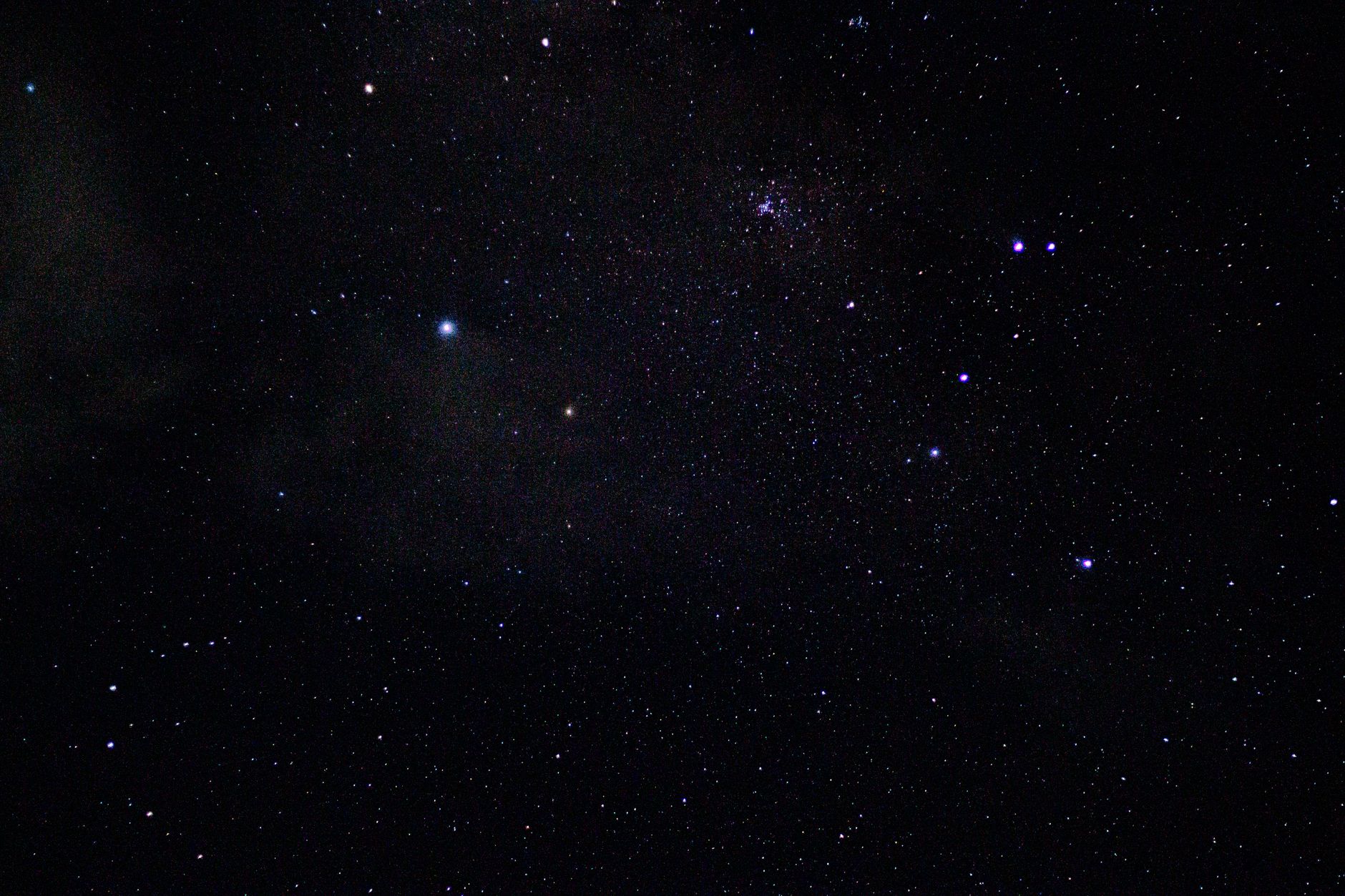
Photo: Francisco Ferreira / Pexels
Webb Just Found a 12.5-Billion-Year-Old Fossil of Our Galaxy
Astronomers have just identified a genuine fossil of our own galaxy. Using the James Webb Space Telescope, a team has confirmed that a crowded knot of stars called Terzan 5 is not an ordinary star cluster at all, but a surviving fragment of the very material that built the Milky Way's core some 12.5 billion years ago — when the universe itself was barely an infant.
The object now carries a name that sounds like science fiction but is entirely real: a bulge fossil fragment. It is, in effect, a piece of the early galaxy that refused to disappear, frozen in place while everything around it merged and mixed over billions of years.

A relic hiding in plain sight
Terzan 5 was first spotted back in 1968 and quietly filed away as a globular cluster — one of those tightly bound balls of old stars that orbit galaxies by the hundreds. For decades it sat in the catalogues, unremarkable on paper, mostly because nobody could see it clearly.
The problem is location. Terzan 5 lies roughly 19,000 to 22,000 light-years away toward the constellation Sagittarius, buried in the dense, dust-choked region at the center of the Milky Way known as the galactic bulge. Thick clouds of interstellar dust block ordinary visible light, smearing out the details. To telescopes for most of the last half-century, it was a fuzzy smudge in one of the most crowded neighborhoods in the sky.
That is exactly the kind of problem Webb was built to solve.

How Webb cracked it open
Webb sees in near-infrared light, which slips through dust that stops visible light cold. Using its NIRCam instrument, the team finally resolved individual stars inside Terzan 5, separating them from the chaotic swarm of bulge stars in the foreground and background.
The second trick was time. Researchers paired Webb's fresh observations with archival images from the Hubble Space Telescope taken about 12 years earlier. Over that gap, stars shift their apparent positions by tiny amounts — their proper motion. By measuring those minuscule movements, the team could tell which stars genuinely belong to Terzan 5 and which were just passing through the same patch of sky.
That clean separation is what made the real discovery possible.
Four generations of stars in one place
Globular clusters are supposed to be simple. The classic picture is a single batch of stars, all born around the same time from the same cloud of gas. Terzan 5 broke that rule completely.
The combined Webb and Hubble data revealed four distinct stellar generations, born billions of years apart:
- 12.5 billion years ago — the original population, almost as old as the cosmos itself
- 4.7 billion years ago
- 3.8 billion years ago
- 2.5 billion years ago
That spread is the smoking gun. A simple star cluster cannot keep forming new stars across roughly ten billion years. To do that, an object needs to be massive enough to hold onto its gas even after generations of supernova explosions blast energy and heavy elements outward. Each new generation here was enriched by the deaths of the stars before it — a self-contained cycle of birth, death and rebirth running for almost the entire age of the universe.
In other words, Terzan 5 behaved like a tiny galaxy unto itself.
Why "fossil fragment" is the right word
Here's the part that makes this a wow story rather than a footnote. According to the leading theory, the Milky Way's central bulge wasn't built smoothly. It assembled from giant primordial clumps of gas and stars that formed in the young universe and then sank toward the center, smashing together to create the dense core we see today.
Most of those clumps were torn apart and folded into the bulge long ago, their identities erased. Terzan 5 appears to be one that survived — battered, stripped down, but recognizably intact. As the research team put it, it resembles the very building blocks that made the bulge. That is why they call it a bulge fossil fragment: a literal surviving sample of the galaxy's construction material.
Think of it as finding an original brick from a building that was supposedly demolished and rebuilt thousands of years ago, still sitting in the foundation.
It once weighed far more than it does now
Today Terzan 5 holds around two million times the mass of the Sun, packed into a region only a few tens of light-years across. Impressive — but it's a shadow of its former self. Studies of its chemistry suggest the original progenitor was vastly heavier, potentially hundreds of times more massive, before billions of years of gravitational stripping wore it down.
That lost bulk is the point. Only something that started enormous could have retained its gas long enough to keep forming stars across ten billion years. The two-million-solar-mass remnant we see is essentially the dense, stubborn heart of a much larger primordial object that the galaxy never finished digesting.
A class of exactly two — so far
Terzan 5 is now considered the prototype of bulge fossil fragments, but it is not entirely alone. A second object, Liller 1, also sits in the bulge and shows the same telltale signatures: multiple stellar generations, multiple chemical compositions, and the look of a survivor rather than a typical cluster.
Two confirmed examples is a small sample. But it's enough to suggest these relics are a genuine category of object, not a one-off fluke. If more are hiding in the dust-shrouded center of the galaxy, Webb is the instrument most likely to find them — and each one would be another preserved chapter from the era when the Milky Way was still taking shape.
What this changes
The study, led by Giorgia Zullo of the University of Bologna and published in Astronomy & Astrophysics, does more than reclassify one object. It hands astronomers a rare, direct line of evidence about how galactic bulges form — a process that usually has to be inferred from distant galaxies seen as tiny smudges across billions of light-years.
Here, the evidence is on our doorstep, inside our own galaxy, readable star by star. Terzan 5 lets researchers test their models of cosmic assembly against a real surviving specimen instead of a simulation.
The next steps are clear: comb the bulge for more fossil fragments, refine the ages and chemistry of the stars already found, and pin down exactly how these clumps sank and merged. For now, the headline fact is enough to sit with. Twenty-odd thousand light-years away, behind a curtain of dust, there's a clump of stars that watched the Milky Way being born — and is still there to tell the story.