Berrettini vs Arnaldi: Italy's All-Italian Roland-Garros QF
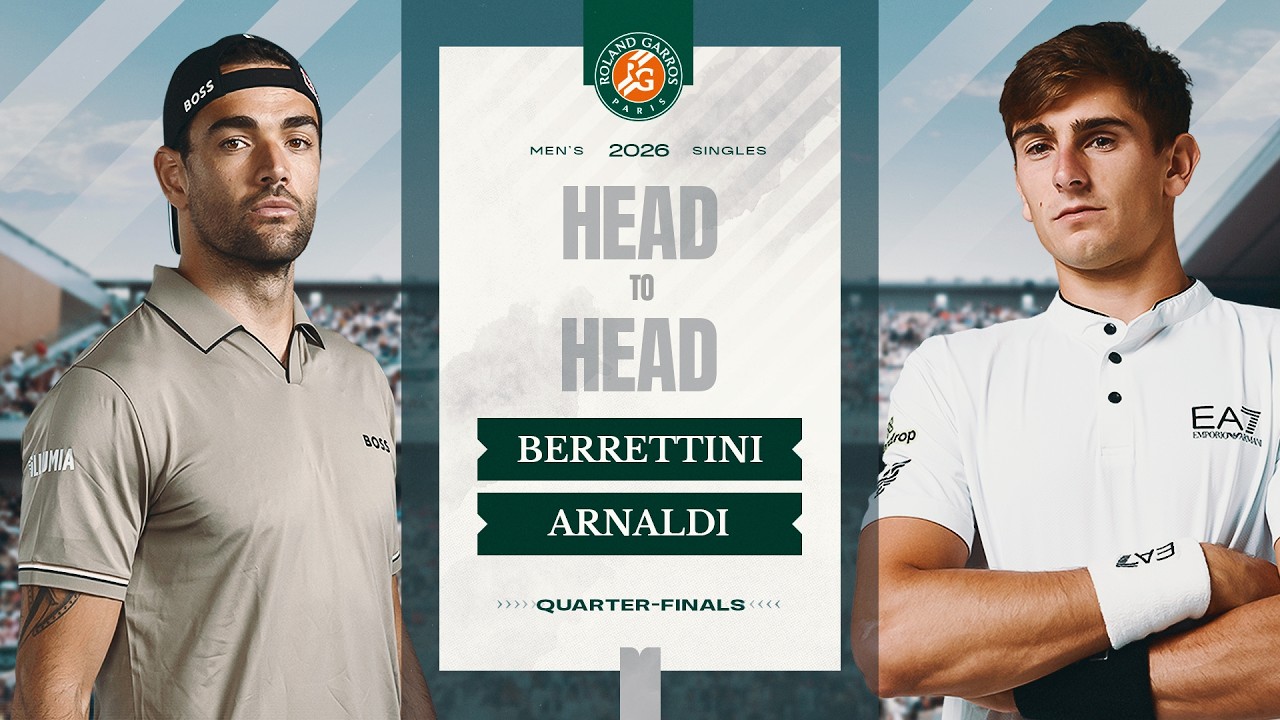
A simple head-to-head preview clip for a Roland-Garros quarter-final has become an unlikely talking point, and the reason says more about modern tennis than about the two-minute video itself. The match it teases is an all-Italian last-eight tie at the French Open between Matteo Berrettini and Matteo Arnaldi — two players who share a first name, a passport, and a place in what has quietly become the sport's most talked-about national story. For viewers far beyond Italy, including a growing tennis audience in India, the clip is a doorway into a bigger shift: clay-court tennis is no longer dominated by the old guard, and Italy is suddenly everywhere.
Why the Berrettini vs Arnaldi clip is trending
On the surface, a federation-style Berrettini vs Arnaldi preview is routine promotional material — short, clean, designed to be shared. What pushes it into people's feeds is the matchup it frames. A Grand Slam quarter-final that guarantees an Italian in the semis is a headline in itself, and the novelty of two Matteos facing off makes it irresistible for clipping and captioning.
There is also an algorithmic logic at work. Short, high-production tennis previews travel well on autoplay because they need no commitment from the viewer, and a marquee surname like Berrettini pulls in casual fans who may not follow the tour week to week. The result is a clip that over-performs relative to its modest format.
It is worth being precise about what the video actually is. It is a buildup/preview, not match footage, so it tells you the fixture exists and sells the storyline — it does not reveal a result. Anyone treating it as evidence of how the contest played out is reading more into it than the clip contains.
Who are the two Matteos
Matteo Berrettini is the established name. Born in Rome in 1996, he announced himself on the world stage by reaching the 2021 Wimbledon final, a rare feat for an Italian man in the modern era, and climbed into the world's top handful of players at his peak. A booming serve and a heavy forehand made him a threat on faster surfaces, and his charisma turned him into one of the tour's most marketable figures.
What complicates his story is his body. Berrettini's career has been repeatedly interrupted by injuries, and long absences cost him ranking points and rhythm. Each time he has returned, the question has been the same: can he rediscover the level that took him deep at the majors? A clay-court run to a quarter-final is exactly the kind of result that answers it.
Matteo Arnaldi sits at the other end of the arc. Born in 2001 and raised in Sanremo, he broke through more recently, grinding his way up the rankings and into the top tier of the tour over the past couple of seasons. He is a different kind of player — quick, scrappy, comfortable in long rallies — and the type of competitor who tends to thrive on the patience that clay demands.
Clay, and why this is a surprise
For most of tennis history, Italian men were respected on clay but rarely contenders at the very top of the majors. The surface rewarded Spaniards, South Americans and a handful of specialists, while Italy's deepest runs came in spurts rather than as a pattern. That historical backdrop is what makes an all-Italian quarter-final at Roland-Garros feel genuinely new.
Clay is the great equaliser and the great examiner. Points last longer, serves matter less, and matches are won by movement, shot tolerance and the willingness to stay in a rally one ball longer than your opponent. A player like Berrettini, whose game leans on first-strike power, has to adapt; a player like Arnaldi, built for the grind, is in many ways at home.
That contrast is the real drama beneath the preview. It is power versus persistence, pedigree versus momentum, the established star versus the hungry climber — and the slow surface tends to amplify exactly those differences.
Italy's golden generation
The deeper reason this fixture resonates is context. Italy is enjoying the strongest period in its tennis history, and the names go well beyond these two. The headline act is Jannik Sinner, who reached world No. 1 and turned Italy into a country that now expects to contend at every Grand Slam rather than hope to.
Around him sits unusual depth. Consider what makes the Italian wave different:
- A genuine world No. 1 in Sinner, giving the country a true superstar.
- A clay-comfortable shot-maker in Lorenzo Musetti, equally at home in Paris.
- A proven big-stage performer in Berrettini, when fit.
- A rising cohort, including Arnaldi, pushing from just behind.
- A strong domestic structure of academies, coaching and federation support feeding the pipeline.
No single result built this; it is a system producing players in volume. An all-Italian quarter-final is less a fluke than a statistical near-inevitability once a country has this many competitive bodies in the draw.
The public reaction
Fan response has split along familiar lines. Italian supporters have embraced the tie as a feel-good guarantee — whatever happens, the flag advances — while neutral fans have latched onto the Matteo-versus-Matteo curiosity as an easy, shareable hook. Online, the loudest debate is the obvious one: does Berrettini's experience outweigh Arnaldi's youthful momentum on a surface that flatters the latter?
There is sympathy in the mix too. Berrettini's injury history has made him something of a comeback figure, and many viewers are pulling for the elder Matteo simply because his career has been so often paused by misfortune. Arnaldi, by contrast, carries the lighter burden of the underdog who has nothing to lose.
For Indian tennis followers, the appeal is partly about the broader game. With no home singles star in the latter rounds of the majors, audiences here increasingly adopt storylines — and a rising-nation narrative, full of fresh names, is an easy one to invest in.
What may happen next
The honest answer is that a preview clip cannot tell you the winner, and it would be wrong to pretend otherwise. What can be said is that the survivor of this quarter-final walks into a Grand Slam semi-final, the kind of stage that defines seasons and reshapes rankings. For Berrettini, it would be powerful proof that he is fully back; for Arnaldi, it would be the biggest result of his career to date.
The wider trajectory is clearer than any single scoreline. Italy's strength in depth means these intra-national showdowns are likely to recur, at Roland-Garros and elsewhere, and the country looks set to remain a fixture in the business end of the majors for years.
A few honest caveats are worth keeping in mind:
- Rankings and form shift week to week, so treat any pre-match favourite label loosely.
- Injuries — central to Berrettini's story — can change a contest before it begins.
- The viral clip is promotion, not reporting; it sets the stage rather than settling it.
Stripped of hype, that is what the trend really captures: not a prediction, but a snapshot of a sport in transition, where a routine preview of two players named Matteo became a small symbol of how far and how fast Italian tennis has climbed.