Denmark vs DR Congo: Why This Friendly Is Trending
A friendly that no one circled on the calendar has quietly become one of the most-searched football fixtures of the week. Denmark vs DR Congo, played at the Stade Maurice Dufrasne in Liège, Belgium on 3 June 2026, is not a qualifier, not a tournament tie and not even a meeting of two long-time rivals — the two nations had never faced each other before. Yet live-stream links for it are racking up views on YouTube, especially among Indian fans hunting for any football to watch in the buildup to the World Cup. The reason it is resonating says as much about the modern football calendar as it does about either team.
The role reversal that makes this friendly fascinating
The hook here is a near-perfect inversion of expectations. Denmark — a fixture at recent major tournaments, semi-finalists at Euro 2020, and a side many Indian fans grew up rating above most African opponents — will not be at the 2026 World Cup. They were knocked out in the UEFA playoff final, losing on penalties to Czechia, a brutal way to miss a tournament being staged across the United States, Canada and Mexico.
DR Congo, by contrast, are going. The central African side, nicknamed the Leopards, secured qualification and now have a finals place to prepare for. So the script flips: the European team that should be sharpening for the World Cup is instead rebuilding, while the African team many casual viewers underrate is the one with a tournament to plan around. For neutral fans, that is an unusually juicy subplot for a June friendly.
Who is actually playing, and why now
The timing is no accident. International windows in late May and early June exist precisely so national teams can fine-tune before tournaments or reset after disappointment. Both coaches are using this match to experiment rather than chase a result.
- For DR Congo, it is a high-quality dress rehearsal. They are scheduled to play one final warm-up against Chile on 9 June before opening their World Cup campaign in Group K against Portugal (17 June), Colombia (24 June) and Uzbekistan (28 June) — a daunting draw that makes match sharpness against organised European opposition genuinely valuable.
- For Denmark, it is the first outing since the playoff heartbreak. With a friendly against Ukraine on 7 June to follow, the staff are widely expected to look at fringe players and younger options as they pivot toward the next Nations League cycle.
As of the latest updates, the contest was a tight, low-scoring affair, sitting at 0-0 around half-time — the kind of cagey, feeling-out friendly that the scoreline rarely captures fully. Because it is the first-ever meeting between the countries, even a goalless draw writes a fresh line into both nations' record books.
Why a low-profile friendly is blowing up on YouTube
Here is the part that genuinely matters for Indian readers. A match like this almost never lands on a mainstream Indian sports channel. Broadcasters and streaming platforms pay for marquee leagues, big internationals and full tournaments; an off-calendar friendly between a non-qualifier and a qualifier rarely justifies a dedicated slot. That vacuum is exactly what unofficial "live match" YouTube channels rush to fill.
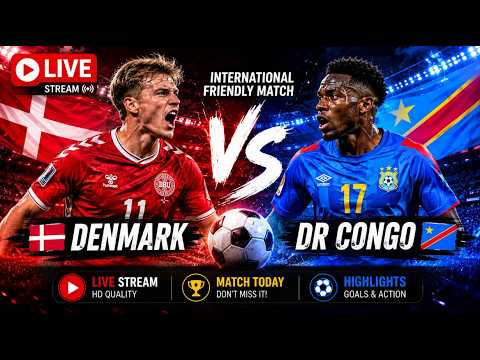
These channels thrive on a simple formula. They post a thumbnail with a red "LIVE" dot, both flags, and words like "Live Match Today" and "Highlights", then ride search demand from fans who can't find the game anywhere else. When a fixture is obscure enough that legitimate options are thin, these listings shoot up the results — which is precisely why this Denmark vs DR Congo stream is trending rather than, say, a Champions League final that everyone already knows where to watch.
It is worth being clear-eyed about what many of these streams actually are. A large share rebroadcast a feed they do not hold rights to, and the experience is often nothing like the title promises.
The risks behind "free live stream" links
Unofficial streams are not just a legal grey area; they can be an outright trap. Indian fans chasing a free feed should know the common pitfalls before clicking.
- Bait-and-switch content. Some "live" videos are loops of old highlights, a static scoreboard graphic, or a countdown that never delivers the actual match.
- Malware and shady ads. Pop-ups urging you to "install a player," "verify you're human," or download an app are a classic vector for malicious software and phishing.
- Scam redirects. Fake betting sign-ups, crypto giveaways and "claim your prize" pages frequently piggyback on these streams to harvest payment details.
- Sudden takedowns. Rights holders issue copyright strikes, so a stream can vanish at kickoff or mid-match, leaving you scrambling.
- Poor quality and lag. Buffering, low resolution and audio in an unrelated language are routine.
None of this means every link is dangerous, but the safest assumption is skepticism — never enter card details, never install prompted software, and treat any "too good to be true" overlay as exactly that.
How to watch football like this legally in India
The honest answer is that ultra-low-profile friendlies sometimes have no official Indian broadcaster at all, which is the root cause of the whole unofficial-stream economy. Still, fans have better options than a sketchy link:
- Check licensed sports platforms first. India's major sports broadcasters and their streaming apps carry most internationals that matter; search the fixture there before assuming it isn't available.
- Look at official federation and team channels. National federations and some clubs occasionally stream friendlies free on their verified YouTube or social pages — a legitimate version of what the pirate channels imitate.
- Follow live text and verified highlights. Sites and apps that offer minute-by-minute updates, plus official post-match highlight clips, are a safe fallback when no live feed is licensed locally.
- Mind the time difference. A Liège evening kickoff lands late at night in India, another reason fans hunt for on-demand replays rather than the live broadcast.
What this match — and the buzz around it — tells us next
Result aside, the bigger story is what this fixture signals. DR Congo's presence at the 2026 World Cup, and their willingness to test themselves against European sides in Europe, is part of a steady rise in African football's competitiveness — a trend Indian fans will see play out across Group K when the Leopards face Portugal, Colombia and Uzbekistan. Denmark, meanwhile, become a cautionary tale about how thin the margins are at the top: one shootout, and a tournament regular is reduced to a summer of rebuilding friendlies.
For India's football audience, the trend line is just as telling. As global football fragments across more platforms and more obscure windows, demand keeps outrunning legal supply — and that gap is what sends fans toward unofficial streams. The smarter response is not to chase every risky link, but to know where the legitimate feeds live, stay alert to scams, and treat a quiet June friendly for what it really is: a window into who is heading to the World Cup, who is watching from home, and how the rest of us actually get to see any of it.