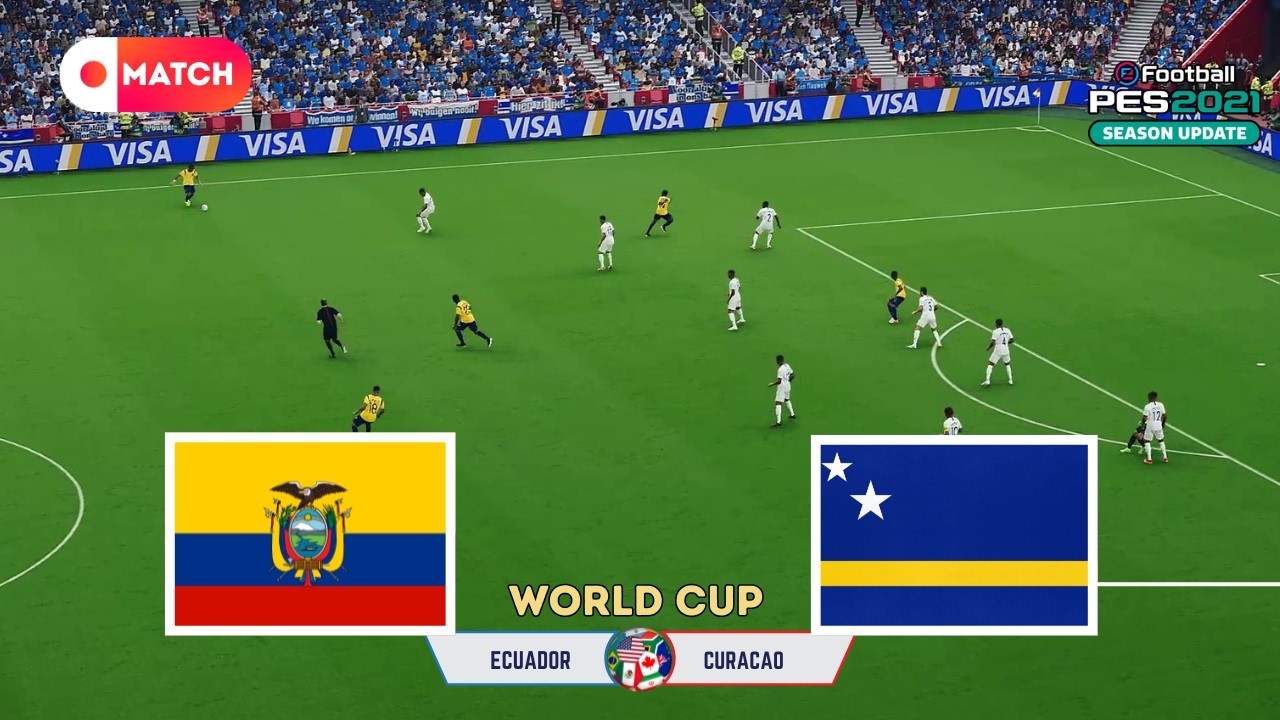
Why a Fake Ecuador-Curacao Match Is Lighting Up YouTube
A made-up football match is currently doing better numbers on YouTube than some real ones. A clip billed as Ecuador vs Curacao | World Cup 2026 Simulation, played out inside the eFootball PES 21 video game, has been racking up views, comments and shares from fans who know full well the clip is not a real match. It is a computer-generated contest, dressed up with kits, crowd noise and a scoreboard, and it is pulling people in anyway.
The pull is easy to understand once you see the genre for what it is. With the 2026 World Cup dominating sports talk, anything carrying those words in the title gets a lift from the algorithm. Channels that specialise in game-engine simulations have turned that into a reliable formula: pick a fixture people are curious about, let the game play it, and let the comments argue about whether the scoreline is fair. This particular matchup happens to sit on top of one of the most charming real-world stories of the entire qualifying cycle.
What the clip actually is
Strip away the presentation and this is a single match of a football video game, recorded and uploaded. The teams are controlled by the game's artificial intelligence, the ratings come from the developer's database, and the result is whatever the engine spits out that day. Run the same fixture again and you may get a completely different score.
That matters because the title leans on the phrase "realistic gameplay," which can read as a forecast. It is not. No simulation here is modelling form, injuries, travel or tactics from the real camps. It is entertainment built on a licensed-looking template, and the smart way to watch it is the same way you would watch a coin toss with nicer graphics.
The real story behind one of these names
Here is where the trend gets genuinely interesting. Curacao, a small Caribbean island that is a constituent country within the Kingdom of the Netherlands, has booked a place at the 2026 World Cup through CONCACAF qualifying. It has been widely reported as the smallest nation by population ever to reach the men's World Cup finals, a milestone that would have sounded absurd a decade ago.
For context, Curacao's population is in the low hundreds of thousands. The team has leaned heavily on players with island heritage who grew up or developed in the Netherlands, a recruitment model that has slowly turned a minnow into a side capable of beating bigger Caribbean and Central American rivals. The qualification is not a fluke so much as a long project finally landing.
That is why a fictional fixture involving Curacao travels so well. The name now carries a real underdog narrative, so a simulated match becomes a stand-in for a question fans are actually asking: how would this tiny nation cope against a hardened South American side?
Ecuador, the seasoned counterweight
On the other side sits Ecuador, and the contrast is the whole appeal. Ecuador came through the famously brutal CONMEBOL qualifying group, the round-robin that pits all the South American nations against one another over a punishing schedule. Surviving that is a credential in itself.
Ecuador are World Cup regulars rather than newcomers, with a young, athletic squad that has impressed in recent tournaments. Pitting them against a debutant island makes for a tidy David-and-Goliath framing, which is exactly the kind of hook these channels hunt for. The simulation does not need to be accurate; it just needs the matchup to feel like it means something.
Why simulation videos keep blowing up
This is not a one-off. An entire corner of football YouTube runs on simulated matches, and the economics explain the flood:
- Cheap to produce. One person, one console or PC, and a screen recorder. No rights, no broadcast deal, no crew.
- Endless supply. Every fixture, real or imagined, is content. Group stages, finals, dream matchups, retro teams — all fair game.
- Search-friendly titles. Stuffing in "World Cup 2026" and two national teams captures people Googling those exact words.
- Built-in debate. A surprising scoreline guarantees arguments in the comments, and engagement feeds reach.
- Filling the calendar. Between actual matches there are long dead stretches. Simulations keep fans fed when nothing real is happening.
The genre exploded during the pandemic, when live sport stopped and gamers filled the void with virtual leagues and tournaments. It never really went away. If anything, the approach to a 48-team World Cup has supercharged it, because there are simply more nations, more permutations and more curiosity to monetise.
The catch viewers should keep in mind
There is a soft risk in all of this, and it is worth naming plainly. When a video looks like a broadcast and uses official-sounding language, casual viewers can come away thinking they watched a preview of a likely result. They did not. A game's player ratings and physics are not a prediction model, and treating a simulated 2-1 or 3-0 as insight is a mistake.
There is also a murkier edge to football's simulation scene. Some channels recycle old footage, mislabel highlights, or run "LIVE" streams that are really looped clips designed to harvest watch time. The Ecuador-Curacao upload appears to be a straightforward game recording, but the broader category rewards eye-catching titles over honesty, so a sceptical eye helps. If a stream promises a real match for free and asks you to click off-platform or hand over details, walk away.
What happens next
The simulation wave will only grow as the tournament plays out. Expect every plausible group pairing, every glamour tie and every underdog fixture to get the game-engine treatment, often multiple times across competing channels. Curacao, as the feel-good story of the cycle, will feature constantly, because the name now sells.
The real test, of course, comes when these nations play for keeps — and as it happens, the draw has placed Ecuador and Curacao together in Group E, so the matchup is no longer just a thought experiment. That is when Curacao's debut stops being a hypothetical and becomes history, and when Ecuador get to show whether their qualifying form holds on the biggest stage. Either way, the virtual version is best enjoyed for what it is — a fun, low-stakes curiosity, not a forecast. Just do not put money, or your expectations, on a scoreline a console invented.
The enduring takeaway is almost sweet. A fake match went viral partly because the true story underneath it is so unlikely that fiction struggles to top it. An island of a few hundred thousand people is going to a World Cup, and the internet is so excited it is happy to watch a video game imagine the rest.