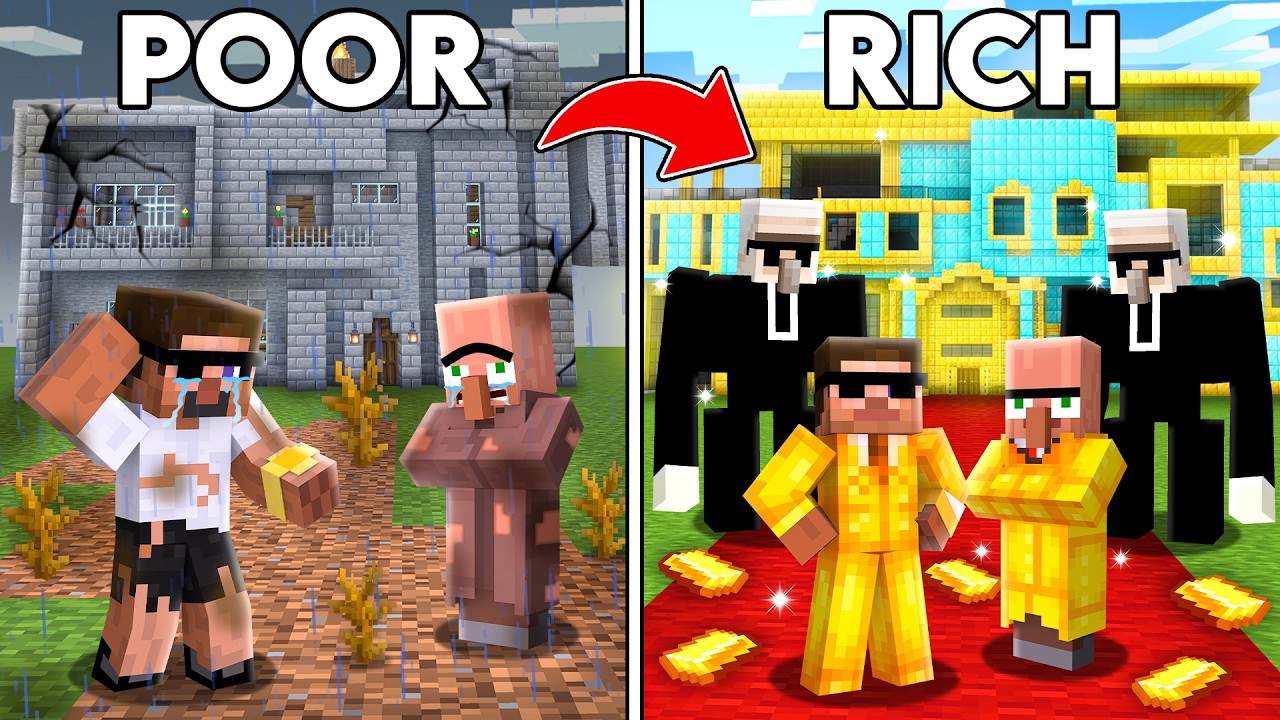
Poor to Rich Minecraft: Why the Mansion Glow-Up Trend Is Booming
A short clip titled "From Poor to Rich Mansion in Minecraft.." is racking up views, and it belongs to one of the most reliable money-machines on YouTube right now: the Poor to Rich Minecraft glow-up. The premise is almost insultingly simple — start in a cramped dirt shack, end in a sprawling marble mansion — yet it is precisely that simplicity that keeps millions of viewers, many of them children, tapping replay.
The video itself is embedded above, so there is no need to walk through every block placed. What is more interesting is why a format this basic has become one of the dominant shapes of gaming content in 2026, who is really watching, and what it tells us about how attention is engineered online.
What the Poor to Rich Minecraft format actually is
At its core, the Poor to Rich genre is a transformation story compressed into a few minutes. A creator begins with the most pitiful possible base — a one-block hut, a hole in a hillside, a wooden box with a single torch — and then, stage by stage, upgrades it.
The arc is almost always the same:
- The "poor" start — a deliberately ugly, tiny shelter that signals struggle.
- The grind montage — gathering materials, mining, trading, or simply cutting to the next tier.
- The mid-tier home — stone, glass and a bit of decoration.
- The "rich" reveal — a mansion with pools, chandeliers, gardens and gold.
That clean structure is the whole point. Viewers know exactly where the video is going, and the pleasure is in watching it get there. It is the same dopamine loop behind home-renovation shows, satisfying-cleaning reels and "day in the life" upgrade montages — just rendered in blocks.
Why it is blowing up right now
Several forces are pushing these videos up the charts at once. The first is Minecraft's sheer scale. The game remains one of the best-selling titles in history and, crucially, one of the few that spans generations — a seven-year-old and a twenty-seven-year-old can both watch the same build and enjoy it.
The second is the short-form algorithm. Platforms now reward content that hooks in the first three seconds and holds attention to the end. A title that promises poor to rich front-loads the entire payoff: you already know what you came for, so you stay to see it delivered.
Third, these builds are endlessly repeatable. There is no franchise fatigue, no script to write, no actors to pay. A creator can produce "poor to rich castle", "poor to rich underwater base", "poor to rich secret bunker" indefinitely, each one a fresh thumbnail with the same proven skeleton.
The India angle: a giant, young audience
For a site read in India, the most relevant fact is that India is among the largest Minecraft audiences on the planet, especially on mobile and on YouTube. A wave of Indian gaming creators built enormous followings precisely on Minecraft survival series, lifesteal SMPs and exactly this kind of build content.
That matters because the Poor to Rich format travels effortlessly across language. The story is visual, so a child in a Tamil-, Hindi- or English-speaking home can follow it without subtitles. Add cheap data, affordable smartphones and long school holidays, and you have a near-perfect distribution engine for this style of video.
It also feeds a real local ambition. For many young Indian viewers, watching a creator turn nothing into a palace is partly aspiration and partly a tutorial — a low-stakes fantasy of building something impressive from scratch, and a nudge to try it themselves in their own world.
The thing most viewers miss: it is staged
Here is the honest caveat that rarely makes it into the comments. The vast majority of Poor to Rich Minecraft videos are not spontaneous survival gameplay. They are planned creative builds, often made in creative mode or with the hard parts edited out, then narrated as if they happened naturally.
That is not a scandal — it is filmmaking. But it is worth understanding, because the format quietly sells a fantasy of effortless progress. In real survival Minecraft, a mansion like the "rich" reveal would take many hours of mining, farming and trading. The video collapses that grind into a montage, the same way a movie shows a training sequence in ninety seconds.
Treating these clips as entertainment rather than instruction keeps expectations realistic, particularly for younger builders who may feel their own homes look poor by comparison.
The public reaction and the copycat economy
The response to viral builds like this one tends to split along familiar lines. Younger viewers and Minecraft fans react with delight, flooding comments with requests for the next tier, the world download or a tutorial. Many treat the best builds as blueprints to copy, screenshotting rooms to recreate later.
The more skeptical crowd points out the obvious: that the genre is formulaic, ad-saturated and easy to fake. Because the structure is so cloneable, a long tail of low-effort and even scam-adjacent channels has sprung up around it. Some lookalike videos exist mainly to funnel viewers toward sketchy "free skins", "free Minecoins" or modded-APK sites.
A few practical cautions for parents and young players:
- Be wary of "free reward" links in descriptions or comments — legitimate creators almost never gate skins or currency behind random sites.
- Avoid downloading modded APKs promising unlocked features; these are a common malware and account-theft vector.
- Check the channel, not just the clip — established creators have a consistent history; throwaway accounts rarely do.
- Treat the builds as inspiration, not a contest your own world has to win.
What comes next for the glow-up genre
The Poor to Rich wave is unlikely to crash soon, but it will keep mutating. Expect creators to chase novelty by stacking constraints — poor to rich in one block, in 24 hours, but everything is lava — because the core arc is so strong that it survives almost any twist.
Two deeper shifts are worth watching. One is the role of AI-assisted thumbnails and editing, which is lowering the cost of pumping out polished build videos and intensifying the flood. The other is platform pressure on content aimed at children, where rules around ads, data and "made for kids" labelling continue to tighten and could reshape how these channels earn.
There is also a creative ceiling. As audiences see the hundredth identical mansion, the truly successful creators will be the ones who add storytelling, humour or genuinely clever engineering rather than just bigger gold rooms. The block-by-block glow-up got everyone in the door; keeping them will take more than another marble staircase.
For now, though, the formula holds. A dirt shack, a few minutes, and a mansion at the end — it is a tiny, complete story of progress, and that is exactly why a clip like this keeps spreading.