Photo: Steven Skelley / Pexels
The 'Seasquatch' Is Back: A Hidden Sea Star Lair Off California
A diver off the northern California coast spotted something last summer that scientists had nearly given up hope of seeing in those waters: a cluster of giant, many-armed sea stars sprawled across the rocks. The reaction was instant. One researcher later admitted she screamed through her regulator underwater. What she had found was a hidden colony of the sunflower sea star — the creature researchers have taken to calling the "Sasquatch of the Sea."
The nickname is only half a joke. This animal had become so scarce along the California coast that searching for one felt like chasing a legend. And like any good cryptid story, the punchline is that it turned out to be real all along — tucked away in a lair nobody had thought to check.

A Creature That Became a Myth
The sunflower sea star, Pycnopodia helianthoides, is not a delicate tide-pool ornament. A full-grown adult can sprout up to 24 arms, stretch about three feet across, and glide along the seabed at a startling pace — roughly three feet per minute, which by sea-star standards is a sprint. It is one of the largest sea stars on Earth and, in a healthy kelp forest, one of the most important predators in the neighbourhood.
Then, almost overnight, it vanished. Beginning in 2013, a mysterious epidemic known as sea star wasting disease tore down the West Coast of North America. Infected animals essentially dissolved — arms twisting off and crawling away, bodies disintegrating into mush within days. The sunflower sea star was hit hardest of all.
The scale of the die-off is hard to picture. Researchers estimate that as many as 5.75 billion of these animals died. Across the southern half of their range, more than 99% disappeared. In 2020 the International Union for Conservation of Nature declared the species critically endangered, and U.S. authorities have since moved to protect it under the Endangered Species Act. For years afterward, a large adult sunflower star in California was so rare that spotting one was an event.

Why One Missing Sea Star Wrecked a Whole Forest
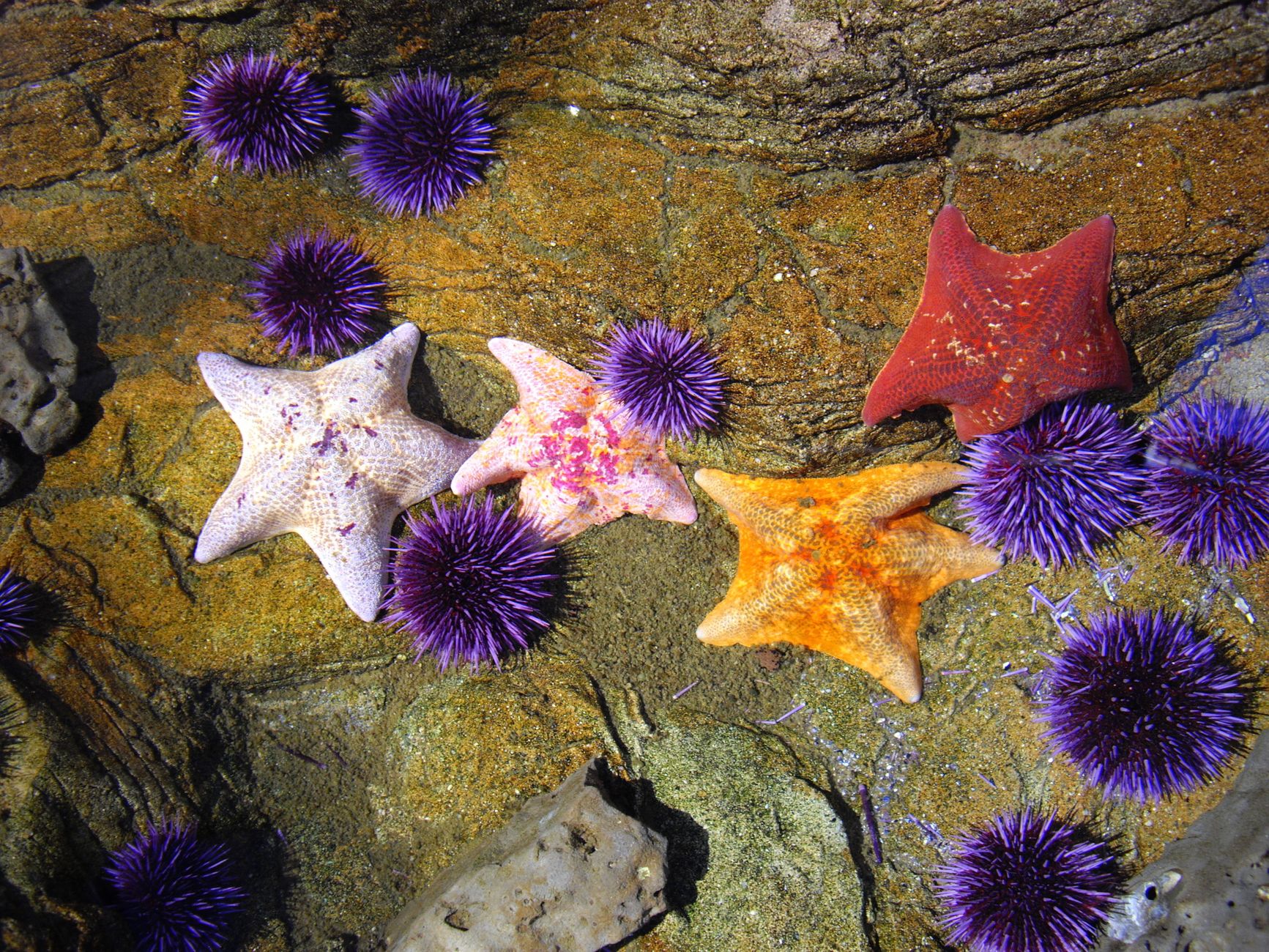
Here is where the story stops being a tale about a single charismatic animal and becomes something far bigger. The sunflower sea star is what ecologists call a keystone predator, and its favourite meal is the purple sea urchin.
Urchins eat kelp. Left unchecked, they eat all of it. So when the sea stars vanished, the urchins were handed an empty buffet and no one to stop them. Their numbers exploded.
The timing could not have been worse. In late 2014 a vast marine heatwave nicknamed "the blob" spread down the coast, followed by a strong El Niño. Warm water already stresses kelp. Add billions of hungry urchins and a missing predator, and the ecosystem simply gave way. The result along northern California has been staggering: satellite imagery shows more than 95% of the region's bull kelp forests have disappeared, replaced by what scientists grimly call urchin barrens — stretches of seabed carpeted in spiny purple urchins and almost nothing else.
It is one of the clearest real-world demonstrations of how removing a single species can topple an entire system. Pull one thread, and the whole tapestry of a kelp forest comes apart.
The Lair at Sea Ranch
Which brings us back to that scream underwater. In June 2025, a team led by Rachael Karm of Sonoma State University — part of marine ecologist Dr. Brent Hughes's lab — was surveying the coast near Sea Ranch in northern California when they came across the sea stars. A larger expedition followed in August, bringing together 25 scientific divers from eight institutions to document what was there.
The count came to 18 adult sunflower sea stars. That may sound modest, but in context it is remarkable: it is described as the largest and southernmost surviving population recorded in California since the wasting disease struck. More importantly, it is the first group found with enough big, mature individuals to actually reproduce.
That detail matters enormously. A scattering of lone survivors can't rebuild a population. A cluster of large adults living close together can. As one researcher on the project put it, this is the first group with "meaningful reproductive potential" — the difference between a relic and a comeback.
Why Scientists Are Genuinely Excited
For a decade, efforts to bring sunflower sea stars back have leaned heavily on captive breeding — raising the animals in labs and aquariums in the hope of one day releasing them into the wild. That work remains vital. But a naturally surviving, breeding population in the open ocean is a different and more powerful thing.
Wild survivors carry a few advantages:
- They already live where they belong. No acclimatisation, no release shock — they have weathered the disease and the heatwaves and are still here.
- They may carry useful genetics. Animals that survived a 99% die-off could hold clues to disease resistance.
- They can seed the surrounding coast. Sea stars broadcast eggs and sperm into the water; a healthy cluster can send offspring drifting to nearby reefs.
There was also a scientific breakthrough that made 2025 a banner year for this animal. Researchers finally pinned down a likely culprit behind the wasting disease: a bacterium called Vibrio pectenicida. Knowing the enemy is the first step toward protecting survivors and, eventually, raising disease-resistant animals.
What Happens Next
Nobody is declaring victory. Eighteen sea stars do not undo the loss of billions, and the urchin barrens off northern California won't vanish on their own. The surviving urchins have entered a strange zombie-like state, persisting in near-starvation and nibbling away any young kelp that tries to take root — which makes natural recovery painfully slow.
But the discovery reshapes what's possible. Conservationists now have a wild population to monitor, protect and study. The questions for the months ahead are practical ones:
- Will the Sea Ranch group breed successfully, and can their larvae settle on nearby reefs?
- Are there other hidden lairs along the coast that surveys have simply missed?
- Can survivors and lab-raised stars be combined to rebuild populations faster than either could alone?
The larger lesson is almost poetic. The fight to save California's kelp forests — vast underwater jungles that shelter fish, otters and countless other species, and that quietly soak up carbon — may hinge not on some grand intervention but on the quiet return of a knobbly, many-armed predator most people have never heard of.
The Sasquatch of the Sea was never a myth. It was just waiting to be found again. And this time, the people who found it knew exactly how much was riding on it.