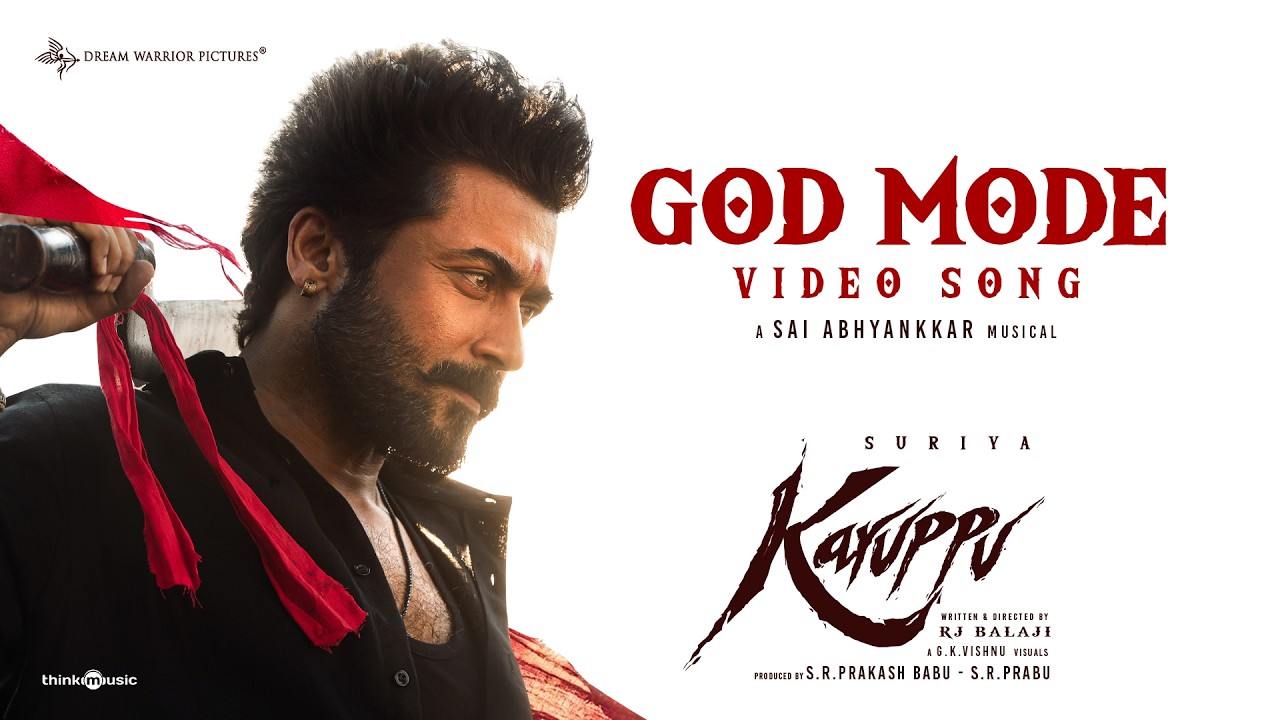
Suriya's 'God Mode' From Karuppu Goes Viral: Why It Hits
When the first proper single from a Suriya film drops, Tamil cinema's internet stops scrolling — and "God Mode", the new video song from Karuppu, did exactly that. Within hours of landing on YouTube, the track from Dream Warrior Pictures was trending, flooding timelines with reaction clips, lyric breakdowns and the kind of fevered comment-section energy usually reserved for a teaser. The combination on the credits is what makes it unusual: a megastar, a radio-jockey-turned-director, and a Gen-Z composer who has spent the last year rewriting what a viral Tamil hit sounds like.
Why 'God Mode' is blowing up on YouTube
The headline reason is the line-up. Suriya anchors the song, RJ Balaji directs the film, and Sai Abhyankkar composes — three names that each carry their own fan armies, now pulling in the same direction. A single that bundles all three was always going to over-perform, but the speed of the climb surprised even trade watchers.
The title itself is a marketing masterstroke. "God mode" is gamer slang for invincibility — the cheat code that makes a character unstoppable — and slapping it on a Suriya mass number tells the audience exactly what to expect before a single note plays. It frames the star not as a man but as a force, and that promise is catnip for fan edits.
There is also the first-single effect. For a big Tamil release, the opening track is a referendum on the whole project. A weak song breeds doubt; a banger like this resets expectations and converts curiosity into committed hype. The early numbers suggest "God Mode" cleared that bar comfortably.
Sai Abhyankkar, the sound of the moment
The most talked-about credit may not be the star at all. Sai Abhyankkar is the breakout composer behind monster hits that crossed language barriers, including the inescapable "Aasa Kooda", and his rise from independent releases to scoring a Suriya film is one of the fastest in recent Tamil music memory.
His signature is a particular kind of catchiness — earworm hooks, folk-flavoured percussion and a chorus engineered to be looped on Instagram Reels and YouTube Shorts. That instinct for the short-form clip is precisely why his work travels, and why "God Mode" was practically built to be sampled and remixed by fans.
For Suriya, pairing with a composer half a generation younger is a deliberate signal. It tells a fresh audience that the actor is plugged into the current sound rather than coasting on legacy collaborators, and it gives the song a contemporary texture that older mass numbers sometimes lack.
RJ Balaji and the risk behind Karuppu
RJ Balaji is one of Tamil cinema's genuine wildcards. He built a following as a sharp, fast-talking radio jockey, became a bankable comic actor, and then moved behind the camera with films that mixed social commentary and crowd-pleasing entertainment. Directing Suriya, though, is a different order of pressure.
Helming a star of that magnitude means balancing a hero's well-honed image against a director's own voice — a tightrope many first- and second-time filmmakers have wobbled on. The early reception to "God Mode" matters here because it quietly answers a question fans had: can Balaji deliver the scale a Suriya vehicle demands? The song's mounting and energy suggest he is leaning into spectacle rather than shrinking from it.
Karuppu itself, produced by the reliable Dream Warrior Pictures, is being positioned as a mass entertainer with a rooted, folk-tinged identity — the title translates loosely to "black," a colour heavy with cultural and devotional meaning in Tamil contexts. The branding around the song plays into that mythic, almost ritualistic register.
What the song actually signals about the film
Without narrating the visuals frame by frame, the broad strokes of "God Mode" tell you what kind of movie this wants to be. The track leans into the mass-hero template: a larger-than-life central figure, swelling percussion, and imagery built to detonate in a packed single-screen theatre on day one.
A few things the song hints at, read sensibly rather than as confirmed plot:
- A folk and devotional aesthetic rather than a slick urban one, in keeping with the title.
- A fan-service first approach, with the music engineered around Suriya's screen presence.
- A bet on theatrical spectacle, the kind designed for whistles and front-bench celebration.
It is worth a note of caution: a strong single is not a guarantee of a strong film. Tamil cinema history is littered with chartbusters attached to projects that underwhelmed. The song is a promise, not a verdict, and that gap is exactly what keeps audiences anxious and engaged.
The public reaction, and the fan-edit economy
The response has followed a now-familiar viral arc. First came the view-count milestones, screenshotted and shared as proof of dominance. Then the reaction videos, where creators film themselves hearing the hook for the first time. Then the breakdowns — slow-motion freezes, beat-by-beat analysis, and debates over which second of the song is the "goosebumps" moment.
This ecosystem is not incidental; it is the engine. Modern Tamil promotions are designed to hand fans raw material they can re-cut, and "God Mode" supplies plentiful clip-able peaks. Every Reel and Short made from it is, in effect, free advertising that compounds the original video's reach.
Not all the noise is uniform praise, and that is healthy. Some listeners argue the mass-number format is becoming formulaic, while others insist Sai Abhyankkar's freshness elevates a tired template. That friendly disagreement keeps the song in conversation longer than unanimous applause ever could.
The wider context: Suriya's high-stakes phase
Suriya is in a deliberately ambitious stretch of his career, alternating between experimental, content-led films and unabashed crowd-pleasers. Karuppu sits firmly in the latter camp, and its success or failure will shape how aggressively he pursues the mass-hero lane going forward.
The stakes are amplified by the company he is keeping. Backing a young composer and a relatively new director is a calculated wager — if it lands, Suriya looks like a star with an instinct for the next wave; if it stumbles, the same choices invite second-guessing. "God Mode" buying early goodwill takes some of that pressure off the opening weekend.
There is also a market reality. In an era where streaming has made theatrical first weekends more decisive than ever, a film needs a strong pre-release buzz cycle to guarantee packed houses. A viral single is the cheapest, most reliable way to manufacture that buzz, and this one is doing its job.
What comes next
Expect the promotional machine to escalate from here. A first single this loud typically precedes a lyric or making-of video, a second track, a teaser, and eventually a trailer timed to a festival or holiday window for maximum footfall. Each drop will be calibrated to keep "God Mode" from fading before the film arrives.
The real test, of course, is the movie. If Karuppu delivers on the swagger its first single is selling, the song becomes the anthem of a hit and replays on every fan channel for months. If the film disappoints, "God Mode" risks becoming a what-could-have-been — proof that the marketing peaked before the product.
For now, though, the scoreboard is simple. A Suriya mass number, a composer at the height of his cultural moment, and a director with everything to prove have combined into the kind of launch that Tamil cinema's internet lives for. Whether it converts into box-office god mode is the question the next few weeks will answer — and a very large audience is watching closely.