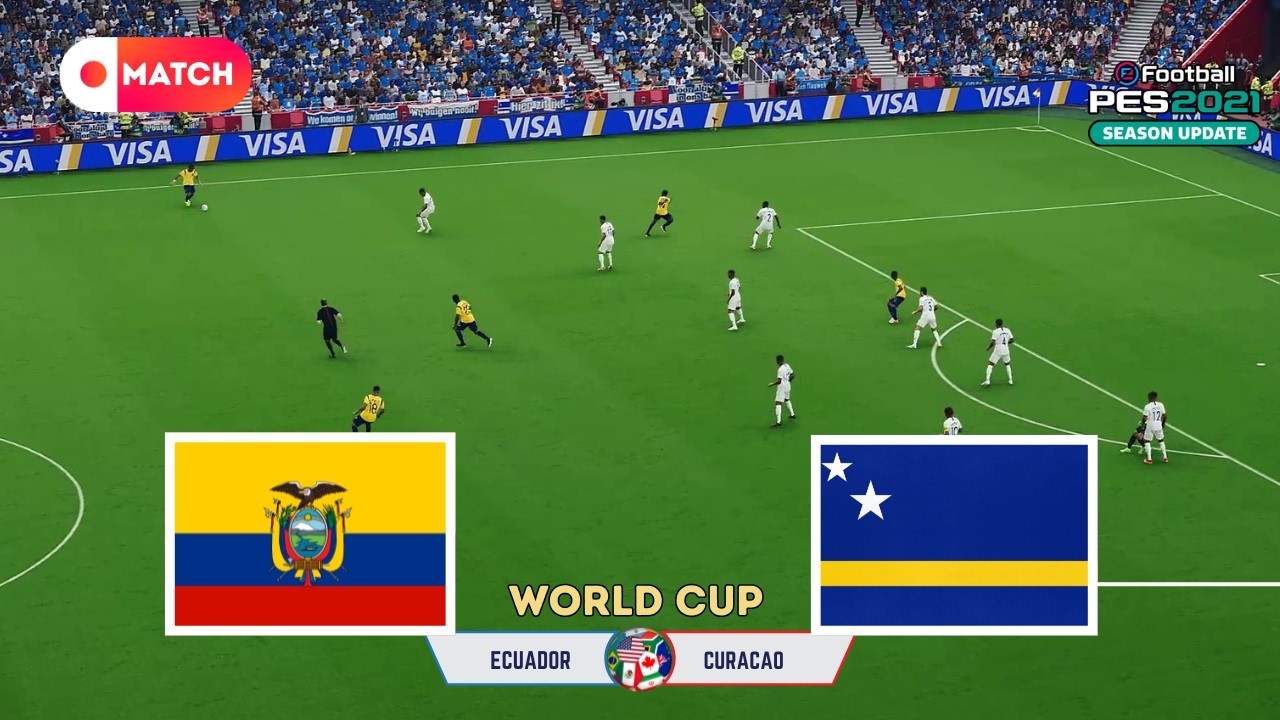
Curacao vs Ecuador: Why a PES Sim Clip Has Football Fans Hooked
A simulated football match between Ecuador and Curacao, played not on grass but inside the video game eFootball PES, is quietly racking up views on YouTube. There is no referee, no real crowd and no points at stake. Yet thousands of people are clicking on a virtual World Cup 2026 fixture that may never happen in real life, and the reasons behind that say a lot about how football is consumed today.
The clip belongs to a fast-growing genre: gamers running tournament "simulations" on PES (now formally eFootball) and uploading the results as if they were broadcast highlights. Commentary, kits, stadium atmosphere and player likenesses are all rendered by the game. What makes this particular upload travel further than most is the matchup itself, and one genuinely remarkable real-world story sitting behind it.
The real reason Curacao is the hook
Most casual fans could not point to Curacao on a map. It is a small Dutch Caribbean island, with a population in the region of 150,000 to 185,000 people, sitting off the coast of Venezuela. In footballing terms it has long been a minnow.
That changed when Curacao pushed through CONCACAF qualification for the expanded 2026 tournament, putting it among the smallest territories by population ever to reach a men's World Cup. For context, Iceland was widely celebrated in 2018 as the tiniest nation to qualify, with a population north of 330,000. Curacao's story is smaller still, and that David-versus-Goliath framing is catnip for content.
Pair that underdog against Ecuador, a established South American side with World Cup pedigree and a reputation for stubborn, athletic football, and you have a contrast that practically writes its own thumbnail. The simulation is really a vehicle for a question fans are already asking: what would a side like Curacao actually look like on the biggest stage?
What the video actually is, and is not
It is worth being clear about what readers are watching, because the format can blur the line between fact and fiction.
- It is a video game simulation, with two AI-controlled or creator-controlled teams.
- The final score is not a prediction. It reflects the game engine, the chosen difficulty, squad ratings and a degree of randomness.
- Player faces, names and abilities are approximations built into the game, which sometimes lag behind real squad changes.
- There is no official link to FIFA, the real tournament, or either national federation.
None of that has hurt its appeal. If anything, the gap between the polished, broadcast-style presentation and the playful premise is part of the draw. Viewers know it is make-believe, and they lean in anyway.
Why simulation clips keep going viral
This is not a one-off. Around every major tournament, a cottage industry of creators churns out match simulations, group-stage run-throughs and "realistic gameplay" series. The mechanics of why they spread are fairly simple.
- They fill the wait. Months before a ball is kicked, fans are hungry for anything World Cup-flavoured. A simulation offers an instant, watchable version of a fixture that does not yet exist.
- They are cheap to produce. A console, a capture setup and some editing can turn one person's bedroom into a content studio. Compared with real sports rights, the barrier to entry is almost nothing.
- The algorithm rewards specificity. A title pairing two real national teams and the words "World Cup 2026" captures exactly the search terms fans are typing.
- Low stakes, high replay value. Nobody is genuinely heartbroken by a virtual result, so the videos are easy to share, argue about and move on from.
For a small football nation like Curacao, this kind of fan-made attention is a strange new form of exposure. The island's footballers are being rendered, debated and cheered on by audiences who may never see them play live.
The eFootball backdrop
The engine doing the heavy lifting here is eFootball, the free-to-play title that Konami built from the long-running Pro Evolution Soccer series. PES spent years as the connoisseur's football game, often praised for gameplay feel even when it trailed rivals on licences and presentation.
The shift to a free, live-service model widened its reach dramatically, especially in markets like India, Southeast Asia and Latin America, where mobile-first, low-cost gaming dominates. That global, value-conscious audience is exactly the crowd that creates and consumes simulation content at scale. A clip like Ecuador vs Curacao is, in a sense, a by-product of that ecosystem.
It also speaks to how blurred the boundary between gaming and football media has become. Highlights, tactics breakdowns, transfer rumours and now fictional fixtures all sit side by side in the same feeds, competing for the same attention.
What it tells us about the 2026 build-up
The expanded 48-team World Cup, co-hosted across the United States, Mexico and Canada, has thrown open the door to nations that rarely featured before. More qualifiers means more unfamiliar names, more underdog narratives and, inevitably, more curiosity about how these sides might fare.
That curiosity is precisely what simulation creators are tapping into. Every fresh qualifier becomes a potential thumbnail, every unlikely matchup a possible viral moment. A tiny island taking on an established South American side is the kind of story the tournament's new format was always going to generate.
For Indian fans in particular, who follow the World Cup intensely despite their own team not being in it, these clips offer a no-cost way to engage early. They can pick favourites, debate group draws and build emotional investment in nations they had barely heard of, long before the real action begins.
What happens next
Expect a lot more of this. As qualification confirms more squads and the draw takes shape, the volume of simulation content will only grow, and the matchups will get bolder. Some creators will lean into realism, others into chaos and comedy, but the underlying appetite is the same.
The one thing worth keeping in perspective is that a game engine's verdict is just that. If Curacao's footballers do reach the tournament proper, their real story, written on actual pitches against actual opponents, will be far more compelling than anything a console can script. A viral simulation is a fun appetiser. The main course is still to come, and no amount of virtual goals can settle it in advance.