Fatima Sana's Wicket Clip Goes Viral: The Pacer Decoded
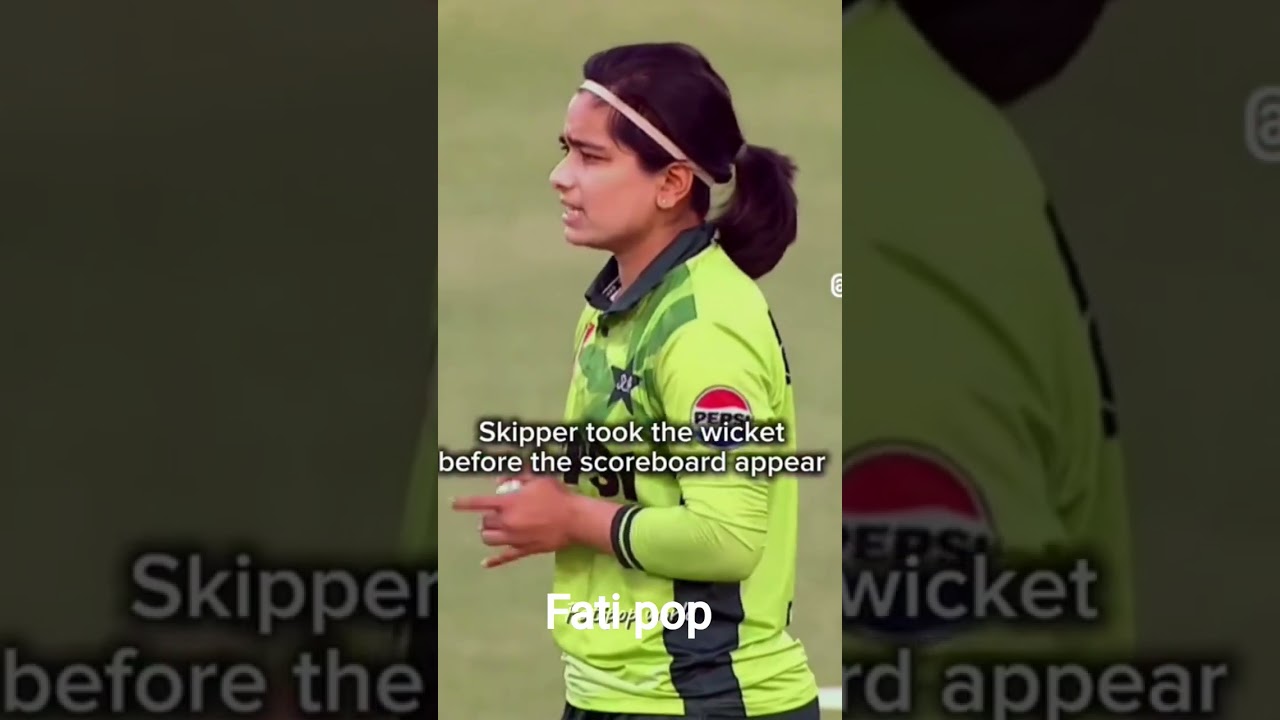
A few seconds of footage is doing what entire match broadcasts often cannot: making millions stop scrolling. A clip of Fatima Sana ripping out a batter and wheeling away in celebration — captioned with the cheeky claim that she takes the wicket "before the scoreboard appears" — is climbing fast across YouTube Shorts and short-video feeds. It is not a press conference, a controversy or a record. It is a bowler in full flight, and that turns out to be more than enough.
The Fatima Sana moment is a neat case study in how modern cricket fame is built. The delivery, the stumps or the leading edge, the roar, the teammates piling in — compressed into a loop you can watch five times before you decide to. Below the surface, though, sits a more interesting story about who she is, why women's fast bowling is suddenly box-office in the subcontinent, and how a hashtag salad turns a domestic clip into a global one.
Who Fatima Sana actually is
Fatima Sana is a right-arm fast-medium bowler and lower-order hitter who has become the public face of Pakistan's women's cricket. She broke through as a teenager, was handed the national captaincy across formats, and was honoured as the ICC Emerging Women's Cricketer of the Year for 2024 — the award that flags the most promising young talent in the global game.
What makes her watchable is the package. She runs in hard, hits the seam, and bowls with visible aggression — a style that reads instantly on camera even to viewers who cannot tell a googly from a yorker. For a women's game still fighting for airtime, a captain who bowls fast and celebrates harder is exactly the kind of figure who can carry a highlight beyond the usual fan base.
It is worth being precise about what the viral clip does and does not prove. It shows a wicket and a celebration; it does not, on its own, tell you the opponent, the match or the stakes. The specific dismissal in any single repost is not always clearly labelled, and reuploads frequently strip out that context. Treat the clip as a snapshot of her bowling, not as evidence of a particular scoreline.
Why this clip is blowing up
The mechanics of the virality are almost more interesting than the wicket. Three things are working together here.
- Format fit. A wicket plus celebration is the perfect raw material for a sub-15-second vertical video. There is a clear build-up, a payoff and a burst of emotion — the exact rhythm short-form algorithms reward.
- The caption hook. The "before the scoreboard appears" line is pure showmanship, implying the wicket came so fast the graphics could not keep up. It is hyperbole, not a literal claim, and it primes viewers to feel they have just seen something explosive.
- Emotion over information. People do not share clips because they are informative; they share them because they feel something. A fired-up celebration travels because it is legible across languages and borders.
There is also a quieter driver: novelty. Many casual viewers have simply not seen much women's fast bowling, and a genuinely quick delivery from a woman still surprises a chunk of the audience. That surprise is engagement fuel.
The hashtag trick you should notice
Look closely at the original title and you will spot Babar Azam and Shadab Khan tagged alongside the clip. Neither is in it. This is a well-worn discovery tactic: piggybacking on the biggest, most-searched names in Pakistan cricket so the video surfaces whenever fans look those players up.
It is not necessarily dishonest — it is how a huge share of cricket content is now distributed — but readers should know what they are seeing. The names are SEO bait, not a signal that the men's stars are connected to the moment. If anything, the tactic underlines how much heavier the men's game still is in raw search volume, and how women's clips often have to borrow that gravity to break out.
A few habits help you read trending cricket clips more honestly:
- Check the uploader. Official boards and broadcasters carry context; anonymous reupload accounts usually do not.
- Ignore the tag soup. Strings of unrelated star names are a reach-hack, not a description.
- Distrust superlatives. "Fastest ever," "before the scoreboard" and similar lines are vibes, not statistics.
The bigger shift behind the moment
The clip lands at a genuine inflection point for the women's game in the region. The 2025 ICC Women's ODI World Cup, hosted in India, ended with India winning the title for the first time — a result that pulled record attention to women's cricket across South Asia. That tournament reset expectations about how big the audience can be when the cricket is given a real stage.
That surge in interest does not evaporate when a trophy is handed over; it spills into the everyday content economy. Clips of individual players — a six, a sharp catch, a fiery over — now find audiences who started paying attention during a marquee event and kept the tab open. Fatima Sana, as a captain and a fast bowler with on-camera charisma, is precisely the kind of player who benefits from that lingering spotlight.
For Pakistan specifically, the stakes are pointed. The women's team has fought for consistency and visibility, and a marketable, aggressive captain is an asset both on the field and in the algorithm. Every clip that travels is, in effect, free promotion for a programme that needs eyeballs to justify investment.
Why women's fast bowling is suddenly content gold
Fast bowling has always been cricket's most cinematic act, and that is no less true in the women's game. A quick bowler offers a clean, repeatable piece of drama: the run-up, the leap, the stumps. It does not require a commentator to explain why it mattered.
There is also a representation angle that drives shares. For a generation of girls picking up a ball, seeing a woman steam in and celebrate a wicket like she owns the ground is aspirational in a way a statistics table never will be. That emotional pull is part of why these clips outperform polished, longer highlight reels — they sell a feeling, not a result.
The flip side is worth naming plainly. Reduced to loops, players risk becoming memes before they are understood as athletes, their craft flattened into a single celebration. The challenge for the women's game is to convert that fleeting attention into something durable: ticket sales, broadcast deals and fans who follow careers rather than clips.
What happens next
The immediate future is predictable. The clip will be reuploaded, remixed with different music and captions, and stitched into compilation videos, each version chasing the same engagement. A slice of new viewers will look up Fatima Sana, watch a few more videos, and either drift off or stick around.
The more meaningful question is whether the moment converts. The markers to watch are concrete:
- Follower spikes on her and the team's official accounts in the days after a clip peaks.
- Search interest in her name, which signals curiosity beyond passive viewing.
- Carry-over into actual viewership when Pakistan's women next take the field.
If those needles move, a throwaway highlight will have done real work for the sport. If they do not, it will simply join the endless churn of cricket content that burns bright for a day and is gone by the weekend. Either way, the clip is a reminder of where attention now lives: not in the full broadcast, but in the few seconds sharp enough to make a stranger stop and watch a fast bowler celebrate.