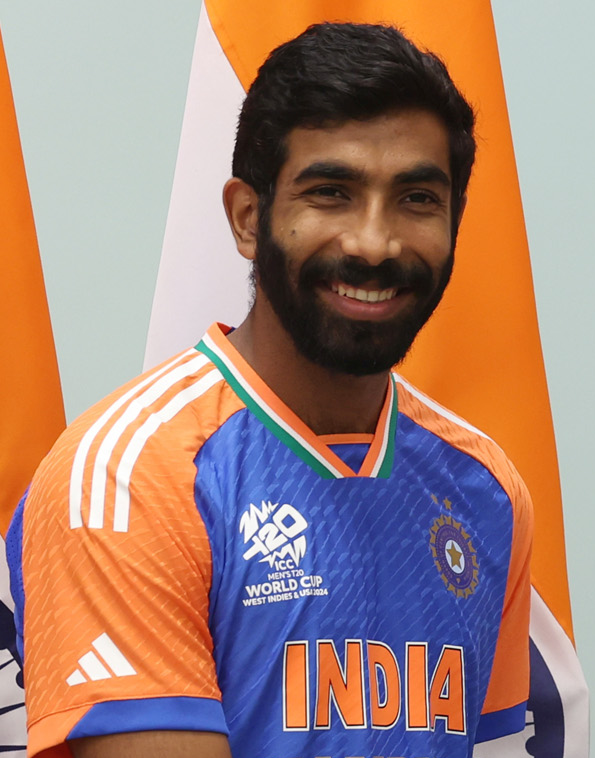
Photo: Prime Minister's Office · GODL-India / Wikimedia Commons
Person of the Day: Jasprit Bumrah, the Action No One Could Coach
Most great fast bowlers are built on a textbook: high front arm, smooth run-up, classical follow-through. Jasprit Bumrah was built on a Gujarat balcony and a tennis ball. The action that now terrifies the world's best batters — short run, stiff front leg, that whip-crack release from an arm bent at an impossible angle — is the same one a young boy used to keep noise down at home. No academy designed it. No coach dared to fix it. That refusal to be standardised is the whole story.
Today Bumrah is, by a fair distance, the most feared bowler in cricket. He has done something no bowler had managed before: held the world No.1 ranking across all three formats of the game. To understand how rare that is, you have to go back to a kid whose method looked wrong to everyone except the batters who couldn't lay a bat on it.
From tennis-ball nights to a state cap
Bumrah's cricket grew out of Gujarat's hard, fast outfields and the informal game played on them. His pace was natural and his release point was deceptive from the start, which is exactly the kind of thing selectors either ruin or leave well alone. Fortunately for India, they left it alone.
He came up through age-group and domestic ranks before the moment that changed everything: a 2013 IPL contract with Mumbai Indians. He was nineteen and almost unknown. On debut he returned figures of 3/32 against Royal Challengers Bangalore, and in a single over announced his temperament by removing Virat Kohli after first being hit for boundaries. The franchise saw what it had and held on to him.
The IPL apprenticeship that hardened him
Mumbai Indians did not rush him. They used those early seasons to turn a raw quick into a death-overs specialist, the bowler a captain throws the ball to when twelve are needed off the last over and the crowd is screaming.
That schooling shows in his record. Across his MI years he has been part of five title-winning sides and has gone on to become the franchise's all-time leading wicket-taker, having passed Lasith Malinga, with reportedly around 180 wickets. The yorker that has since broken Test stumps in Melbourne and Cape Town was first sharpened under IPL pressure, against batters with nothing to lose.
The international leap
India first picked him in white-ball cricket. He made his ODI debut against Australia in Sydney on 23 January 2016, and quickly became the bowler India trusted at the back end of an innings in both ODIs and T20Is.
The doubters had a fair question: could a limited-overs death bowler survive the long grind of Test cricket? Bumrah answered it himself. He made his Test debut at Newlands, Cape Town, on 5 January 2018, and took AB de Villiers as his first Test wicket. What followed was a run of overseas dominance that few Indian fast bowlers in history have matched. He took five-wicket hauls in South Africa, England and Australia in the same calendar year — his very first in Test cricket — and added the West Indies soon after, a sign that his method travelled to every kind of pitch.
Records that redraw the map
The numbers around Bumrah read less like a career and more like a rewriting of what an Indian fast bowler is supposed to do. A few stand out:
- He is the first bowler ever to be ranked No.1 in the ICC rankings in all three formats, a marker of how complete he is.
- He became the fastest Indian fast bowler to 200 Test wickets, reaching the mark in his 44th Test, and did it with one of the best averages among bowlers at that landmark.
- He was the first Indian bowler to take 100 wickets in Tests, ODIs and T20Is alike.
His spell-by-spell impact is just as telling. In a recent Border–Gavaskar Trophy in Australia, his 32 wickets were the most by an Indian bowler in an away Test series — the kind of single-handed effort that keeps a touring side competitive even when the batting wobbles.
Recognition at the very top
The sport's official honours have caught up with the eye test. Bumrah was named ICC Men's Test Cricketer of the Year for 2024, and also won the Sir Garfield Sobers Award as the year's ICC Men's Cricketer of the Year, becoming only the fifth Indian to take that honour, after Rahul Dravid, Sachin Tendulkar, Ravichandran Ashwin and Virat Kohli. He has been selected in ICC Teams of the Year across formats, and was central to India's triumphant 2024 T20 World Cup campaign, where he was named Player of the Tournament.
He has also led. India have handed him the captaincy in Tests on occasion, a measure of how much weight his judgment carries in the dressing room despite a quiet, undemonstrative manner. Among current players he has gone past the 500-international-wicket mark, and his death bowling continues to win India knockout matches on the biggest stages.
Why his story matters beyond cricket
There is a wider lesson in Bumrah that goes past sport. Indian cricket spent decades importing the orthodoxy of fast bowling and producing few genuine match-winners with the new ball overseas. Bumrah broke that ceiling by doing the opposite of conforming. His success has quietly told a generation of young quicks that an unusual action, properly managed, can be a weapon rather than a flaw.
His discipline off the field is part of the package. Fast bowling punishes the body, and Bumrah has worked carefully on managing his workload to keep delivering across formats. When he is fit and firing, India simply look like a different team — a point opposition batters and coaches make freely.
What comes next
The road ahead is about longevity and legacy. If he stays fit, Bumrah is positioned to climb India's all-time wicket lists in every format and to anchor the attack through the next cycle of world events. There is also a mentoring role waiting: the bowler whose method no one could teach is now the template younger pacers study.
For now, the simplest summary is the truest. A boy who learned to bowl quietly so as not to disturb the neighbours grew up to become the loudest argument India has ever made for doing things your own way. Jasprit Bumrah did not fit the mould. He replaced it.