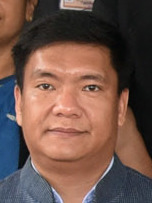
Photo: Vice President Office, Government of India · GODL-India / Wikimedia Commons
Person of the Day: Pema Khandu, From Tawang to India's Youngest CM
Few politicians enter office under the weight Pema Khandu carried in 2016. At 36, he became the youngest chief minister in India, leading one of the country's most rugged and strategically sensitive states. The journey that brought him there began far from the corridors of power, in the high-altitude town of Tawang, and it is a story worth telling for what it says about service in India's remotest frontier.
A Tawang upbringing
Pema Khandu was born on 21 August 1979 in Tawang, in the western corner of Arunachal Pradesh, into the Monpa community. The Monpa are a Buddhist people whose homeland sits among some of the highest, coldest and least accessible terrain in the country. Growing up here meant understanding from childhood what isolation costs ordinary families: roads that vanish under snow, hospitals a day's drive away, schools that struggle to retain teachers.
He finished his schooling locally before moving to Donyi-Polo Vidya Bhawan in Itanagar for higher secondary studies. He then travelled to the capital to study at Hindu College, University of Delhi, where he earned a Bachelor of Arts in History, graduating in 2000. That stretch outside the state — a young man from a Himalayan border district navigating a sprawling national university — gave him a wider frame of reference that would later shape how he pitched Arunachal to the rest of India.
Learning the trade from the ground up
Khandu did not parachute into politics. From the late 1990s he worked alongside his father in public life, getting a close look at how development actually reaches villages that are days from a paved road. The practical files he absorbed early — horticulture, the Eri silk trade, education and basic infrastructure — would stay with him for the rest of his career.
His own organisational climb was methodical. He became secretary of the Arunachal Pradesh Congress Committee in 2005, and in 2010 took charge as president of the Tawang District Congress Committee. These are unglamorous posts, the kind that involve booth-level work, local grievances and the slow business of building trust. It was an apprenticeship in retail politics rather than a shortcut.
Into the assembly
Khandu's entry into electoral office came in 2011, when he won a by-election to the Mukto constituency. He was returned uncontested, a rare mark of standing in his home turf. He was soon brought into the state cabinet, handling portfolios including Water Resource Development and Tourism — both central to a state whose rivers and landscapes are among its biggest assets.
Those ministries were a fitting training ground. Tourism forced him to think about how a state this scenic could be opened up responsibly, and water resources put him at the heart of Arunachal's single largest economic question: what to do with the immense power locked in its rivers. He spent these years learning how the machinery of government moved, or failed to move, in a place where geography fights you at every turn.
The youngest in the country
In July 2016, after a prolonged period of political churn in the state, Khandu was chosen to lead. He was elected leader of the legislature party and took oath as chief minister on 17 July 2016, at the age of 36. That made him the youngest serving chief minister in India — a striking distinction for a man from a frontier district that rarely features in national headlines.
What could have been a footnote about age became, instead, a long innings. He steadied the government, and over the following years built a reputation for keeping Arunachal's development agenda tied closely to national infrastructure pushes. In the 2024 Arunachal Pradesh Assembly election, his party swept the state, winning 46 of the 60 seats, and he was returned to the chief minister's chair with one of the most commanding mandates the state has seen.
Building roads where there were none
The defining theme of Khandu's tenure has been connectivity, because in Arunachal almost everything else depends on it. His government has overseen a dramatic widening of the rural road network and the steady addition of national highways and bridges across valleys that were once cut off for months at a stretch.
The most visible symbol of this is the Sela Tunnel near Tawang, an all-weather crossing beneath the formidable Sela Pass. For generations, heavy snow could sever Tawang from the rest of the state; the tunnel changed that calculation, giving the district dependable, year-round access. It is the kind of project that quietly reorders daily life for people who live at altitude.
Looking ahead is the Frontier Highway, a planned road of roughly 1,748 kilometres running through the state's northern reaches. Conceived as a spine for some of the country's most remote settlements, it is among the most ambitious road undertakings attempted in such terrain, and Khandu has been one of its most consistent advocates.
Rivers, silk and the long game
Beyond roads, Khandu has pushed to unlock Arunachal's standout natural endowment: hydropower. The state is estimated to hold potential of more than 58,000 MW, a figure that, if even partly realised, could reshape its finances and India's clean-energy mix. During his tenure several long-stalled projects have regained momentum, with large schemes on the Subansiri and Dibang systems moving forward and fresh approvals drawing significant investment commitments.
He has paired these big-ticket ambitions with attention to the everyday economy. The horticulture sector, the indigenous Eri silk industry and schooling in far-flung districts have remained on his agenda, reflecting an understanding that headline megaprojects mean little if a farmer or weaver in a border village sees no change. Environmental and health initiatives, including plantation drives and medical camps in his home region, have been part of the same approach.
Why his story resonates
Arunachal Pradesh is easy to overlook from the plains. It is vast, sparsely populated, ethnically diverse and tucked against a sensitive frontier. A leader from this state reaching national prominence is, in itself, a quiet correction to how India tends to picture its own map.
A few threads make Khandu's rise notable:
- He climbed through party organisation work, not a single dramatic leap, learning governance at district level first.
- He took charge at an unusually young age and turned it into durability, securing a sweeping mandate in 2024.
- His signature push — connectivity — speaks directly to the lived needs of people in one of the hardest landscapes in the country.
What comes next is largely about delivery: turning the Frontier Highway from blueprint into tarmac, bringing major hydropower online, and ensuring that growth reaches the smallest hamlets rather than stopping at the bigger towns. For now, the arc from a Tawang childhood to the chief minister's office stands on its own — a reminder that India's frontier produces leaders as readily as its heartland, and that patient ground-level work can carry someone a very long way.