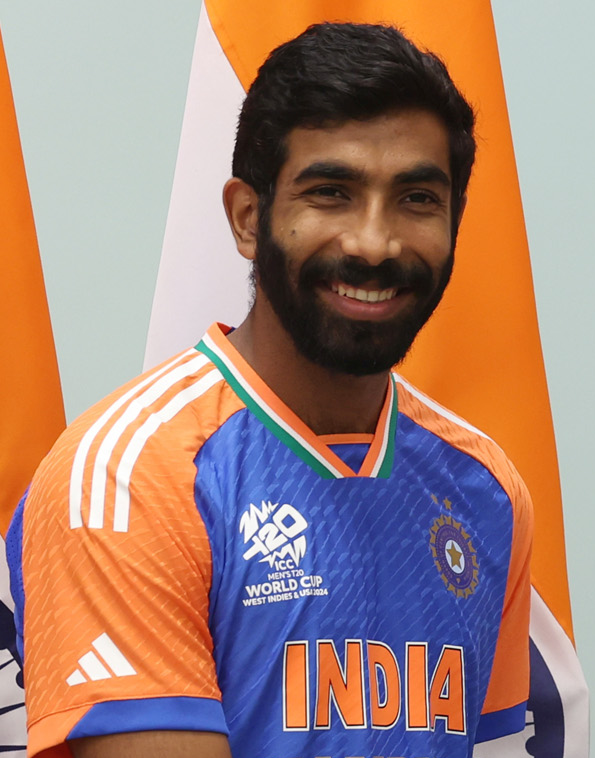
Photo: Prime Minister's Office · GODL-India / Wikimedia Commons
Person of the Day: Rohit Sharma, Still Setting the Pace at 39
A teenager from Borivali who could not always afford the train fare to practice grew up to hold a world record that has stood untouched for more than a decade. The story of Rohit Sharma is one of patience rewarded, of a gifted strokemaker who waited years for his place and then refused to give it back. By the time he handed over the Test captaincy in 2025, he had reshaped what Indian fans expect from an opening batter and from a leader.
This Person of the Day profile traces the career of the man Indian crowds call the Hitman: how he began, the milestones that defined his climb, and where he stands today as one of West India's most celebrated sportsmen.
A Nagpur boy raised in Mumbai's cricket nurseries
Rohit was born on 30 April 1987 in Nagpur, Maharashtra, into a family of modest means. For much of his childhood he lived with his grandparents and uncles in Borivali, a Mumbai suburb, while his father worked a low-paying job. Cricket was not an obvious career so much as a refuge that slowly became a calling.
He joined a local cricket camp, and coaches quickly noticed a boy with unhurried timing and a knack for finding gaps without obvious effort. He started out batting in the lower middle order and even bowled some off-spin. The Mumbai age-group circuit, one of the most competitive in the country, sharpened him, and a flood of runs in domestic cricket pushed him toward the national reckoning.
Breakthrough year, then the long wait
His full international debut came on 23 June 2007 against Ireland in Belfast. Within months he was part of the India squad that won the inaugural 2007 T20 World Cup in South Africa, where a composed cameo against South Africa announced his temperament on a big stage.
What followed, though, was not a straight line. For several years Rohit drifted in and out of the middle order, talented but inconsistent, often spoken of as a player of unfulfilled promise. The turning point arrived in 2013, when MS Dhoni asked him to open the batting alongside Shikhar Dhawan for the Champions Trophy. The move freed him to face the new ball, build slowly and then accelerate, and it transformed his career almost overnight. India won that tournament, and Rohit had found the role that would define him.
The records that rewrote the one-day game
Once settled at the top, Rohit began producing scores that bordered on the unreal. He is the only batter in history with three ODI double centuries — 209, 264 and an unbeaten 208 — a feat no one else has matched even once with regularity.
The centrepiece remains his 264 against Sri Lanka at Kolkata's Eden Gardens in November 2014. Off just 173 balls, with 33 fours and nine sixes, it stands as the highest individual score in the history of one-day internationals. It is the kind of number that tends to outlive careers, and it has.
A few highlights that capture his white-ball dominance:
- Three ODI double hundreds, more than any other batter has managed.
- A share of the record for the most T20I centuries, with five.
- Among the most prolific six-hitters in international cricket.
- A reputation as one of the most successful World Cup batters India has produced.
What makes these feats striking is the manner of them. Rohit rarely looks rushed. He plays late, lets the ball come, and unleashes power only when the situation invites it.
Eleven years of building an IPL dynasty
Franchise cricket gave Rohit a second laboratory for leadership. He won his first IPL title in 2009 with Deccan Chargers, then joined Mumbai Indians in 2011. Handed the captaincy in 2013, he steered the side to the title in his very first season in charge.
Over eleven seasons leading Mumbai, he lifted five IPL trophies, a haul that makes him a joint-most successful captain in the tournament's history. Across all his titles he holds six in total. His Mumbai years were a study in calm man-management: backing young players through lean patches, trusting big-match temperament over form, and rarely letting a setback rattle the dressing room.
The captaincy that ended a drought
Rohit took charge of the national side across formats during a period when India had not won a major ICC trophy in over a decade. He answered that with the two results every Indian fan had been waiting for.
In 2024 he led India to the T20 World Cup, an unbeaten campaign that brought a global title back after years of near-misses. He retired from the format on that high. Months later, in March 2025, he captained India to the Champions Trophy, scoring 76 in the final against New Zealand and becoming the first captain to win the player-of-the-match award in a Champions Trophy final. The double made him the only captain in the game to claim two ICC titles within nine months.
His numbers as a one-day captain reflect the same authority. Across his ODI captaincy he posted a winning percentage of around 76 percent, the highest among India's one-day skippers. In May 2025 he stepped away from Test cricket, closing a red-ball career of 67 matches and more than 4,000 runs, a format in which he reinvented himself as an opener late in his career and scored memorably at home.
Defying the clock at 39
What makes Rohit's recent run remarkable is his age. Born in 1987, he is now 39 — among the oldest players still operating at the top of international cricket, an age when most batters are written off rather than topping the world rankings. After lifting the T20 World Cup in 2024, he stepped away from the shortest format, a deliberate call to protect his body and pour his energy into the fifty-over game. Stepping back from Tests in 2025 sharpened that focus further.
For Rohit, age has become an asset rather than a limit. Years at the crease have honed his judgement of when to attack and when to wait, and the calm that comes only with experience. Younger team-mates lean on that read of the game as much as on his runs. How long he keeps going is a question Indian fans would rather not ask — but for now the veteran keeps answering it with his bat, a reminder that staying at the top this long is its own kind of greatness.
Where he stands now
Far from fading, Rohit kept climbing. In October 2025, after an unbeaten 121 in Sydney and a player-of-the-series effort against Australia, he reached the top of the ICC Men's ODI batting rankings for the first time, becoming the oldest India batter to do so. It was a fitting reward for a player who had spent his career being underrated before being recognised.
Today Rohit remains a central figure in India's fifty-over plans and a touchstone for younger cricketers learning how to pace an innings and lead without drama. His journey carries a simple, durable lesson: talent matters, but the players who endure are the ones who keep refining their craft long after the early hype has faded.
From a Borivali maidan to the summit of the world rankings, the arc of Rohit Sharma's career is a reminder that the slow build is often the most lasting one. The records will be chased; the calm with which he made them will be harder to copy.