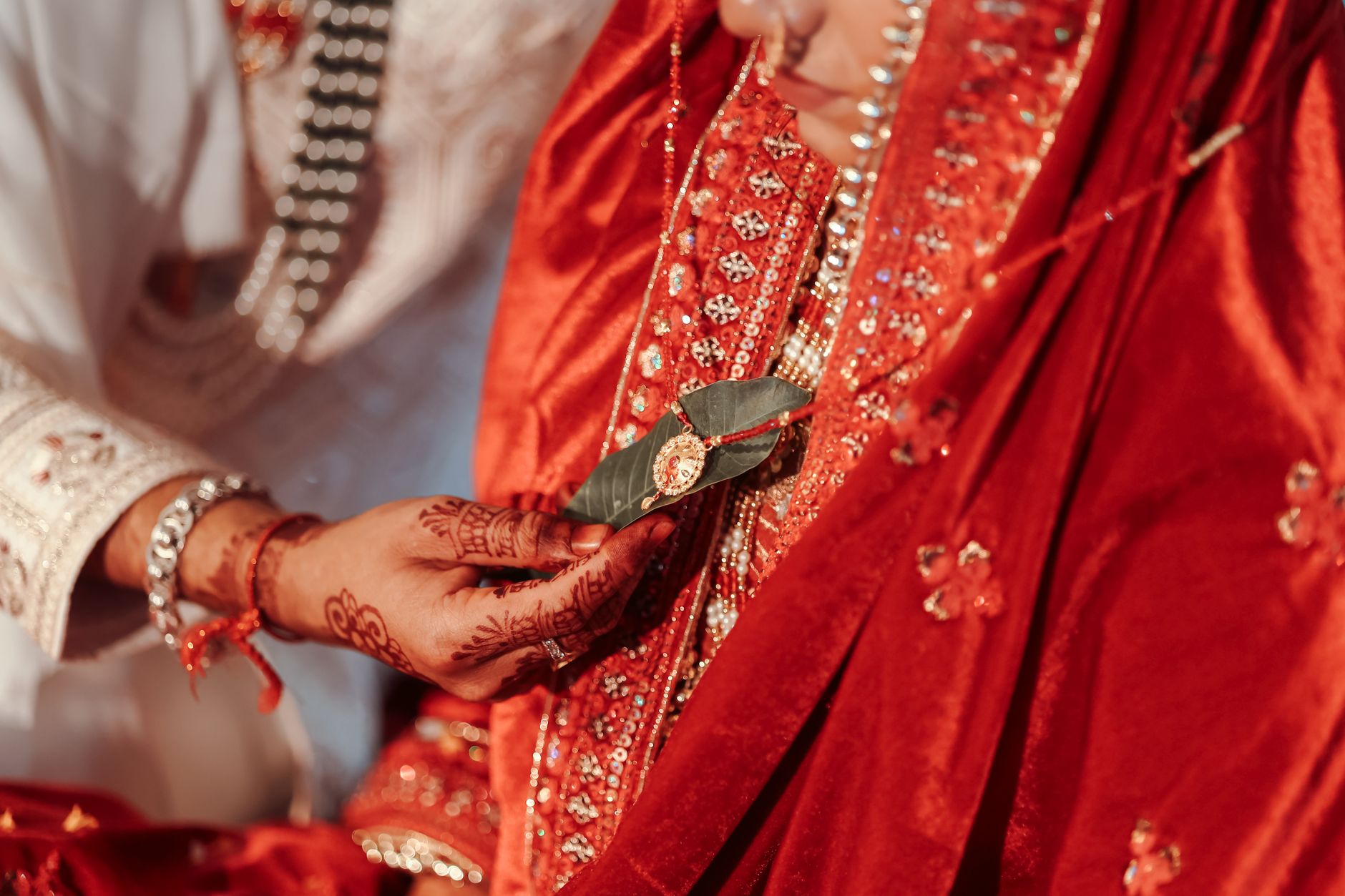
Photo: Rohit Piple / Pexels
The Manglik Myth: What Mangal Dosha Really Means for Marriage
Few words can stall an Indian marriage proposal faster than "the girl is Manglik" or "the boy has Mangal Dosha." Families that have already swapped photos and salary details suddenly go quiet. Matrimonial profiles carry the label like a warning sticker. And yet, if you ask a careful astrologer how common this so-called defect really is, the answer is almost comic: Mars lands in a "dosha" house in close to half of all birth charts. A flaw that shows up in one of every two people is not a rare curse. It is arithmetic.
This piece pulls apart the most persistent Manglik myths and looks at what genuinely shapes a marriage — because the gap between the fear and the fine print is enormous.

What Mangal Dosha actually is
In Vedic astrology, Mangal Dosha (also called Manglik Dosha or Kuja Dosha) is said to form when Mars occupies certain houses counted from the ascendant, the Moon or Venus. The houses usually cited are the 1st, 4th, 7th, 8th and 12th, with many schools adding the 2nd. Mars is the planet of heat, drive, aggression and physical energy, so the logic goes that when it sits near the houses governing self, home, marriage and intimacy, it can stir friction.
That is the entire technical claim. Not death, not doom — a temperament running hot. Everything else piled on top is folklore that hardened into rule over generations of nervous matchmaking.
The more revealing fact is the frequency. Because the dosha is defined purely by Mars sitting in one of several houses, it statistically applies to a huge slice of the population. Classical astrologers knew this, which is exactly why the same texts that describe the dosha also describe long lists of conditions that cancel it. Something that common was never meant to be read as a severe alarm.

Myth 1: A Manglik will cause their spouse's death
This is the cruellest belief attached to the label, and the flimsiest. The idea that marrying a Manglik invites widowhood or an early death is a folk exaggeration, not a literal rule in the foundational texts. Older astrology spoke of marital stress, clashes of ego, health strain and the risk of separation in extreme readings — and even those were hedged with conditions.
Reduce it to plain language and the "effect" is mostly about temperament: a partner who is intense, impatient or quick to argue. Those are things couples manage every day through maturity and communication, not omens of mortality. When an astrologer leads with the death-of-spouse line, they are selling fear, not reading a chart.
Myth 2: A Manglik must marry another Manglik
The popular fix is neat and wrong: pair one Manglik with another so their "defects" cancel out. There is a kernel of real tradition here — many practitioners do treat both partners being Manglik as a recognised cancellation, on the reasoning that two people with similar Mars energy understand each other's drive and intensity.
But as an absolute rule it collapses. Compatibility is not a single switch. A non-Manglik partner with a strong, well-placed chart can balance a Manglik partner perfectly well, and forcing two charts to match on this one count while ignoring everything else is poor analysis. The fixation has also produced real harm — anxious parents narrowing the pool, delaying weddings, or rejecting otherwise excellent matches over one box on a printout.
Myth 3: Tree and pot weddings are scriptural cures
You have probably heard of the remedies: a symbolic marriage to a peepal or banana tree, or to a clay pot, performed before the real wedding so the "first marriage" absorbs the Mars energy. Kumbh Vivah — marriage to a pot — belongs to this family of rituals. Reports over the years have linked such customs to high-profile weddings, though those accounts are rarely confirmed by the families themselves and are best treated as media talk rather than fact.
The key point: these are cultural practices layered on over centuries, not commandments from the core texts. They persist because they offer comfort and a sense of control. If a ritual reassures a family and harms no one, that is their choice. The problem starts when it is sold as a non-negotiable medical-style cure, often bundled with hefty fees.
What the classical texts say cancels the dosha
Here is what rarely makes it into the panic. The same tradition that defines Mangal Dosha lists numerous ways it loses its bite. Commonly cited conditions include:
- Mars in its own or exalted sign — in Aries, Scorpio or Capricorn, Mars is considered strong and refined rather than disruptive.
- A Jupiter aspect or conjunction on Mars — widely regarded as one of the strongest neutralising influences, with Venus also softening it.
- Ascendant-based exceptions — for certain ascendants such as Cancer, many practitioners do not apply the dosha at all.
- Sign-and-house combinations — specific placements (for instance Mars in the 7th in Cancer or Capricorn) are treated as no-dosha by classical rules.
- Both partners affected — matched Mars energy is taken to offset rather than collide.
In other words, the supposed defect comes with a built-in fine print so generous that a competent reading neutralises it in a large share of cases. An astrologer who mentions the dosha but never the cancellations is giving you half the page.
What actually matters for compatibility
Strip away the Manglik drama and traditional matchmaking itself rates other factors higher. In the Ashtakoota system used for kundli matching, the Nadi and Bhakoot koota carry the heaviest weight, touching health, progeny and the long-term emotional and financial flow of the marriage. Overall chart strength, the condition of the 7th house and the Moon's placement all feed into a serious reading. A single planet's house is one line in a far longer story.
Step outside astrology and the real predictors of a marriage that lasts are not mystical at all:
- Temperament and emotional maturity — can both people handle conflict without scorched earth?
- Shared values and life goals — money, children, careers, where and how to live.
- Communication — the daily, unglamorous skill that outlasts every wedding.
- Family fit and respect — the ecosystem the couple actually lives inside.
None of that shows up in a Manglik checkbox. A chart can hint at tendencies; it cannot substitute for two people choosing each other and doing the work.
How to use the label without being ruled by it
If your family takes astrology seriously, you do not have to reject it to stay sane about it. Ask the astrologer to spell out not just whether the dosha exists but whether it is cancelled, and by what — a vague "it's there" is not an analysis. Be wary of anyone who jumps straight to expensive remedies or the death-of-spouse warning. And weigh the reading against the things you can actually observe: how the two people treat each other, how they argue, what they want from life.
The Manglik label has broken off engagements and kept good matches apart for generations, largely on the strength of a misunderstanding. Mars in a marriage house is not a verdict. It is, at most, a note in the margin — and a marriage is written in far bolder ink than that.