Why 'I Flooded My World With Chocolate' Owns Kids' YouTube
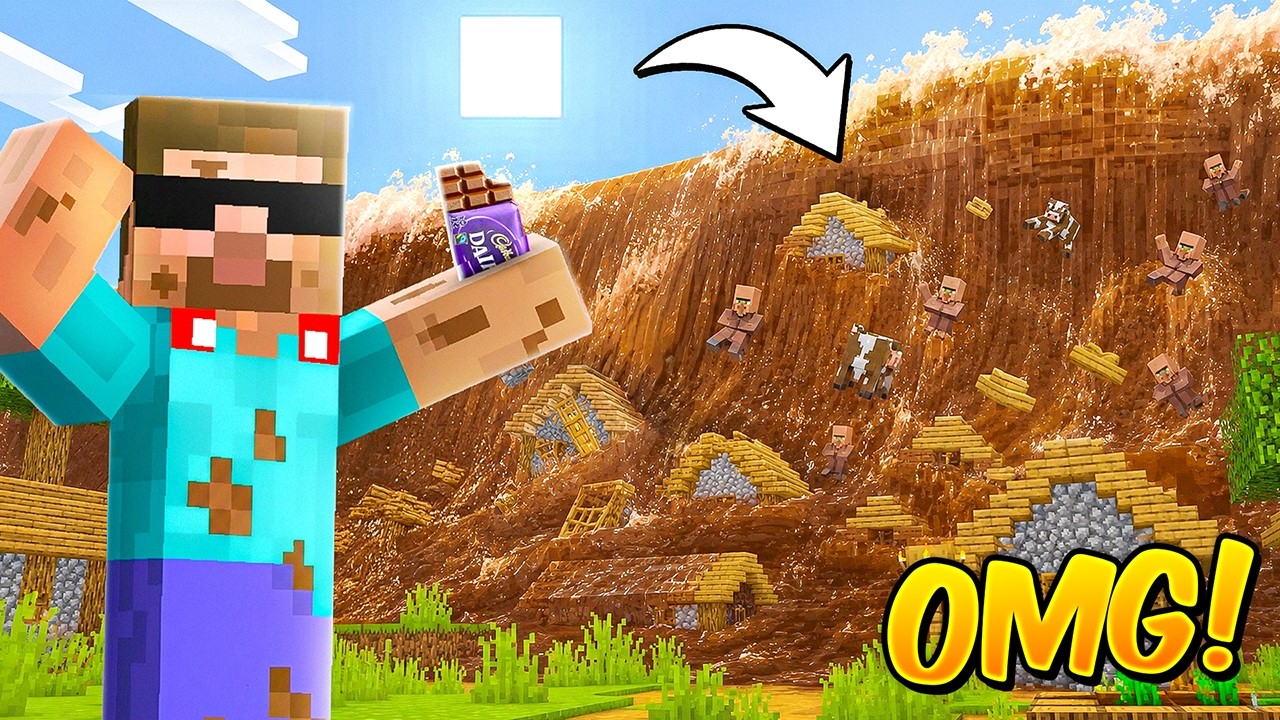
A video titled around flooding an entire Minecraft world with chocolate is doing what a surprising number of gaming clips now do: pulling in millions of mostly young viewers with a premise that is equal parts silly and irresistible. The idea is simple enough for a six-year-old to grasp from the thumbnail alone, and that simplicity is exactly the point. The Minecraft chocolate flood clip is less a one-off stunt than the latest entry in one of the most reliable formats on children's YouTube.
It is worth understanding why a sentence like "I flooded my entire world with chocolate" can outperform far more polished content. The answer says a lot about how attention works for kids online, how the platform rewards it, and why Indian households are quietly one of the biggest audiences for this stuff.
What the video actually shows
Stripped to its bones, the clip takes Minecraft's familiar blocky landscape and progressively drowns it in a brown, chocolate-styled block until rivers, valleys and builds disappear under a sweet-looking tide. There is no chocolate block in the standard game, so creators reach for mods, command blocks or custom data packs that swap water, terrain or air for a textured block they label as chocolate, then trigger it to spread across the map.
The drama comes from scale and speed. A single block becomes a trickle, the trickle becomes a wave, and within a couple of minutes the whole world is buried. The creator usually reacts in real time, narrating the chaos with exaggerated surprise, the way a parent might gasp at a toddler's drawing.
What the title promises, the video delivers, and it delivers it early. That contract between thumbnail and payoff is the engine of the entire genre.
The 'flood my world' format is a proven machine
This is not new. For years, creators have flooded Minecraft worlds with lava, water, TNT, slime, lava-and-water combinations, and increasingly absurd substances. Chocolate is just the latest skin on a template that already works.
The format succeeds because it satisfies three things at once:
- A clear promise. The title is the whole pitch. No setup, no lore, no skill required to follow along.
- A visible transformation. Kids love watching order turn to chaos. A clean world becoming a chocolate ocean is catnip.
- An impossible wish fulfilled. No child can actually flood their bedroom with chocolate. A game lets them watch it happen with zero consequences.
That last point matters more than it looks. Much of the most-watched kids' content is built on safe transgression: making a mess, breaking rules, doing the thing an adult would never allow. Minecraft, being a sandbox with no fail state, is the perfect place to act it out.
Why the algorithm loves it
There is a common assumption that shock or noise is what makes these videos blow up. The more accurate driver is watch time and session length. YouTube's recommendation system rewards videos that keep people watching and that lead smoothly into the next clip.
A flood video front-loads its hook, then sustains curiosity with a simple question: how far will it go, and what gets destroyed next. Young viewers tend to watch to the end to see the final, fully buried world, which sends strong completion signals back to the platform. Autoplay then chains one similar video to the next, and a single chocolate flood becomes a half-hour session of flood-style content.
The titles are also written for a global, low-literacy audience. Short words, a vivid noun, an exclamation. A child who cannot yet read fluently can still recognise "chocolate" and a brown wave in a thumbnail. That visual-first design is a big reason these clips cross language barriers so easily.
India is a bigger part of this audience than you'd think
Minecraft has a deep footprint in India, much of it on mobile. The game runs on modest Android phones and budget tablets, which means it reaches well beyond the gaming-PC crowd and into ordinary middle-class homes. A lot of that play, and viewing, happens on a shared family device.
That changes the picture for Indian parents. The child watching a chocolate flood video at 8pm is often using a parent's phone, with autoplay on and no real supervision of where the next video leads. The content itself is usually benign. The surrounding ecosystem, including ads, channel-hopping and prompts to subscribe or spend, is where the real attention economics live.
There is also a creator angle. A growing number of Indian gaming channels chase exactly these formats, in Hindi and regional languages, because they scale without expensive production. A modest setup, a screen recorder and a reliable template can build a following fast.
The part parents might actually find useful
It is easy to dismiss flood videos as junk-food viewing, and a steady diet of them probably is. But the underlying mechanism is more interesting than the clickbait suggests, and it can be turned into something better.
Flooding a world with a custom block is, at its core, a small lesson in logic. To pull it off, a creator typically has to:
- Understand that the game is made of stackable, replaceable blocks with defined behaviour.
- Use command blocks or simple commands to fill or replace a region.
- Reason about how a fill spreads, where it stops, and what it overwrites.
That is recognisably the same kind of thinking behind early coding: instructions, conditions and cause-and-effect. Minecraft's education-focused versions lean into this deliberately, and many children's first brush with anything resembling programming comes from tinkering with commands to make daft things happen.
For a parent, the practical move is not to ban the genre but to redirect it. Instead of only watching someone else flood a world, a child can be nudged to try a small build or a simple command themselves. The shift from passive viewing to active making is where the value sits.
A few sensible guardrails help:
- Turn off autoplay so one chocolate flood doesn't become an unsupervised hour.
- Use the platform's kids or supervised mode for younger children.
- Keep an eye on in-video calls to buy skins, packs or merchandise.
- Treat the format as a prompt for play, not a substitute for it.
What comes next for the trend
The flood format will not die; it will mutate. Once chocolate has had its run, expect the same template wrapped around whatever is seasonally relevant, from festival-themed blocks to tie-ins with new game updates. Creators chase novelty within a fixed structure, because the structure is what the algorithm trusts.
The more meaningful shift is in how this content is made. Cheap screen recording, easy mods and a flood of lookalike channels mean the bar to entry keeps dropping, which pushes titles to get louder and premises more extreme to stand out. A chocolate ocean today invites a more outlandish version tomorrow.
For viewers, and for the parents footing the data bill, the smart response is not outrage at a harmless cartoon flood. It is recognising the format for what it is: a finely tuned attention machine, built on a genuinely creative game, that rewards the household that engages with it rather than simply leaving it on autoplay.