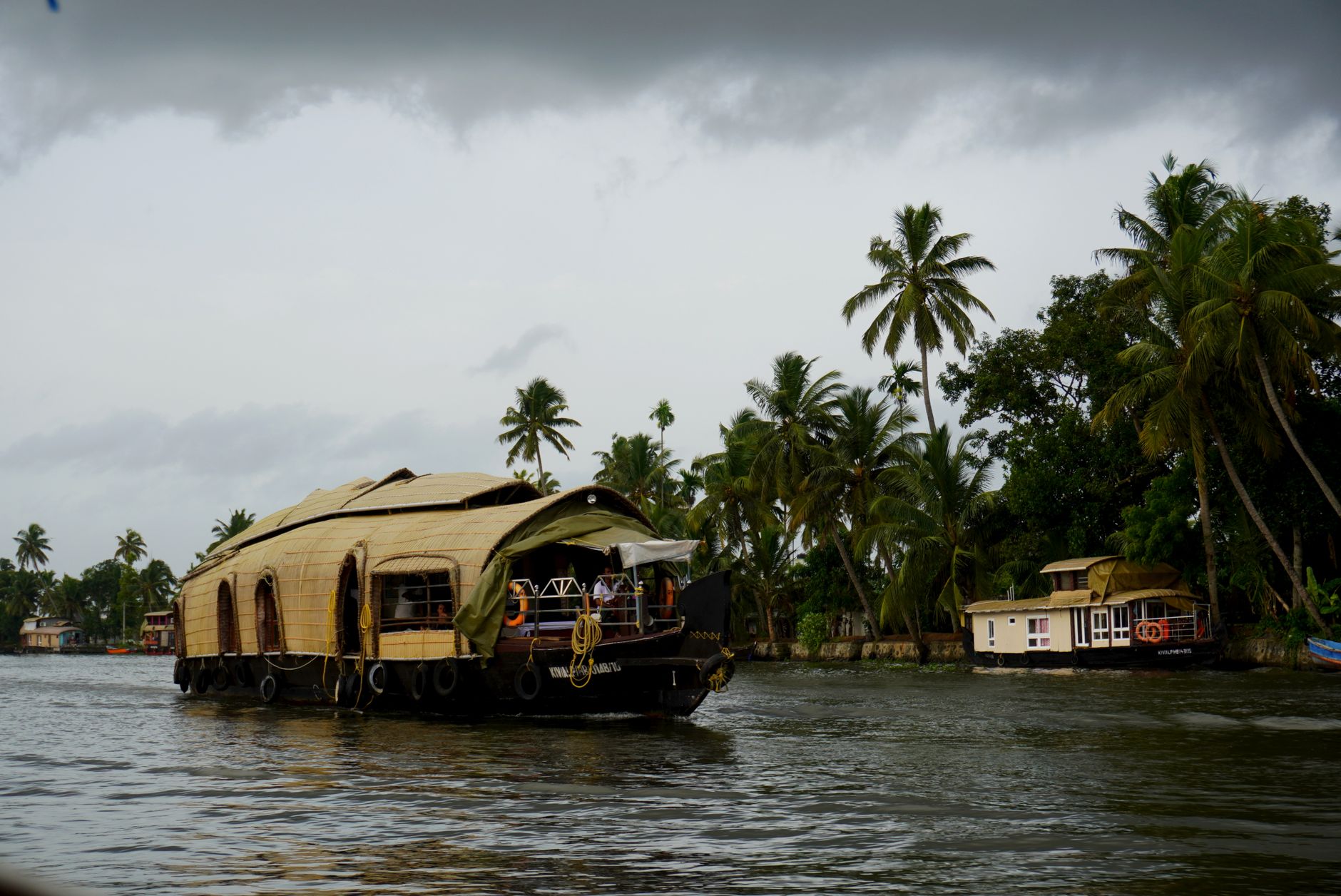
Photo: Ravindra Nadkarni / Pexels
Muziris: India's Lost Port That Made Rome Pay in Gold
Two thousand years ago, before Kochi existed, the most valuable address on India's southwest coast was a port called Muziris. Ships from Egypt rode the monsoon across the open Arabian Sea to reach it, loaded up with pepper, pearls and ivory, and sailed home to make Roman merchants rich. The Roman writer Pliny the Elder grumbled that India was bleeding the empire of its silver and gold. And then, sometime in the medieval centuries, Muziris simply disappeared — its location argued over by historians for generations. It is one of the great vanishing acts of Indian history, and the clues that survive are genuinely thrilling.

The port that fed Rome's appetite for pepper
In the first century CE, the Roman world developed an obsession with black pepper. It was not a mild luxury but a craving that ran through Roman cookbooks, medicine and even tax records. Pepper grew best on the hills behind the Malabar coast, and the gateway to that supply was Muziris, somewhere near present-day Kodungallur in central Kerala.
What made the trade explode was the monsoon. Greek and Roman sailors learned to use the seasonal winds to run straight across the ocean instead of hugging the coast for months. A merchant could leave Egypt's Red Sea ports in summer, catch the southwest monsoon, reach the Indian coast in weeks, trade, wait for the winds to reverse, and be home within a year. That single piece of knowledge turned a trickle of trade into an industrial-scale operation.
Muziris appears by name in two remarkable Roman-era documents. One is the Periplus of the Erythraean Sea, a practical handbook written by an anonymous Greek-speaking merchant, which describes the port and the goods you could buy there. The other is the Tabula Peutingeriana, a medieval copy of a Roman road map, which marks Muziris on the Indian coast and — astonishingly — places a building labelled a temple of Augustus nearby, hinting that Romans may have lived or worshipped at the site.
A papyrus that priced a single shipload
The most spectacular evidence is a battered scrap of papyrus written in Greek, discovered in Egypt and now usually called the Muziris Papyrus. It records the terms of a business deal between a financier and a merchant over a cargo carried from Muziris on a ship named the Hermapollon.
What survives is essentially an ancient invoice and loan agreement. It lists the cargo — sacks of pepper, ivory tusks, and a fragrant plant material — and works out the import taxes the Roman state would take in Egypt. The numbers are eye-watering. Even after a quarter of the value was creamed off as tax, the single shipload was worth a fortune, the kind of sum that could buy large estates back in Italy. This was not exotic dabbling; it was high finance, with credit, collateral and risk-sharing across thousands of miles. The papyrus shows that voyages to Muziris were backed by serious investors who treated a pepper run the way modern banks treat a commodities shipment.
How much Roman gold actually flowed to India
The Romans paid largely in coin, because India in this period wanted bullion more than it wanted Roman manufactured goods. Pliny the Elder famously complained about the drain of precious metal eastward, putting eye-popping annual figures on what India, Arabia and China were costing the empire. Historians debate how literally to take his numbers — he was partly moralising about Roman luxury — but the physical evidence backs up the broad picture.
Hoards of Roman gold and silver coins have turned up across South India, especially in the interior of Tamil Nadu and Kerala, often clustered along the routes that fed the coastal ports. Many bear the faces of emperors like Augustus and Tiberius. Some appear to have been used as money, others valued simply as reliable metal; a number were even slashed with a chisel mark, possibly to check the gold or to cancel the emperor's authority. Whatever the reason, the coins are mute confirmation that for a stretch of decades, Roman wealth really did pour into peninsular India in exchange for what the Romans called the spices of the East.
The search for the lost city of Muziris
Here is where the story turns into a detective case. Despite all this fame, nobody could point to where Muziris actually stood. For centuries the question hung over historians of South India, with candidates proposed up and down the coast.
The strongest lead emerged from excavations at Pattanam, a village near North Paravur in Ernakulam district, Kerala. Digging there uncovered a dense layer of early historic material: fragments of Roman wine and oil jars known as amphorae, Mediterranean fine pottery, glass and semi-precious stone beads, and signs of a working waterfront with brick structures and a wharf. The mix of local and Mediterranean finds, the date range, and the location all fit what the texts describe. Most scholars now treat Pattanam as the leading candidate for Muziris, or at least for a major part of the Muziris trading zone.
It is worth being honest about the uncertainty. The identification is widely accepted but not absolutely proven; no inscription has popped out of the ground reading 'Muziris'. Ancient ports were often sprawling networks of jetties and settlements rather than a single walled city, so the truth may be that Muziris was a stretch of coast rather than one tidy dot on a map. That ambiguity is part of why the site still draws researchers and arguments.
The flood that rewrote a coastline
So how does a port this rich and this connected just vanish from the record? The most popular explanation involves water. Tradition and several historians point to a catastrophic flood of the Periyar river, commonly dated to the fourteenth century, that violently rearranged the coastline. Silt is thought to have choked the old harbour and shifted the river's mouth, while the same upheaval is credited with opening up the natural harbour at Kochi.
If that account is right, it is one of history's great accidents: a single season of flooding ended the long career of one port and launched the rise of another that would go on to host Arab, Chinese, Portuguese, Dutch and British traders in turn. Kochi's gain was Muziris's burial. The older trade had also been fading for other reasons — Roman demand cooled as the western empire weakened, and the rhythms of Indian Ocean commerce kept changing — so the flood may have been the final blow to a port already past its peak rather than a bolt from a clear sky.
Why Muziris still matters
It is tempting to file Muziris under romantic ruins, but it carries a sharper lesson. Long before European colonialism, India sat at the centre of a globalised economy, exporting high-value goods and pulling in foreign bullion on its own terms. The relationship with Rome was not one of a passive supplier; Indian merchants, guilds and rulers set the prices for products the rest of the world could not grow as well.
The story also reshapes how we picture ancient India's connections. Roman pottery in a Kerala village, a Greek contract about an Indian cargo, emperors' coins buried in Tamil fields — together they describe a coast that was cosmopolitan two millennia ago, alive with sailors, financiers and translators.
Kerala has tried to honour that legacy through a heritage project gathering the region's layered past under the Muziris name, weaving together the ancient port, later trading communities and colonial-era monuments. Whether or not Pattanam is finally confirmed beyond doubt, Muziris endures as a reminder that some of the most important places in history are the ones we have to dig, decode and reimagine — a city that made Rome pay in gold, then slipped beneath the silt and the centuries.