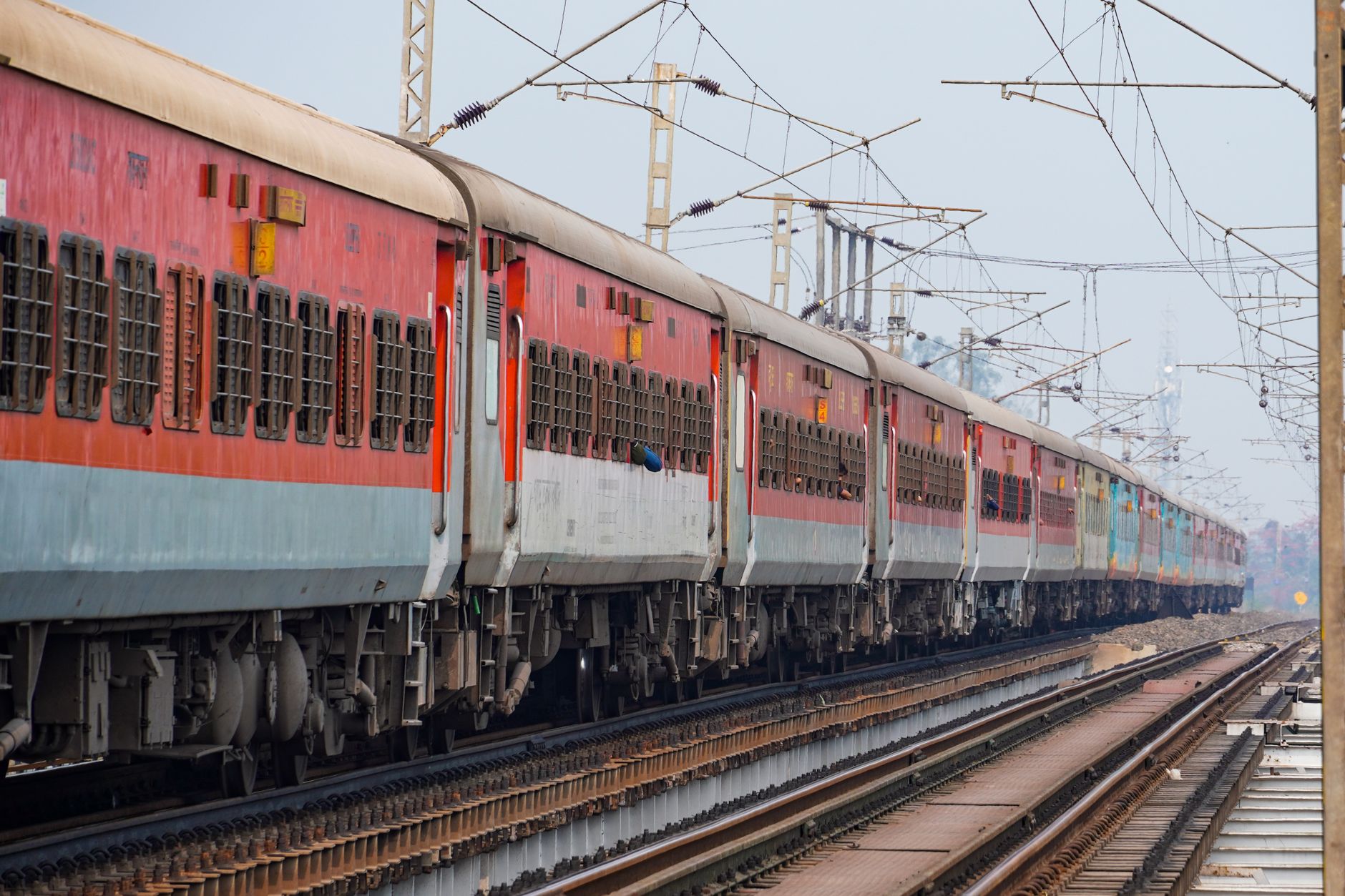
Photo: Rounak Kayal / Pexels
GNWL Clears, TQWL Rarely Does: Train Waitlist Codes
If you have ever stared at a railway ticket that says GNWL 42/WL 21 and wondered whether you will actually travel, you are not alone. Those cryptic train waitlist codes decide your trip far more than the plain waitlist number does, and most travellers never learn to read them. The letters in front of the number tell you which pool your seat will come from, and that pool is the single biggest clue to whether you will be sleeping on a berth or arguing with the TTE.
Indian Railways runs one of the busiest reservation systems on earth, and to manage demand across thousands of stations it splits every train's seats into quotas. Your waitlist code is simply a label for the quota you are queued against. Knowing the code helps you judge confirmation odds before you pay, pick a smarter boarding station, and avoid the nasty surprise of an auto-cancelled ticket on the morning of travel.

What the letters actually stand for
Every code is built from an abbreviation plus your position number. Here are the ones you will meet most often:
- GNWL (General Waiting List): Issued when you book from the train's originating station or a major early stop. This is the queue you want.
- RLWL (Remote Location Waiting List): For passengers boarding at important intermediate stations along the route, drawing on a small quota set aside for that stretch.
- PQWL (Pooled Quota Waiting List): A shared quota covering several smaller stations between two points on the route, used when you travel between two mid-route stops.
- TQWL (Tatkal Waiting List): Created when Tatkal seats sell out. It was earlier shown as CKWL.
- RAC (Reservation Against Cancellation): Not strictly a waitlist. You get to board and share a single berth with another RAC passenger until a full berth frees up.
There are rarer variants too, such as RSWL (Road Side Station Waiting List) for stations near the origin, and RLGN, which is what an RLWL ticket is renamed once it is booked online. The principle stays the same: the prefix tells you the quota, and the quota tells you the odds.

Why GNWL almost always wins
The most useful thing to understand is the priority order. When the system releases seats, it clears them roughly in this sequence: GNWL first, then RLWL, then PQWL, and TQWL last.
GNWL is tied to the originating station's main quota, which holds the largest block of berths. When confirmed passengers cancel, those berths flow straight to the general waiting list. That is why a GNWL ticket with a number in the 30s or 40s on a popular route can still turn confirmed, while a single-digit RLWL ticket sometimes does not budge.
This leads to a counter-intuitive rule that seasoned travellers swear by: a higher GNWL number often beats a lower RLWL number. Position is not destiny. The size of the quota behind your code matters more than where you stand in line.
The trap inside RLWL and PQWL
RLWL and PQWL are where people get burned. Both rely on quotas carved out for intermediate stations, and those quotas are small by design. A remote-location quota for a busy junction might be just a handful of berths. If nobody holding those specific berths cancels, your waitlist simply does not move, no matter how low your number looks.
PQWL is shared across multiple small stations at once, so you are competing with passengers boarding and alighting at completely different stops. Confirmation depends on cancellations from that exact pool, which makes it slow and unpredictable. As a rough guide, treat RLWL and especially PQWL as low-confidence bets unless your number is genuinely small and the route has heavy turnover.
A practical workaround: if your journey allows it, check whether booking from the train's starting station gives you a GNWL ticket instead. Many travellers book a slightly longer segment from the origin precisely to escape the remote-quota trap, then board at their actual station.
Why Tatkal waitlists are the worst bet
TQWL sits at the bottom of the pile, and the reason is economic, not technical. Confirmed Tatkal tickets carry no refund if cancelled. Because passengers lose their entire fare on cancellation, almost nobody cancels a confirmed Tatkal ticket. With so few cancellations feeding back into the system, there is little to release to the Tatkal waiting list.
On top of that, in the clearing order TQWL is processed after the general lists. So even when a few berths do open up, GNWL passengers are served first. If your only option shows TQWL, plan a backup. The odds are stacked against it.
Chart preparation: the moment of truth
Your fate is sealed at chart preparation, when the railways finalise who travels. The first reservation chart is typically prepared a few hours before departure, and a second chart is drawn up closer to the train leaving, often around 30 minutes before, to fill seats freed by last-minute cancellations.
Two things happen at chart prep that every passenger should know:
- RAC tickets may convert to confirmed, and waitlisted tickets that have climbed high enough get confirmed berths.
- Any IRCTC e-ticket still fully waitlisted is automatically cancelled, and the fare is refunded to your account. You are not allowed to board on it.
This automatic cancellation is the part that catches people out. A counter ticket bought at a station window behaves differently: a waitlisted PRS ticket is not auto-cancelled, and technically that passenger can attempt to board, though without a confirmed berth. For online bookings, though, no confirmation means no journey.
How to use this before you book
Reading the code is only half the job. Here is how to turn it into a decision:
- Prefer GNWL. If two options exist, the one originating earlier on the route usually gives you a stronger queue.
- Be wary of low PQWL and RLWL numbers. A small number is not a guarantee when the quota itself is tiny.
- Treat TQWL as a long shot. Keep an alternative train, bus or flight in mind.
- Value RAC highly. An RAC ticket lets you board and travel; it is far safer than a deep waitlist, even if you start with a shared berth.
- Check the confirmation prediction, but verify the code. Prediction tools estimate odds from past data, yet the quota behind your code is the real driver.
The railways also let you opt for alternative arrangements and confirmation-probability displays at the time of booking, which are worth using. But the most reliable signal is sitting right there on your ticket. Once you can read GNWL, RLWL, PQWL and TQWL at a glance, you stop gambling on the waitlist and start making an informed call about whether to book, switch trains, or look elsewhere entirely.
Next time the screen flashes a string of letters and a number, you will know exactly which queue you have joined, and roughly what it is worth.