Photo: Markus Winkler / Pexels
Brahmi Decoded: How India Got Ashoka Back in 1837
The empire nobody could read
For close to six centuries, Indians walked past some of the most important sentences ever written on the subcontinent and could not understand a single one. Tall polished sandstone pillars and smoothed boulders across the land were covered in neat rows of strange characters — clearly writing, clearly old, clearly important — yet entirely silent. The script was Brahmi, the ancestor of nearly every Indian writing system today, and by roughly 350-500 CE it had drifted so far out of use that no living person could read it.
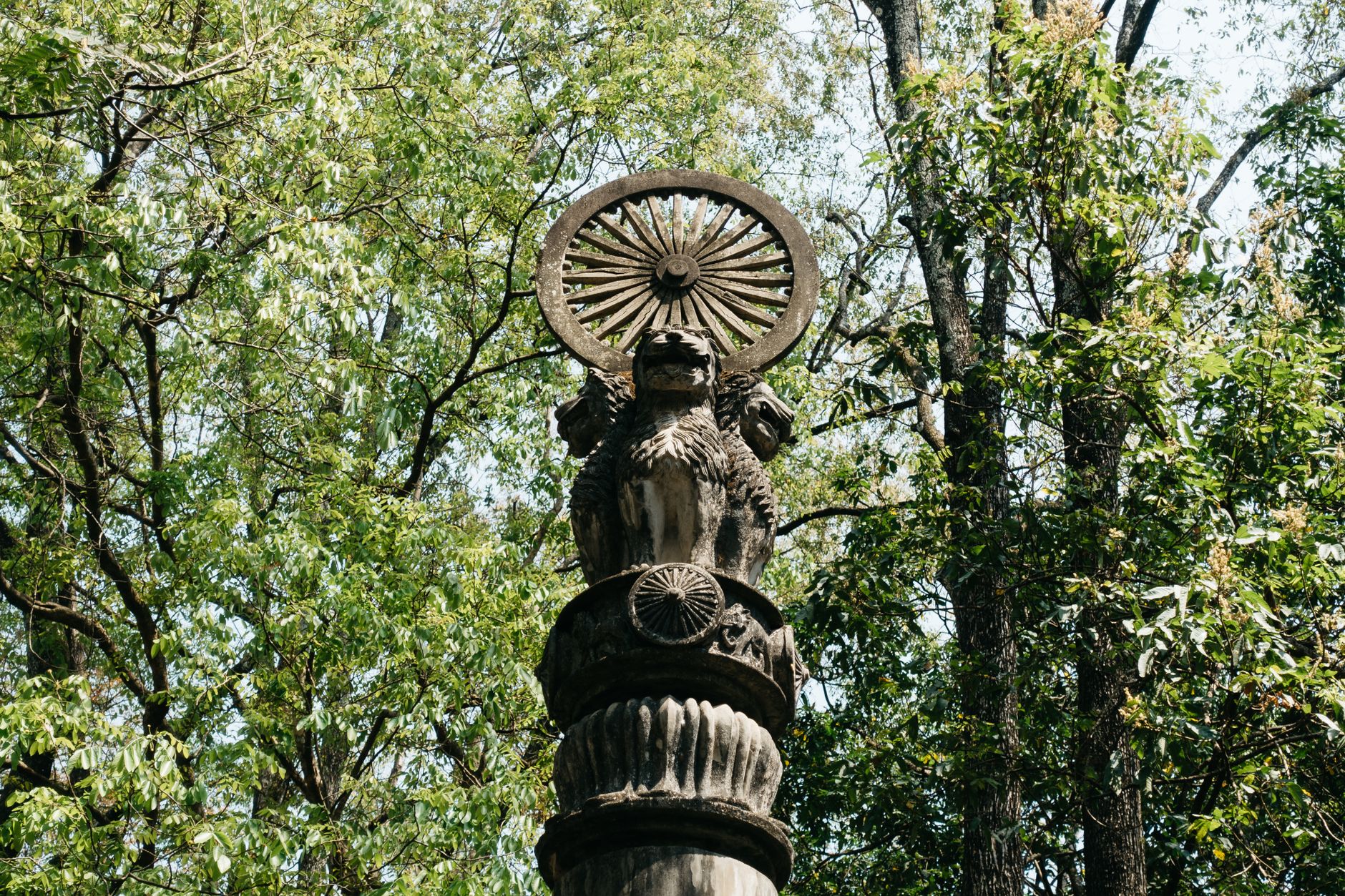
That silence broke in 1837, when a mint official in Calcutta named James Prinsep finally cracked the code. The decipherment did something almost unique in world history: it handed an entire civilisation back a forgotten emperor. The man those mysterious pillars belonged to turned out to be Ashoka, the Mauryan ruler whose lion capital now sits on India's national emblem and whose wheel spins at the centre of the flag.

Pillars that mocked emperors
The strangeness of the situation is worth sitting with. These were not obscure scratchings in a cave. Ashoka had deliberately erected his messages in the busiest, most public places he could find, polished to a mirror shine, so that travellers and subjects would see them for generations.
Instead, generations forgot. By the medieval period the inscriptions had become genuinely uncanny objects. When the Delhi Sultan Firuz Shah Tughlaq had two of the great pillars hauled to Delhi in the 1350s, his scholars could not read them and concluded the marks were magical or simply decorative. A monument designed to be understood forever had outlived comprehension itself.
This is the part most people miss about ancient Indian history: huge chunks of it were not slowly lost so much as suddenly orphaned. Without a readable script, the Mauryas survived only as half-legend in religious texts. There was no firm anchor — no securely dated emperor — on which to hang the centuries before the Guptas.

Enter James Prinsep
Prinsep was not a professor. Born in 1799, he came to India as an assay master, the technical official who tested the purity of metal at the East India Company's mints, first at Benares and then Calcutta. It was precise, fiddly work, and it suited a mind that loved patterns and measurement.
As secretary of the Asiatic Society of Bengal, he became the clearing-house for every odd coin, copper plate and rubbing of an inscription that British officers and Indian collectors dug up across the country. Antiquarians had been staring at Brahmi for decades and getting nowhere. What Prinsep brought was the assayer's habit of treating an unknown like a system to be solved, not a mystery to be admired.
The 'danam' breakthrough
The crucial clue came from the railings of the Sanchi stupa. Here there were not one or two long inscriptions but dozens of very short ones — the records of ordinary donors who had paid for a pillar or a carved panel.
Prinsep noticed something an assayer would notice: nearly all these little inscriptions ended in the same two characters. He reasoned that humble gift-records were likely to repeat a single formula, most probably the word for "gift" — danam in the old language. If those final letters were da and na, he suddenly had hard values for two signs he could test everywhere else.
From that toehold the whole structure came apart in the best way. Letter by letter, he pushed the known values into longer texts, checked whether the results formed real words, corrected, and pushed again. Within a remarkably short span in 1837 the Brahmi alphabet stood essentially decoded. A related but distinct script, Kharosthi, used in the northwest, fell soon after, helped along by bilingual coins of the Indo-Greek kings that paired Greek letters with the unknown script — a ready-made cheat sheet.
'Beloved of the Gods' — but who?
When Prinsep finally read the long pillar and rock texts, a single author kept introducing himself by an unusual royal style: Devanampiya Piyadasi, "Beloved of the Gods, of gracious mien." The voice was unmistakable — a king talking directly to his people about non-violence, kindness to servants, respect across religions, the welfare of animals and the planting of trees.
But a title is not a name, and at first nobody knew which king this was. The answer came from outside India. George Turnour, a civil servant in Ceylon working through Pali chronicles like the Mahavamsa, found that Piyadasi was used there as an epithet for the emperor Ashoka. Cross-reference the two and the pillars had a name at last.
The payoff was enormous. The edicts even mention contemporary Greek kings by name, and those rulers can be dated from Mediterranean sources. That gave Indian history something it had badly lacked — a firm, externally verifiable date in the 3rd century BCE to build everything else around.
Why a dead script still matters
It is tempting to file all this under dusty antiquarianism. It is the opposite. Consider what the decipherment actually delivered:
- A verifiable emperor. Ashoka moved from pious legend to a documented historical figure with his own words on record.
- A date anchor. The Greek synchronisms let scholars fix Mauryan chronology, steadying the timeline for everything around it.
- A national vocabulary. The Ashokan lion capital and the Dharma Chakra became the Republic of India's emblem and the wheel on its flag — symbols recovered, not invented.
- A method. Prinsep's pattern-and-test approach became the template for Indian epigraphy, the study of inscriptions that still rewrites textbooks today.
There is also a quieter lesson about memory. A society can lose the key to its own records while the records sit untouched in plain sight. The information never vanished; the ability to read it did. That gap is exactly what the 1837 breakthrough closed.
The man who got only three more years
The story has a melancholy coda. Prinsep drove himself relentlessly, and his health collapsed under the strain. He sailed home to England and died in 1840, aged just 40, only three years after his greatest work. He never saw how completely he had reshaped the understanding of India's past.
Kolkata remembers him at Prinsep Ghat, the riverside colonnade that still carries his name. It is a fittingly understated memorial for a man who never sought the spotlight and is barely known to the public whose history he restored.
What a reader can take away
If you visit a museum and see a worn pillar fragment behind glass, you are looking at the raw material of this detective story. A few practical things are worth carrying out of it.
First, never assume "ancient and unreadable" means "lost forever" — most decipherments hinge on one repeated, boring word, like danam, not on a magic spark. Second, inscriptions outrank chronicles for hard facts: a king's own dated stone is harder to embellish than a story copied for centuries. Third, the next time you see the Ashoka Chakra on the flag or the lions on a government seal, remember they are not decorative flourishes but the salvaged voice of a 3rd-century-BCE ruler — pulled back from total silence by one stubborn man counting letters at a mint.