Photo: Enrico Bellodi / Pexels
Comet 3I/ATLAS May Be Older Than the Sun, Webb Data Suggests
Picture a chunk of ice and dust that froze solid before the Sun had even switched on, drifted across the galaxy for billions of years, and then sailed straight through our neighborhood in 2025. That is the story astronomers are now telling about comet 3I/ATLAS, and they have the chemistry to back it up.
Using NASA's James Webb Space Telescope, a research team has found that this interstellar visitor carries a chemical signature unlike anything born in our solar system. Their reading suggests 3I/ATLAS may have formed 10 to 12 billion years ago — long before the Sun, the planets, or Earth existed. The work was published in the journal Nature on June 22, 2026.

A visitor that didn't belong here
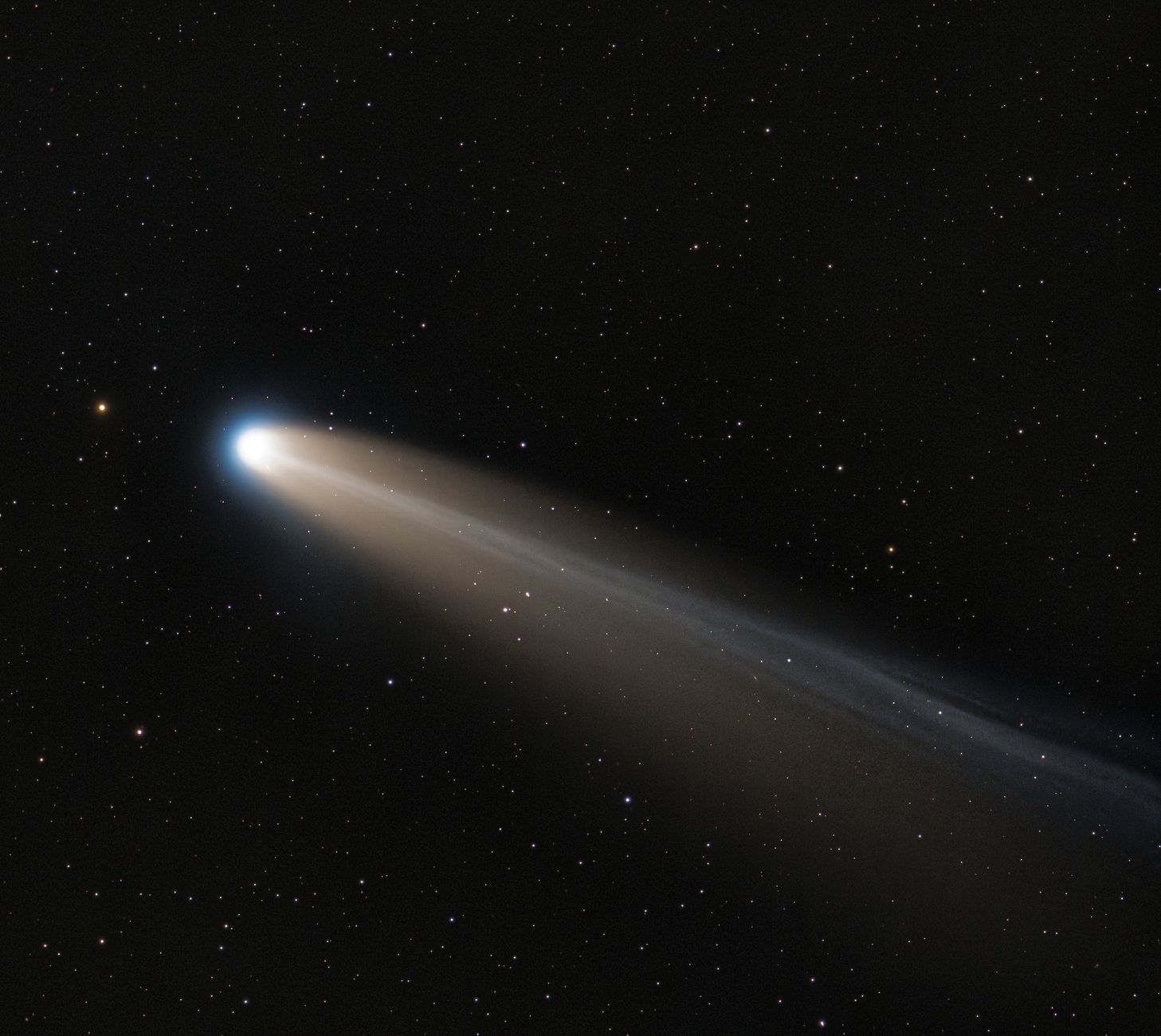
3I/ATLAS was spotted on July 1, 2025, by the NASA-funded ATLAS survey, which scans the sky from a telescope in Chile. The clue that set it apart was its speed and the shape of its path. When discovered it was already moving at roughly 137,000 miles per hour, far too fast for the Sun to have ever trapped it in orbit.
That made it only the third confirmed interstellar object ever seen passing through our solar system, after the cigar-shaped 'Oumuamua in 2017 and comet 2I/Borisov in 2019. Unlike a normal comet that loops around the Sun on a long but closed orbit, 3I/ATLAS arrived from the dark between the stars and is now leaving the same way, never to return.
It reached its closest point to the Sun in late October 2025, swinging in to about 1.4 astronomical units — just inside the orbit of Mars — before the Sun's gravity flung it back outward, briefly boosting it to around 153,000 miles per hour.
Why Webb waited for the comet to leave
The most revealing observations didn't happen during the dramatic close pass. They came afterward, from December 2025 onward, as the comet began heading back into deep space.
That timing matters. Webb's NIRSpec (Near-Infrared Spectrograph) reads the light coming off the gas and dust streaming from a comet, and from that light scientists can pick apart exactly which molecules are present and in what proportions. As the comet warmed and shed material, it laid bare its internal recipe: water, carbon dioxide, carbon monoxide, methane, and cyanide, among other compounds.
The real prize wasn't the list of ingredients. It was the precise ratios of certain atoms hiding inside them.
The 30-to-1 clue
The headline number is about deuterium, a heavy version of hydrogen with an extra neutron. Comets that formed in our own solar system carry a fairly predictable amount of it. 3I/ATLAS carries roughly 30 times more.
That is an enormous difference, and it points squarely at how and where this object was made. A high deuterium load is the chemical mark of an extremely cold, deeply frozen birthplace. The comet appears to have spent its formative years locked in ice at temperatures far below anything our local comets experienced.
Lead author Martin Cordiner, an astrochemist at NASA's Goddard Space Flight Center, described the moment as a rare chance to examine an ancient object that likely predates the Sun and the solar system. In plain terms: we sent no probe, yet a relic from the deep past delivered itself to our doorstep.
Reading a comet's age in carbon
The deuterium isn't the only fingerprint. Webb also measured the balance between two forms of carbon, carbon-12 and the slightly heavier carbon-13. In 3I/ATLAS, carbon-13 was strikingly scarce.
That scarcity is, in effect, a clock. Galaxies grow richer in carbon-13 over time, because each generation of stars that lives and dies seeds the surrounding gas with more of it. A system born when the galaxy was young — before many of those stellar generations had run their course — would carry very little. The low carbon-13 reading therefore lines up with the deuterium evidence, both pointing to a very early origin in the history of our galaxy.
The team places that origin around cosmic noon, the era roughly 10 to 12 billion years ago when star formation across the universe was running at full tilt. If that holds, 3I/ATLAS was already an old, cold traveler by the time our own solar system began to take shape about 4.6 billion years ago.
What this tells us — and what it doesn't
It is worth being precise about the claim. The evidence is chemical and statistical, not a birth certificate. Webb cannot point to the exact star or cloud where this comet condensed. What it can do is show that the building blocks of 3I/ATLAS simply do not match the recipe of anything cooked up near the early Sun.
That alone reframes the comet as a kind of time capsule. Consider what the findings open up:
- A direct chemical sample of conditions in the galaxy billions of years before Earth existed, without launching a single spacecraft.
- A yardstick for measuring how typical — or how unusual — our own solar system's chemistry really is.
- Fresh evidence that the galaxy has been quietly shuttling ancient material between star systems for eons.
Cordiner framed the double payoff neatly, noting that the comet gives both insight into that distant time and place and a lesson in how unusual our own solar system may be.
A growing catalogue of cosmic drifters
Three interstellar objects in less than a decade is not a coincidence. It reflects how much sharper our sky surveys have become at catching faint, fast-moving specks. Each new visitor has been richer than the last in what it reveals: 'Oumuamua was a tumbling mystery glimpsed too late, Borisov behaved like a recognizable comet, and 3I/ATLAS has now been pinned down to a startling estimated age.
The pace is only set to quicken. New observatories built to scan the entire sky night after night are expected to flag many more such travelers in the coming years, and astronomers will be ready to swing instruments like Webb onto them within days of discovery.
For now, 3I/ATLAS is already receding, carrying its ancient ice back into the dark. But the data it left behind will be studied for a long time. A lump of frozen material that may have formed before our Sun took its first breath came close enough for us to read its chemistry — and then quietly continued on its way across the galaxy.