Photo: Mrudula Thakur / Pexels
12 Hidden Facts About India's Most Famous Monuments
You can visit the Taj Mahal a dozen times and still miss the fact that its towers are deliberately crooked. India's famous monuments are full of these quiet engineering tricks and forgotten stories, the kind that rarely make it onto the signboard at the entrance. We pulled together twelve of the most surprising ones, the sort of facts that change how you look at a place you thought you already knew.

The Taj Mahal keeps a few secrets
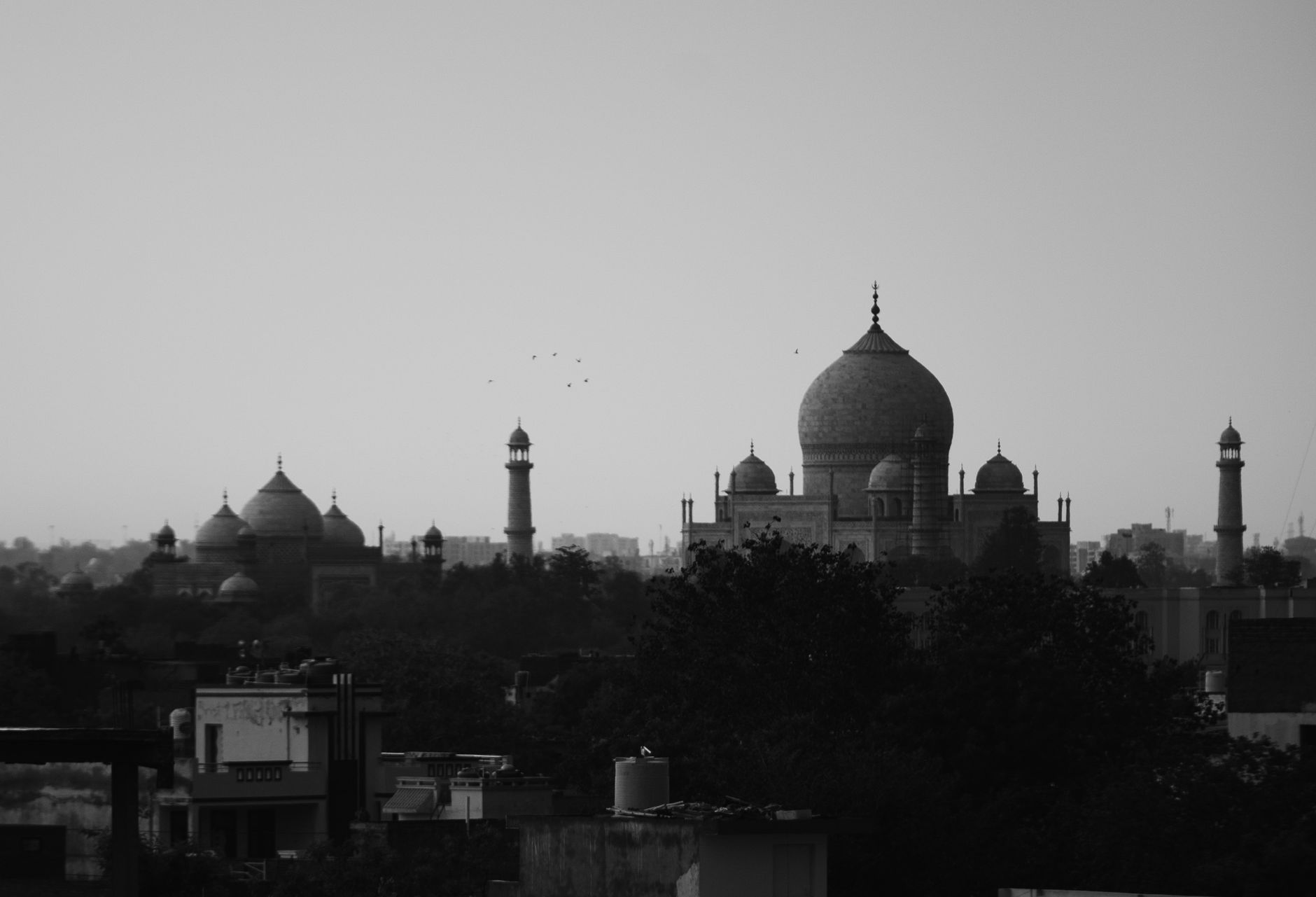
Start with those four white minarets at Agra. They look perfectly upright, but each one tilts slightly outward, away from the central tomb. The builders did this on purpose. In an earthquake, the towers would fall away from Mumtaz Mahal's resting place rather than crashing down onto it. It's a 17th-century insurance policy hiding in plain sight.
The marble itself is doing something clever too. Quarried at Makrana in Rajasthan, it is faintly translucent, which is why the building seems to shift colour through the day. Soft pink at sunrise, plain white by noon, and a pale gold under a full moon. None of it is paint.
Underneath all that stone sits a foundation many people would find alarming: a base resting partly on timber. Wood normally rots, but the structure stands beside the Yamuna, and the damp soil has kept the timber swollen and intact for nearly four centuries. The river isn't just scenery; it is part of the structure.
Towers, gates and the British paint job
The Red Fort in Delhi has a confusing name, because it wasn't always red. Large sections were originally finished in white. As the lime plaster flaked away, the British are said to have painted the exposed walls red to keep the look consistent, and the colour stuck along with the name.
Over in Mumbai, the Gateway of India carries a small irony. It was built to mark the 1911 visit of King George V, the first British monarch to come to India. The catch is that the grand arch wasn't finished until 1924, more than a decade after he sailed in. The king never actually passed through the monument built to welcome him.
Kolkata's Victoria Memorial has a quieter connection to Agra. The gleaming white marble that makes it glow at dusk comes from the very same Makrana quarries that supplied the Taj Mahal. Two of India's most photographed buildings, separated by centuries and a thousand kilometres, are cut from the same hillside.
A palace you enter from the back
Jaipur's Hawa Mahal is one of the most photographed facades in the country, that five-storey honeycomb of pink sandstone with hundreds of tiny windows. Yet almost nobody arrives the way you'd expect. There is no grand entrance on the famous front. You walk in from a modest gate at the rear.
The building is essentially a tall screen, barely a room deep in places, and it has no deep foundation to speak of. Its curved shape and light frame keep it standing, which is why it often turns up on lists of the tallest structures built without a conventional foundation.
The design had a clear purpose. Its roughly 953 latticed windows, the jharokhas, let the women of the royal household watch street processions and festivals below without being seen. They also funnel breeze through the building, which is how the "Palace of the Winds" got its name and stays cool in the Rajasthan heat.
A fort where the walls really do have ears
Golconda Fort in Hyderabad was built as a fortress, and its cleverest weapon was sound. The Qutb Shahi rulers shaped the acoustics so precisely that a single clap at the main Fateh Darwaza gate can be heard at the Bala Hisar pavilion at the top of the hill, almost a kilometre away. It worked as an early warning system: guards at the entrance could signal the royal court above without a runner or a horn.
Hyderabad also clings to one of India's favourite monument legends, a supposed secret tunnel linking Golconda to the Charminar, several kilometres away, as a royal escape route. It's a great story. Historians are far less convinced, pointing out that the rocky plateau makes such a tunnel almost impossible to dig. Despite repeated searches, no one has ever found it.
Temples that track the sun and defy gravity
The Konark Sun Temple in Odisha was designed as a colossal stone chariot for the sun god, pulled by carved horses and riding on 24 giant wheels. Those wheels are not just decoration. Several of them work as accurate sundials. Line up the shadow cast by the central axle against the spokes and you can read the time of day, an idea many visitors still test for themselves.
Then there is Lepakshi in Andhra Pradesh, home of the famous hanging pillar. One of the temple's stone columns doesn't quite touch the ground; you can pass a thin sheet of paper or cloth underneath it. It's become a small ritual for visitors, and a reminder of just how confident the original masons were.
Stumbled upon and almost lost
Some of India's greatest sites survive by luck. The Ajanta Caves in Maharashtra, with their extraordinary Buddhist murals, sat forgotten in a forested gorge for centuries. In 1819, a British officer named John Smith spotted an arch while out on a tiger hunt and rediscovered the complex by accident. The paintings inside had been waiting in the dark for well over a thousand years.
And a couple of bonus details worth carrying with you:
- Mysore Palace switches on close to 97,000 light bulbs on Sunday evenings and during Dasara, turning the whole building into a glowing outline visible across the city.
- The Sanchi Stupa in Madhya Pradesh, one of India's oldest stone structures, was commissioned by Emperor Ashoka in the 3rd century BCE, long before most of the monuments on this list existed.
Why these details matter
It's easy to treat famous Indian monuments as backdrops for a photograph, tick them off a list and move on. The leaning towers, the whispering walls and the sundial wheels tell you something more useful: these places were engineered by people solving real problems, whether that was surviving an earthquake, spotting an enemy or beating the summer heat.
Next time you stand in front of one, look for the part the guidebook skips. The story hiding in the stonework is usually the one you'll actually remember.