Photo: Mrudula Thakur / Pexels
The Red Fort Wasn't Always Red: 8 Indian Monument Secrets
Most of us have stood in front of these places at least once, phone out, jostling for the postcard shot. We rarely look closer. Yet some of India's most famous monuments are hiding details that even regular visitors miss entirely. A fort that started out white. Towers built to fall the right way. A pillar that has outlasted empires without a fleck of rust.
Here are eight little-known facts about famous Indian monuments, each one verified and genuinely worth carrying with you the next time you go.

The Red Fort was never meant to be red
Start with the most famous misnomer in Indian heritage. The Red Fort in Delhi, the backdrop to every Independence Day address, did not always wear that deep red coat.
The Archaeological Survey of India has found traces of original lime plaster on several sections of the walls, a fine mix of lime, marble dust and other binders that once gave the surface a smooth, almost mirror-like white finish. Much of that plaster wore away over the centuries. When the British took over the fort, the weathered red sandstone underneath was left exposed, and stretches were painted red to even out the look. The colour we treat as timeless is, in a sense, a later edit.
The Taj Mahal's minarets lean on purpose
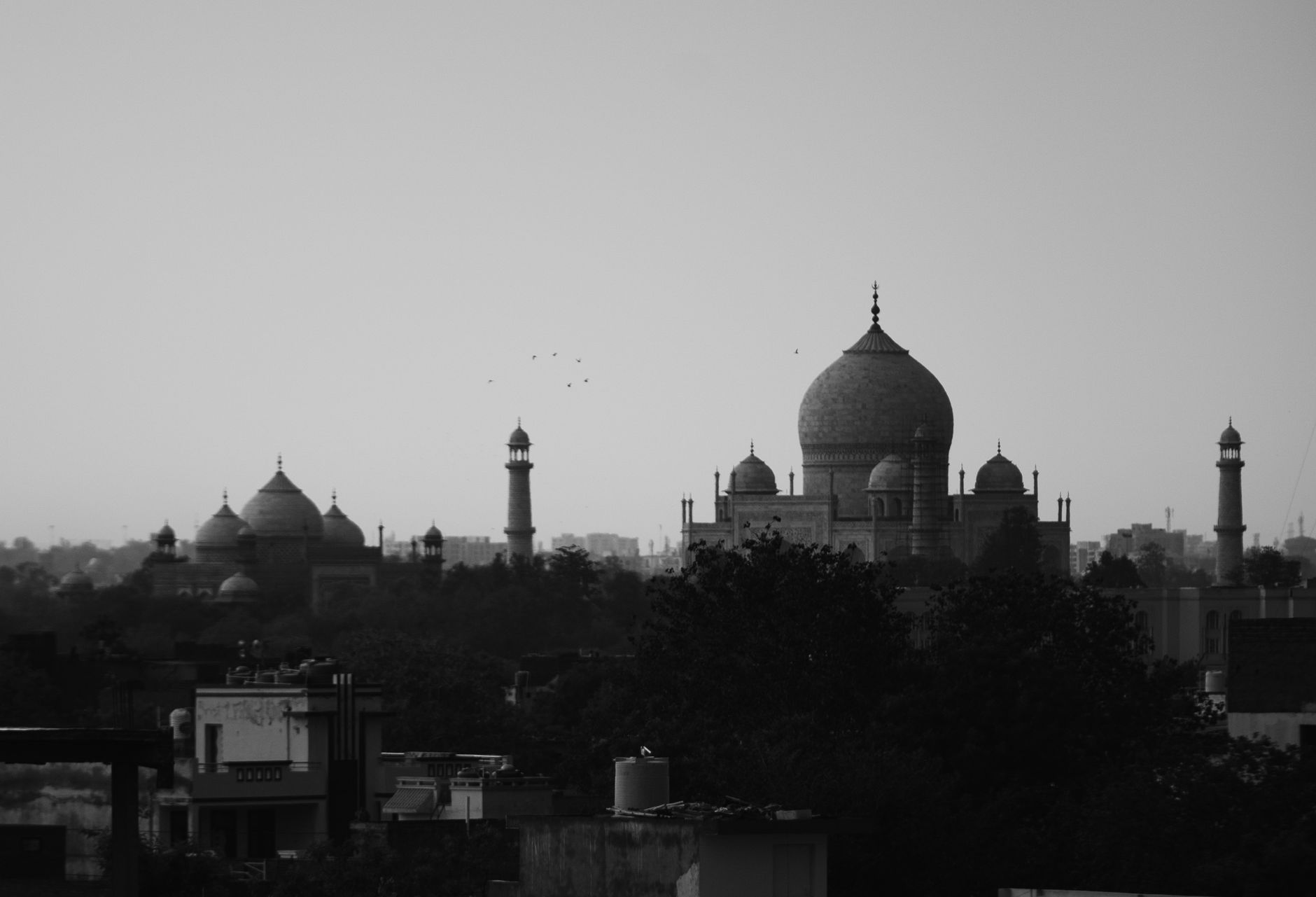
Look hard at the four white towers framing the Taj Mahal and they seem flawlessly upright. They are not. Each minaret tilts very slightly outward, by a couple of degrees.
This was no slip of the measuring rope. The builders angled the towers away from the central dome so that in the event of an earthquake, they would collapse outward, away from the tomb of Mumtaz Mahal and Shah Jahan, rather than fall inward and crush it. It is earthquake-aware design, worked out in the seventeenth century.
And there are sealed rooms beneath it
Below the main platform of the Taj sits a network of around 22 chambers, a run of larger halls and smaller rooms linked by narrow corridors. They were built as tahkhana, cool underground spaces that offered relief from Agra's brutal summers, and once carried painted decoration.
They have been kept locked for two practical reasons. The chambers help support the foundation, so heavy footfall could threaten the structure, and damage from the 1978 Yamuna flood pushed the ASI to seal them off. Predictably, the secrecy has spawned theories about hidden treasure and buried temples. Historians and the ASI have repeatedly found no evidence for any of it.
Delhi's Iron Pillar refuses to rust
In the courtyard near the Qutub Minar stands a slim iron column that has stood in the open for more than 1,600 years with almost no corrosion. For generations it was treated as near-magical.
The real answer is metallurgy, not magic. The wrought iron holds an unusually high phosphorus content, close to 1 percent, where modern iron sits well under 0.05 percent. Ancient smiths kept that phosphorus in and hammered the metal so it migrated toward the surface, forming a thin protective film known as misawite that has shielded the pillar ever since. The full mechanism was finally pinned down by researchers in 2003.
Hawa Mahal stands on almost nothing
Jaipur's pink five-storey screen, the Hawa Mahal, is famous for its honeycomb of windows. The exact count is 953 jharokhas, each a small carved opening that pulls air through the building. The effect keeps the interior breezy even in peak Rajasthan heat, an early use of what we now call the Venturi effect.
The stranger fact is structural. The Hawa Mahal was raised without a deep conventional foundation, often described as the tallest building of its type to stand this way. It survives because of its shape, a curved, pyramid-like profile that leans at about 87 degrees, balancing its own weight. Designed by Lal Chand Ustad and completed in 1799, it was meant as a screen from which royal women could watch the street unseen.
Konark's stone wheels can tell the time
The Konark Sun Temple in Odisha is shaped like the sun god's chariot, with 24 great wheels carved into its base. They are not only ornament. Several of these wheels function as sundials.
Each wheel has eight major spokes dividing the day into segments of about three hours, with finer markings between them. As the sun moves, the shadow of a spoke falls across the carved divisions, and a reader who knows the system can work out the time with surprising accuracy. Some of the wheels are said to work at night too, read against moonlight. It is thirteenth-century engineering doubling as sculpture.
Golconda Fort has a built-in alarm system
At Golconda Fort in Hyderabad, a clap of the hands at a particular spot under the dome of the Fateh Darwaza, the victory gate, carries clearly to the Bala Hisar pavilion at the fort's highest point, nearly a kilometre away.
This was not a party trick. The acoustics were engineered to act as an early warning, so a sentry at the gate could signal the royal quarters far above the moment trouble arrived at the entrance. The fort is also tangled in one of Hyderabad's favourite legends, a secret tunnel said to run all the way to the Charminar. Plenty of old structures have been dug up over the years, but the long passage itself has never been confirmed.
The Gateway of India began as cardboard
Mumbai's Gateway of India was built to mark the 1911 visit of King George V and Queen Mary. There is a catch. When the royal couple actually arrived, the monument did not exist yet. They were shown a cardboard model of the planned arch. The stone version was only finished in 1924.
The Gateway carries one more piece of irony. Built to welcome a British monarch, it became the exit point for the empire. The last British troops to leave independent India marched out through this arch in 1948.
Why these details matter
None of this changes a ticket price or a queue length. What it changes is how you look. A monument stops being a single famous silhouette and becomes a record of decisions, of builders solving for heat, earthquakes, sound and rust with the tools they had.
The next time you are standing in front of one of these places, give it the extra minute. Count the windows on the Hawa Mahal. Check which way the Taj's towers lean. The famous view is only the surface.