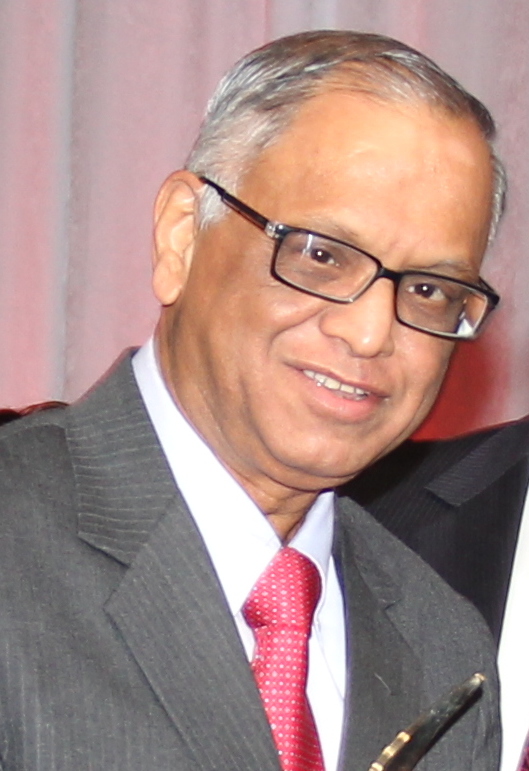
Photo: ps482207 · CC BY-SA 4.0 / Wikimedia Commons
Person of the Day: N. R. Narayana Murthy and the $250 Bet That Built Infosys
Few founders can point to a single, modest sum and say their life's work grew out of it. N. R. Narayana Murthy can. The man widely called the father of the Indian IT industry launched Infosys in 1981 with roughly $250 of borrowed money, a handful of colleagues and a stubborn belief that a software company run with honesty out of India could compete anywhere in the world. Today that bet underpins one of India's most valuable companies and a personal fortune Forbes estimated at about $5 billion in early 2025.
This is a career worth reading not because of the wealth at the end of it, but because of how unglamorous the beginning was. Murthy's story is less about genius and more about patience, discipline and a clear set of principles applied for decades.
From Mysore classrooms to a borrowed idea
Murthy's foundation was academic and unflashy. He earned a degree in electrical engineering from the National Institute of Engineering in Mysore in 1967, then a master's from IIT Kanpur in 1969. Those two campuses gave him the technical grounding, but it was his early jobs that shaped his thinking about what a well-run organisation should look like.
He worked at the Indian Institute of Management Ahmedabad as a chief systems programmer, an unusual role that put him close to both computing and management theory at a time when very few Indians had access to either. He absorbed how institutions are built, governed and held to standards.
His first attempt at running his own company, a venture called Softronics, did not last. It folded in about a year and a half. Rather than treating that as a verdict, he took it as tuition. He joined Patni Computer Systems in Pune, sharpening his understanding of the software business and the clients who paid for it.
The 1981 leap
In 1981, Murthy and six other software professionals decided to start something of their own. The capital was tiny by any measure, and most of it was borrowed. There was no office to speak of, no marquee client, no funding round. What they had was a thesis: India's deep pool of engineering talent could be organised to deliver software to companies abroad.
Murthy became the chief executive and stayed in that seat for 21 years, from 1981 to 2002. That longevity matters. He was not a founder who handed the controls to professional managers and stepped back. He ran the company through the lean years, when winning a single overseas contract could take months and a telephone line was a luxury.
The early going was slow and often discouraging. Infosys spent its first decade as a small player. The breakthrough came not from one lucky deal but from a way of working that the company refined patiently.
The model that changed Indian IT
The single most important idea Murthy is credited with is the Global Delivery Model. The principle sounds simple now and was radical then: take a piece of software work, break it into parts, and do each part wherever it can be done best and most cost-effectively, much of it in India, then deliver the finished result to a client anywhere in the world, on schedule and on budget.
That approach became the template for the entire Indian software services sector. Companies that came after Infosys, and many that competed with it, built their businesses on the same logic. When people talk about India becoming the world's back office for technology, they are describing a system that Murthy helped formalise and prove.
What made it credible to sceptical foreign clients was discipline. Infosys committed to predictable quality and timelines at a time when outsourcing to a developing country was seen as a gamble. Delivering on that promise, repeatedly, is what turned a risky idea into an industry.
Going public, and sharing the wealth
Two moves under Murthy's leadership stand out for how they reshaped expectations of an Indian company.
The first was governance and ownership. From 1994, Infosys rolled out one of India's earliest large-scale employee stock option programmes. Instead of concentrating the gains at the top, the company handed equity to employees, which famously created a generation of staff who built real wealth alongside the firm. It set a standard for how Indian technology companies would later attract and reward talent.
The second was the 1999 listing on NASDAQ, which made Infosys the first Indian company to list on the American exchange. For a firm born on borrowed pocket money less than two decades earlier, planting a flag on the same exchange as the world's biggest technology names was a statement about ambition and credibility.
Through all of it, Murthy pushed a culture built on meritocracy and transparency. He spoke often about "compassionate capitalism" and the idea that a company should create wealth legally and ethically, then use it responsibly. Whether or not every reader agrees with the phrase, it gave Infosys an identity that went beyond its balance sheet.
Stepping back, and what came next
Murthy handed the chief executive role to co-founder Nandan Nilekani in 2002, then served as chairman until 2011, when the board named him Chairman Emeritus. He briefly returned as executive chairman in 2013 during a transitional phase before stepping away again in 2014.
His work did not stop at Infosys. In 2009 he set up Catamaran Ventures in Bangalore, an investment firm that backs companies across public markets, private equity and early-stage ventures. It has become a vehicle through which he supports a new wave of founders, many of them decades younger than he was when he started.
He has also remained one of India's most quoted voices on entrepreneurship, work ethic, education and the responsibilities that come with success. His comments on how hard young people should work, and on building world-class institutions, regularly spark national debate, which says something about the weight his opinions still carry.
Why the journey still resonates
The recognition has piled up over the years. Murthy received the Padma Shri in 2000 and the Padma Vibhushan in 2008, India's second-highest civilian honour. France conferred its Legion of Honour on him, and Britain awarded him a CBE. He has been celebrated by business schools and global bodies as one of the defining entrepreneurs of his generation.
But the most useful part of his story for a reader in 2026 is not the trophy shelf. It is the shape of the climb:
- A failed first company that taught more than it cost.
- A tiny, borrowed sum turned into a global enterprise through patience, not shortcuts.
- A model of doing business, sharing ownership and keeping promises that an entire industry copied.
Narayana Murthy did not arrive with capital, connections or a guaranteed market. He built a method, applied it for decades and trusted that consistency would compound. For anyone weighing a leap of their own, that may be the most encouraging thing about his career: the starting line was far more ordinary than the finish.