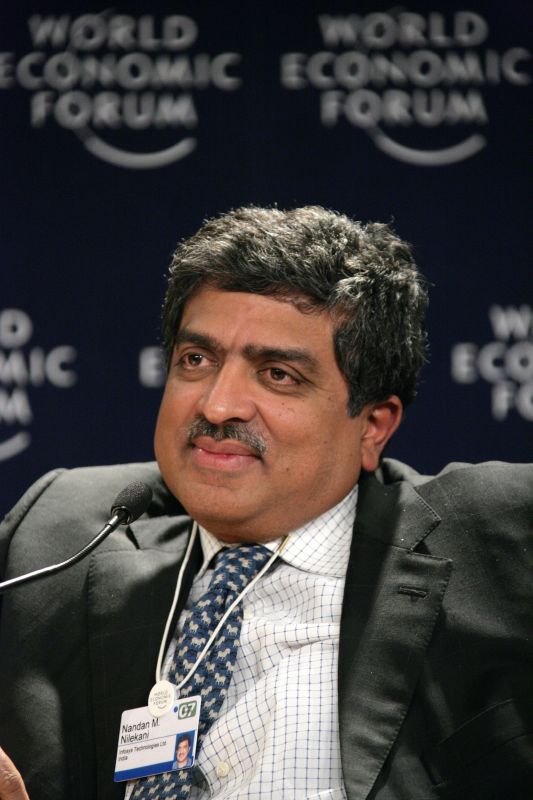
Photo: World Economic Forum from Cologny, Switzerland · CC BY-SA 2.0 / Wikimedia Commons
Person of the Day: Nandan Nilekani, the Engineer Who Gave India an Identity
Few people can claim to have built a company that reshaped how the world sees Indian engineering and then built a system that gave more than a billion people a verifiable identity. Nandan Nilekani has done both. At 71, the Infosys co-founder remains one of South India's most influential public figures, equal parts business builder and civic technologist, and his career reads like a map of how modern India learned to scale.
From a Bangalore boyhood to IIT Bombay
Nilekani was born on 2 June 1955 in Bangalore, Karnataka. Like many bright students of his generation, his path ran through one of the country's toughest entrance filters. He earned a B.Tech in Electrical Engineering from IIT Bombay in 1978, and the institute clearly stayed close to his heart: decades later he donated ₹315 crore to IIT Bombay, one of the largest gifts the campus has received.
What is striking about his start is how ordinary it looked. There was no instant founder myth. He was a freshly minted engineer looking for his first real job, and the company he joined would set the rest of his life in motion in a way nobody could have scripted.
The interview that changed everything
In 1978, Nilekani joined Patni Computer Systems in Mumbai. The man who interviewed him was N.R. Narayana Murthy. That meeting turned into a partnership. After about three years learning the software business from the inside, the two left Patni in 1981 along with five other colleagues to start their own firm with very little capital and a great deal of conviction.
That firm was Infosys. The seven co-founders pooled modest savings and bet on an idea that felt audacious for India at the time: that a homegrown company could write world-class software and compete with established global names on quality and trust rather than just cost.
Building Infosys into a global name
Nilekani held a string of leadership roles as the company grew, including managing director and president, before becoming Chief Executive Officer and Managing Director from March 2002 to April 2007. His tenure coincided with Infosys cementing a reputation that mattered as much as revenue: clean corporate governance, transparent disclosure and a culture that treated investors and employees seriously.
That reputation became part of the brand. In an era when many doubted whether Indian firms could be trusted at scale, Infosys made predictability and ethics into a selling point. By the time Nilekani stepped back from the CEO role, the company had become a symbol of what Indian talent could achieve globally, and he had become one of the most recognisable faces of the country's services boom.
He also turned author. His 2009 book Imagining India: The Idea of a Renewed Nation laid out his thinking on the country's demographics, technology and reform, and put him on a wider intellectual stage well beyond the IT industry.
The Aadhaar years
The second act is what made him a household name far outside boardrooms. In 2009 he left the comfort of corporate life to become the founding chairman of the Unique Identification Authority of India (UIDAI), taking on the rank of a cabinet minister and leading the project until 2014.
The assignment was enormous. The goal was to give every resident a unique, verifiable identity in a country where millions had no reliable proof of who they were. The result, Aadhaar, grew into the world's largest biometric identification system, and it changed everyday life:
- It gave people without documents a way to open bank accounts and access services.
- It let governments route welfare and subsidies directly to beneficiaries.
- It cut out duplicate and ghost entries, which is credited with saving large sums in subsidy leakage.
Whatever one thinks of any single feature, the engineering feat is hard to overstate. Enrolling and authenticating people at that scale, across languages, geographies and connectivity gaps, had no real precedent anywhere. Nilekani approached it like a product to be built and operated, not just a policy to be announced, and that operator's mindset is widely seen as why it worked.
A steadying return to Infosys
In 2017, with Infosys going through a period of leadership churn, Nilekani came back, this time as non-executive chairman. His role was to restore calm, rebuild confidence among investors and employees, and put the company back on a stable footing. He brought the credibility of a founder and the detachment of someone who no longer needed the job, a useful combination at a tense moment.
He still holds that chair today. As he turned 71 in June 2026, much of his public commentary turned to succession, an unusually candid theme for a founder. His message has been that an institution must outlast the people who built it, and that planning the transition properly is itself part of the job.
The architect of digital public goods
What ties his career together is a single idea: build shared digital plumbing that everyone can use, then let others innovate on top of it. He often talks about creating digital public goods and population-scale platforms, and that philosophy now runs through his civic work.
Through the EkStep Foundation, which he co-founded and chairs, he backs a technology platform aimed at improving basic literacy and numeracy for millions of children. The approach mirrors Aadhaar's: build an open base layer, then let teachers, content creators and apps plug in.
He has also become a leading voice for ONDC (Open Network for Digital Commerce), sitting on its advisory council, and for the underlying Beckn Protocol. His pitch is unambiguous, that e-commerce should not belong to a handful of giants and that kirana shops, small vendors and restaurants should all be able to sell on an open network. It is the same democratising instinct that shaped his earlier work, applied to retail.
Standing and honours
The recognition has followed the work. Nilekani received the Padma Bhushan in 2006, one of India's highest civilian honours. He was named an International Honorary Member of the American Academy of Arts and Sciences in 2019, and has collected awards abroad for his role in the identity initiative, including from The Economist Group in 2014.
He has also signalled where his wealth is meant to go. Having pledged to give away a large share of it, his philanthropy spans education, research and the digital platforms he believes can lift outcomes for ordinary citizens. The IIT Bombay gift is one visible marker of that commitment.
Why his journey still matters
Nilekani's arc is instructive because it refuses the usual finish line. He could have retired as a celebrated tech founder. Instead he treated each stage as a platform for the next, company, then country, then an open digital economy. The throughline is a belief that good systems, built carefully and kept open, can compound into outcomes no single product ever could.
For a young engineer in a small town today, the lesson is reassuringly concrete. He started with a first job and a good interview, not a grand plan. The plan came from doing the work, noticing where the leverage was, and being willing to leave a comfortable seat to build the next thing. That, more than any single title, is why Nandan Nilekani remains a name worth studying.