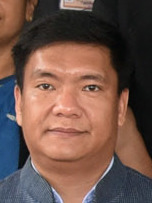
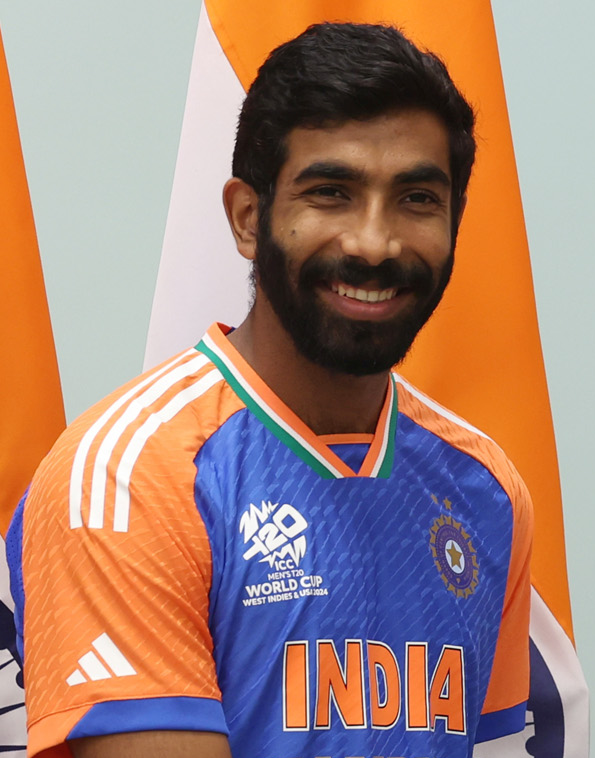
Photo: President's Secretariat · GODL-India / Wikimedia Commons
Person of the Day: Himanta Biswa Sarma's Long Climb to the Top
Few political careers in Northeast India have travelled as far as that of Himanta Biswa Sarma, who today sits at the head of the Assam government and, simultaneously, at the head of Indian badminton. His is a story that began not in a party office but in a college quadrangle, where a sharp-tongued student with a gift for oratory first learned how to organise people and win a room. Decades later, that same instinct for mobilising support has made him one of the most consequential public figures the region has produced.
This profile traces the public arc of Himanta Biswa Sarma — how he started, the milestones that lifted him, and the work he is known for in governance and sport. It stays with the verifiable record: the offices held, the institutions built, the responsibilities carried.
From the Cotton College Quadrangle
Born on 1 February 1969 in Jorhat, Sarma grew up in a household steeped in Assamese letters; his father was a writer and his mother a literary figure associated with the Assam Sahitya Sabha. He went to school in Guwahati and, in 1985, enrolled at the storied Cotton College, the institution that has shaped generations of Assam's leaders.
He took a Bachelor's degree in Political Science in 1990 and a Master's in the same subject in 1992. He did not stop there. He later earned an LLB from Government Law College, Guwahati, and a PhD from Gauhati University, the academic grounding behind the "Dr" that often precedes his name.
College was also where his public life began. Sarma was elected General Secretary of the Cotton College Students' Union three times across the late 1980s and early 1990s, and he was active in the influential All Assam Students' Union (AASU). Long before he held any government post, he had already learned the craft of campaigning, debate and grassroots organisation.
Breaking Into the Assembly
The leap from student leader to legislator came in 2001, when Sarma won the Jalukbari Assembly seat for the first time. It is a constituency he has represented without interruption ever since, a rare run of electoral consistency that became the bedrock of his rise.
Within the state government, he steadily accumulated the heavyweight portfolios. Over successive terms he handled health, education and finance — three of the most demanding briefs any state administration has to fill. Holding all three at various points gave him an unusually broad command of how the machinery of governance actually works, from balancing budgets to running hospitals to managing schools.
That range is part of what set him apart. Many politicians specialise; Sarma became a generalist administrator who could speak with equal fluency about fiscal numbers and primary-school enrolment.
The Health Minister Who Built Colleges
If one chapter of his record stands out for lasting impact, it is his stewardship of Assam's health sector. As health minister, Sarma oversaw the establishment of new medical colleges in Jorhat, Barpeta and Tezpur, widening the supply of doctors and tertiary care in a state long short of both.
He also set in motion plans for further medical colleges in towns such as Diphu, Nagaon, Dhubri, North Lakhimpur and Kokrajhar, pushing healthcare infrastructure outward from the cities toward districts that had historically been underserved. For families who once travelled long distances for treatment, the spread of these institutions changed what was possible close to home.
His education work followed a similar logic of access — strengthening school infrastructure and pressing reforms in higher education so that students in Assam had more to aim for without leaving the state. Taken together, the health and education record is the part of his career most often cited when people talk about tangible, on-the-ground delivery.
Architect of a Regional Coalition
Sarma's national profile grew sharply after 2015, when he moved to the BJP. What followed was less a single appointment than a region-wide project. As convenor of the North East Democratic Alliance (NEDA), he became the principal organiser of a political bloc spanning all eight northeastern states.
This was the period in which his reputation as a strategist crystallised. Stitching together parties, personalities and local priorities across a linguistically and culturally diverse region is no small task, and Sarma's ability to do it made him the BJP's chief troubleshooter and negotiator in the Northeast. Colleagues and rivals alike came to regard him as the man who understood the region's political grammar better than almost anyone.
The culmination came in 2021, when he was sworn in as the 15th Chief Minister of Assam. He had reached the office not by inheritance or sudden fortune but through two decades of incremental, methodical climbing.
A Second Term and a National Stage
On 12 May 2026, Sarma took oath as Chief Minister of Assam for a second consecutive term, after leading his alliance back to power. A second term is, in itself, a verdict — voters returning a leader to finish what he started.
By this point he had become one of the most recognisable faces of governance in the Northeast, a campaigner whose energy and command of detail are widely acknowledged across the political spectrum. His standing reaches well beyond Assam's borders; he is routinely counted among the most prominent leaders the region has sent into national life.
What distinguishes his current standing is the combination of administrative experience and political reach. Few state leaders have simultaneously run health, education and finance, built a regional coalition, and held office through multiple terms.
The Sports Administrator
There is a parallel career that often surprises those who know Sarma only as a politician: he is a serious sports administrator. He served as President of the Assam Cricket Association and earlier headed the Gauhati Town Club, under which academies in chess, boxing, football and cricket took shape.
His biggest sporting role, though, is in badminton. Sarma was elected President of the Badminton Association of India (BAI) in 2017 and re-elected for a further term, steering the national federation during a period when Indian shuttlers were making a real mark internationally. His responsibilities extend abroad as well:
- Vice-President of Badminton Asia
- Member of the Badminton World Federation (BWF) Executive Council
- Chairperson of the Asian Para-Badminton Committee
- President of the Assam Badminton Association
That portfolio places an Assamese leader at the heart of how the sport is governed across the continent and beyond — a quiet but significant achievement for the region.
Why His Journey Resonates
Strip away the offices and the through-line of Sarma's story is persistence. A student leader who kept getting elected, a legislator who never lost his seat, a minister who built institutions that outlast headlines, and an administrator who learned governance brief by brief.
For young people in the Northeast especially, the lesson is plain and inspiring: there is no shortcut that substitutes for showing up, learning the work, and building something that lasts. From a college union desk in Guwahati to the chief minister's chair and a seat on a world sports body, Himanta Biswa Sarma has covered remarkable ground — and the institutions he helped raise, in health, education and sport, are the most durable measure of that climb.