Photo: Prime Minister's Office · GODL-India / Wikimedia Commons
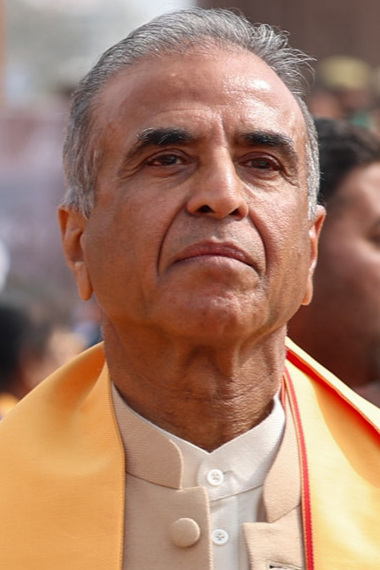
Person of the Day: Sunil Bharti Mittal, From Bicycle Parts to BT's Boardroom
Few business stories in India travel as far as Sunil Bharti Mittal's. The man who today sits on the board of BT Group, one of Britain's most storied companies, began his working life at 18 turning out crankshafts for bicycle makers in Ludhiana. The distance between those two points is the real measure of the Bharti Enterprises founder, and it is worth walking through one milestone at a time.
A ₹20,000 start in Ludhiana
Mittal was born in Ludhiana, Punjab, in 1957 and graduated from Panjab University with a degree in economics and political science. Rather than look for a salaried job, he set up his first venture in 1976, aged 18, with roughly ₹20,000 borrowed from his father. The product was unglamorous: crankshafts and other components for the city's many bicycle manufacturers.
It taught him the basics that would matter for decades. Margins were thin, customers were demanding, and the only way to grow was to spot what the market would want next. By 1980 he and his brothers had folded the early factories and moved into importing, setting up a trading company that took him to Mumbai and into a far bigger arena.
The pivot that built everything
Mittal's first taste of telecom came almost by accident. After importing generators for a while, a policy change in the early 1980s shut that line of business down overnight. Looking for the next thing, he made a trip to Taiwan and saw push-button telephones at a time when most Indian homes still spun a rotary dial.
He began importing and then assembling these handsets, selling them under the Beetel brand, and tied up with Siemens to manufacture phones in India. The instinct proved sharp. The clunky rotary dial gave way to push-button sets, and Mittal had positioned himself right at the front of that shift. He has often described this period as the start of his lasting interest in telecom, and it set up the decision that defined his life.
Airtel and the bet on mobile India
When the government opened cellular licences in the early 1990s, Mittal won the right to operate in Delhi. He launched mobile services in 1995 under the brand name that would become a household word: Airtel. At the time, a mobile call cost a fortune and few believed phones would ever reach ordinary Indians.
Mittal's central insight was about cost, not gadgetry. He reasoned that if calling could be made cheap enough, hundreds of millions of people would sign up. To get there he built what came to be called the minutes factory model: instead of owning every tower, server and switch, Airtel outsourced network management and IT to partners such as Ericsson, Nokia and IBM, paying for capacity as demand grew rather than building everything up front.
The approach freed up capital and drove tariffs down to some of the lowest levels anywhere. Subscribers poured in. Airtel crossed early subscriber landmarks faster than rivals, Bharti listed on the stock market in 2002 at a valuation reportedly around $1.7 billion, and by the middle of that decade its coverage stretched across the country.
Going global, including into Africa
Mittal was never content to stay within India's borders. Airtel pushed into neighbouring Sri Lanka and Bangladesh, then made its boldest move in 2010 by acquiring the African operations of Kuwait's Zain in a deal worth roughly $10.7 billion. Overnight, Airtel became one of the largest operators on a continent of more than a billion people.
The expansion was not smooth at every step, but the strategic logic held: take the low-cost, high-volume playbook that worked in India and apply it to other young, fast-growing markets. Today Airtel operates across more than a dozen countries in Asia and Africa and counts well over half a billion customers, placing it among the largest mobile groups in the world.
Mittal also widened the family business well beyond phones. Bharti Enterprises has had interests spanning insurance, retail, real estate, food and hospitality, and a major stake in the satellite-internet venture OneWeb, which aims to bring connectivity to places that fibre and towers cannot easily reach.
A seat at BT's table
The most striking recent chapter is the reversal of an old script. Through Bharti Global, the group's international investment arm, Mittal acquired a 24.5% stake in Britain's BT Group, completing the purchase in November 2024 for about $4 billion and becoming the company's single-largest shareholder. In 2025 he took a seat on the BT board.
There is a neat symmetry to it. The young man who once imported phone technology from abroad now holds the biggest stake in the company that descends from the British Empire's original telephone network. Mittal called the investment a significant milestone for Bharti, and analysts read it as a long-term vote of confidence rather than a quick trade.
Recognition, and what he is known for
The honours have followed the achievements. Mittal received the Padma Bhushan, India's third-highest civilian award, in 2007. In recognition of his role in UK-India business ties, he was granted an Honorary Knighthood (KBE) with the approval of King Charles III, receiving the insignia in early 2025. He has also chaired global industry bodies and served on international panels on connectivity and development.
Alongside the business, the group runs the Bharti Airtel Foundation, set up in 2000, which focuses on school education and rural development and runs a network of Satya Bharti schools offering free schooling to children in underserved areas.
What stands out across the whole arc is consistency of method. A few principles recur in almost every chapter of Mittal's career:
- Read the shift early. Rotary to push-button, fixed-line to mobile, India to Africa, customer to investor in a foreign giant.
- Compete on cost, then scale. Make the product affordable, win volume, and let volume pay for the next round of growth.
- Partner rather than build alone. The minutes factory turned fixed costs into variable ones and let a relatively small Indian firm punch far above its weight.
From a bicycle-parts workshop to the boardroom of a national British institution, the throughline is a builder who kept finding the next market before most people knew it existed. For anyone tracing how Indian enterprise went global, Sunil Bharti Mittal's journey is one of the clearest maps available.