Photo: Hert Niks / Pexels
Athena Statue Found Face-Down in a 2,000-Year-Old Theatre
Archaeologists clearing the back wall of an ancient theatre in Turkey turned over a slab of rubble and found themselves looking at the back of a goddess. Lying face-down in the debris was a nearly two-metre white marble statue of Athena, the Greek goddess of wisdom and war, still wearing the snake-fringed head of Medusa across her chest after roughly two thousand years underground. It is the kind of find that stops a dig cold.
The marble statue of the ancient Greek goddess came to light on 31 March 2026 at Laodicea, one of the great ruined cities of the ancient world, near modern Denizli in western Turkey. It was announced weeks later by the country's culture ministry, and it has been turning heads from Istanbul to the wider archaeology world ever since.
A goddess buried in the rubble of a stage
The statue was not found in a temple or a tomb. It was lying inside the postskene — the outer rear façade of the stage building — of Laodicea's West Theatre, packed into a fill of broken stone. Whoever last handled it left it face-down, which is almost certainly why it survived as well as it did. The polished front was pressed into the earth, protected from the weather and the centuries.
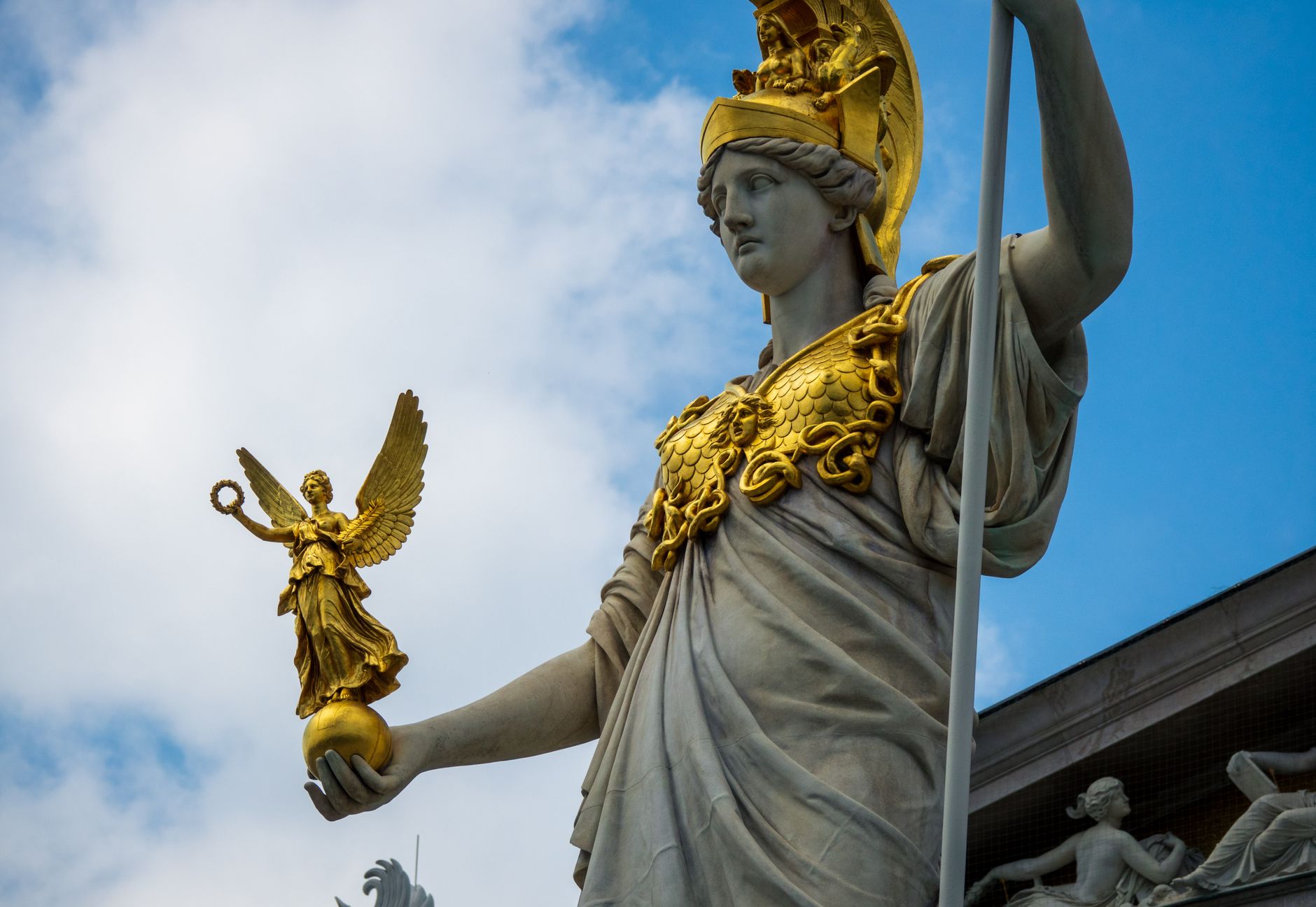
The figure is carved from a single block of white marble and stands close to human height. Athena wears a sleeveless peplos of finely rendered fabric, draped with a cloak across the neck and shoulders. The detail everyone fixes on, though, sits on her chest: the aegis, her protective breastplate, scaled like skin and crowned with the head of Medusa ringed by writhing snakes.
That one feature is how the team knew instantly who they were looking at. The aegis is Athena's signature. No other deity in the Greek pantheon wears the Gorgon's face as armour.

Why Medusa lives on Athena's armour
The Medusa detail is more than decoration — it carries one of the strangest stories in Greek myth. Medusa was a Gorgon whose gaze turned the living to stone. The hero Perseus beheaded her, and in the most familiar version of the tale he handed the severed head to Athena. The goddess fixed it to her aegis, turning a weapon of terror into a shield-emblem that protected her and frightened her enemies.
So a sculptor in the early Roman period carved a goddess wearing the trophy of a monster. Twenty centuries later, that grim little face is the clue that let archaeologists name a headless statue. There is something fitting about Medusa surviving when Athena's own head did not.
How old is it, really
The statue carries no inscription, so its age comes from style rather than a date stamp. Specialists place it in the Augustan period — roughly 27 BCE to 14 CE, the decades when Rome was sliding from republic into empire under its first emperor, Augustus. That puts the carving at the high-water mark of classical sculpture, when Greek artistic tradition was being absorbed and amplified by a confident young empire.
The quality backs up the dating. The folds of the peplos, the modelling of the aegis and the overall poise mark it as serious work, not a provincial knock-off. Laodicea in that era was rich enough to commission exactly this kind of piece.
A theatre that staged Homer
What makes the location so satisfying is what the same team has been pulling out of this theatre for the past two seasons. The West Theatre appears to have functioned as more than a stage for plays — it looks like a cultural hub, and recent digs there in 2024 and 2025 turned up carved figures illustrating scenes straight out of Homer's Odyssey.
Among them are reliefs tied to some of the epic's most famous episodes:
- The land of the Laestrygonians, the giant cannibals who smashed Odysseus's fleet
- The cave of the one-eyed cyclops Polyphemus
- The sea monster Scylla, who plucked sailors from passing ships
Find a near-complete Athena in a building that was already giving up its Homeric storytelling, and you start to picture the place as a working monument to Greek culture, kept alive deep into the Roman age.
The city that history loved to break
Laodicea — its full ancient name was Laodikeia ad Lycum — was no minor outpost. It was one of the wealthiest cities of Roman Asia Minor, a banking centre famous for a rare glossy black wool spun from local goats and for a celebrated eye ointment that drew patients from far away. It sat on a busy trade route, and it had the money to show for it.
Its wealth also fed one of the more famous put-downs in religious history. Laodicea is one of the seven churches of Asia named in the Book of Revelation, where it is scolded for being "lukewarm, neither hot nor cold." That jab had a literal edge: the city had no good water of its own and piped it in through aqueducts, so it arrived tepid and full of sediment — unlike the cold streams of the hills or the hot springs of nearby Hierapolis.
The city's pride showed in disaster, too. When an earthquake levelled Laodicea in roughly AD 60, its citizens are said to have refused Rome's offer of relief funds and rebuilt the whole place with their own money. That self-sufficiency is part of why the ruins are so grand today — and why the soil keeps handing back treasures like this one.
What happens next
The statue is impressive, but it is incomplete. The head is missing, along with part of an arm, and conservators will now study, clean and stabilise the marble while excavation of the surrounding rubble continues. There is real hope that more fragments — perhaps even the head — are still waiting in the same fill where the body was found.
For now, the headless Athena stands as a reminder of how much remains buried at sites we think we already know. Laodicea has been excavated for years, its theatre mapped and studied, and yet it still had a near life-size goddess tucked into a wall, face pressed to the dirt, waiting for someone to turn her over. The next slab of rubble at a thousand other sites could be hiding something just as astonishing — which is exactly the thrill that keeps archaeologists digging.