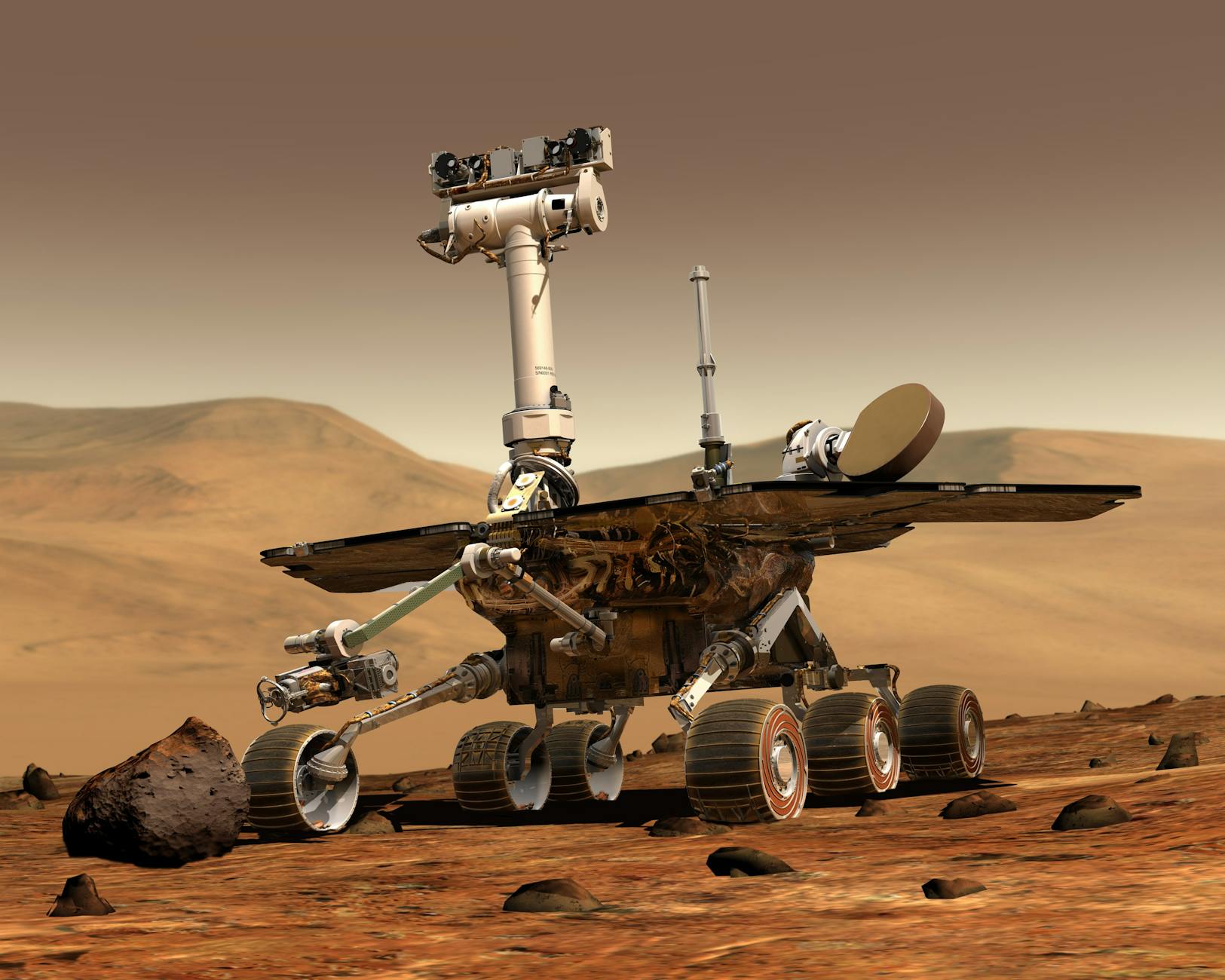
Photo: Pixabay / Pexels
Perseverance Found Mars' Strongest Sign of Ancient Life Yet
On a dried-up riverbed on Mars, NASA's Perseverance rover drilled into an arrowhead-shaped boulder and pulled out something nobody expected: a fingertip-sized core of rock speckled with minerals that, here on Earth, are usually left behind by living microbes. The rover named the rock Cheyava Falls, and the chemistry locked inside it is the strongest hint of ancient life ever picked up on another world.
This is not a movie alien or a fossil you can see. It is something quieter and, in its own way, more thrilling — a chemical fingerprint that looks remarkably like the kind life leaves behind. After a year of careful checking, scientists put their case in the journal Nature on 10 September 2025, and the most senior voices at NASA did not hold back. Acting administrator Sean Duffy called it "the closest we have ever come to discovering life on Mars."
The rock that stopped the rover in its tracks
In July 2024, Perseverance was rolling along the northern edge of Neretva Vallis, an ancient river valley that once fed water into Jezero Crater. Billions of years ago this was a delta — flowing water, sediment, mud. Today it is bone-dry rust-coloured rock. The rover was exploring a band of stone scientists call the Bright Angel formation when it rolled up to a boulder roughly 3 feet across, streaked with pale veins of calcium sulfate and reddish hematite.
Then the close-up cameras caught the detail that changed everything. Scattered across the rock were dozens of tiny off-white spots, each ringed by a dark halo. They looked, unmistakably, like leopard spots. On Earth, patterns exactly like these turn up in mud and sediment where microbes have been busy, feeding on minerals and leaving chemical residue as they go.

Why "leopard spots" make scientists lean in
The spots are not just a pretty pattern. When Perseverance turned its instruments on them, it found a very specific recipe. The dark rings are rich in iron-phosphate, a mineral called vivianite. The pale centres hold an iron-sulfide mineral called greigite. Sitting alongside them was organic carbon — the carbon-based chemistry that all known life is built from.
Here is what makes that combination so interesting. On Earth, microbes generate energy by shuffling electrons between iron, sulfur and phosphorus compounds — and they often leave vivianite and greigite behind as a by-product. Finding all of those ingredients together, in the right setting, in mud laid down by an ancient river, is exactly the scene you would expect if something had once been alive and metabolising there. The rock holds, in the words of project scientist Kenneth Farley, the mission's first confident detection of organic matter.
How the rover read the rock
Perseverance did not jump to conclusions, and neither did its team. Two precision instruments did the heavy lifting:
- PIXL, which fires a fine X-ray beam to map the exact chemical make-up of a rock millimetre by millimetre. It pinned down where the iron, phosphorus and sulfur were concentrated.
- SHERLOC, which uses ultraviolet light to hunt for organic molecules and the minerals that go with them.
Together they built a chemical portrait of Cheyava Falls detailed enough to argue over. The reactions that produced these minerals appear to have happened at low temperature, long after the mud was first laid down — the kind of cool, gentle, watery setting where life could plausibly have survived.
The honest caveat that makes this science, not hype
This is where a serious newsroom and a serious scientist say the same thing: a potential biosignature is not proof. It is a feature that life could have made, but that non-living chemistry might also explain. Greigite and vivianite can, in theory, form without any biology at all — usually when rock is cooked at high temperature or soaked in acid.
The crucial point is what the Perseverance team did next. They went looking for those non-biological explanations and tested them. Their peer-reviewed paper reports no strong evidence that the Bright Angel rocks ever went through the heat or acidity that would produce these minerals abiotically. In plain terms: the obvious boring explanations do not fit the evidence very well. That does not confirm Martian life — but it removes some of the easiest ways to wave the finding away. The rock dates to a wet, possibly habitable Mars of around 3.5 billion years ago, roughly the era when life was getting started on Earth.
Why nobody can shout "aliens" just yet
The truth is that no instrument on Mars can settle this question. To know for sure whether microbes once lived in that mud, scientists need to put the sample under the most powerful microscopes and mass spectrometers on Earth — machines far too big and power-hungry to fly to another planet.
That sample exists. Perseverance sealed the core, nicknamed Sapphire Canyon, into a sterile titanium tube and is carrying it as one of more than two dozen samples collected since the rover landed in 2021. The plan was always to ferry these tubes back to Earth through the Mars Sample Return programme. The science could hardly be more compelling — and yet the mission's future is suddenly shaky.
The twist: the answer may be stuck on Mars
Mars Sample Return has been battered by ballooning costs and political cold feet. NASA's 2026 budget proposal pointed toward cancelling the programme, and a spending package that moved through the US House of Representatives in January 2026 stripped out most of its funding. NASA has been studying cheaper alternatives, but there is no confirmed plan and no firm date to bring the tubes home.
That leaves the world in a strange place. The single rock most likely to answer humanity's oldest question — are we alone? — is sealed, labelled and waiting on the surface of Mars, and we have no guaranteed way to go and get it. Other players have noticed: there has even been open speculation about whether a future Chinese mission could be the one to retrieve a sample first.
For now, Perseverance keeps climbing out of Jezero Crater, healthy and still working, hunting for more rocks like Cheyava Falls. The discovery already rewrote what counts as the best evidence for ancient life beyond Earth. The final word, though, is locked in a metal tube tens of millions of miles away — and whether we ever get to read it now depends less on Martian chemistry than on budgets back home.

